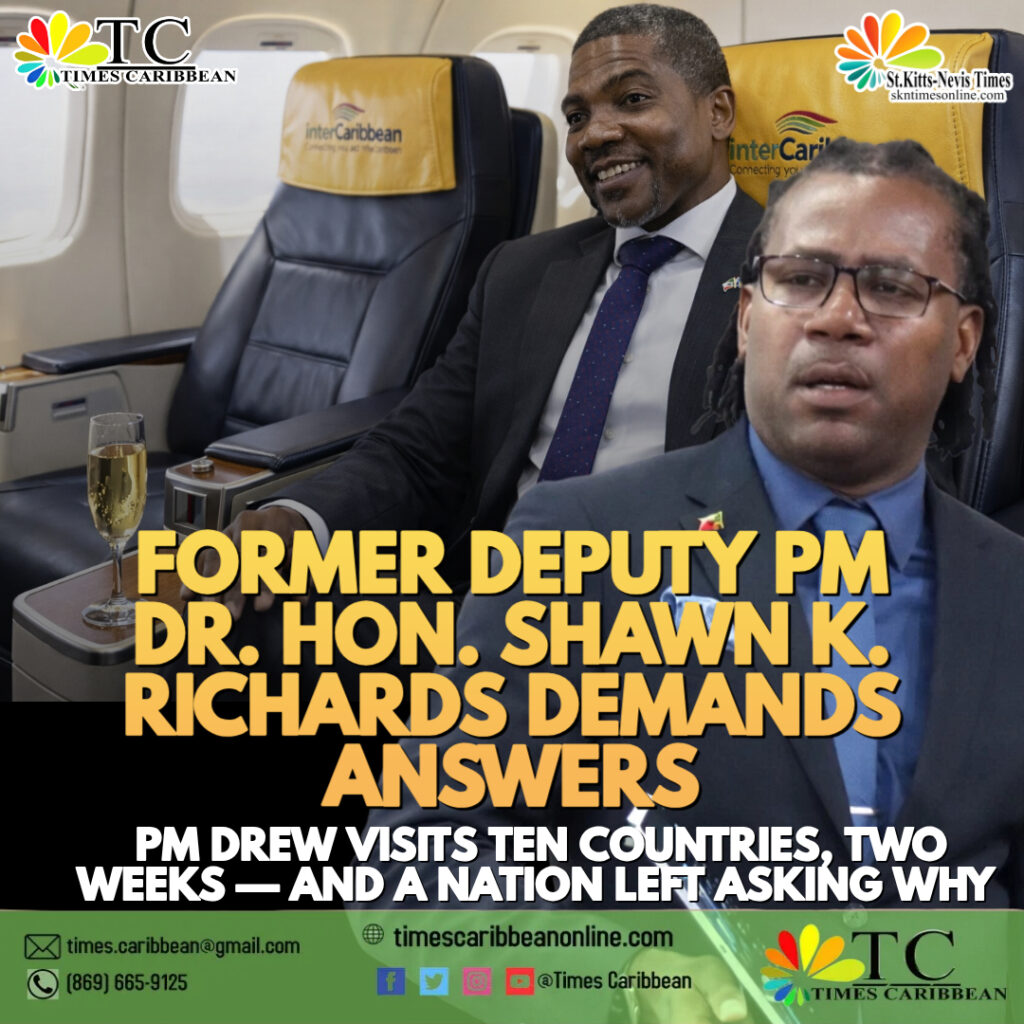
FORMER DEPUTY PM DR. HON. SHAWN K. RICHARDS DEMANDS ANSWERS: PM DREW VISITS TEN COUNTRIES, TWO WEEKS — AND A NATION LEFT ASKING WHY

As St. Kitts and Nevis prepares to host a high-level gathering of the Caribbean Community (CARICOM), a storm of political scrutiny is building at home.
Former Deputy Prime Minister Dr. Hon. Shawn K. Richards has ignited a national debate with a pointed public critique of the Prime Minister’s recent diplomatic sprint across the Caribbean — a whirlwind tour reportedly spanning more than ten countries in just fourteen days, all ahead of a CARICOM meeting already scheduled to take place in Basseterre.
His challenge was blunt: “Make it make sense.”
A DIPLOMATIC DASH — BUT TO WHAT END?
According to Dr. Richards, the Prime Minister personally visited over ten regional leaders before they are due to sit around the same CARICOM table within days.
The question now echoing across talk shows, WhatsApp groups, and political circles is simple:
Why?
CARICOM summits are, by design, structured spaces for multilateral dialogue. Leaders gather in one venue to deliberate regional policy, security, trade, climate resilience, and economic integration. Preparatory diplomatic work typically occurs at ministerial and ambassadorial levels before Heads of Government meetings.
So why the need for an intensive, high-visibility tour at the highest political level immediately before the formal convening?
Is this strategic diplomacy — or political theatre?
COSTS IN A TIME OF CONSTRAINT
The optics of the tour have collided sharply with domestic realities.
St. Kitts and Nevis is grappling with:
- Escalating cost-of-living pressures
- Ongoing healthcare system strains
- Public frustration over economic stagnation
- Concerns about youth employment and crime
Against that backdrop, Dr. Richards argues that a two-week diplomatic circuit involving flights, security teams, accommodations, per diems, and logistical coordination raises serious fiscal questions.
While no official cost breakdown has been released, such engagements are not free. International travel at the Head-of-Government level carries significant expenditure.
At a time when citizens are tightening belts, symbolism matters.
IS THIS NORMAL PRACTICE?
Dr. Richards posed comparative questions that have resonated widely:
- Does the Chair of the United Nations tour every capital before the UN General Assembly?
- Does the Chair of the Organisation of Eastern Caribbean States conduct island-to-island visits immediately before scheduled OECS summits?
In most instances, preparatory engagements occur through diplomatic channels — ambassadors, foreign ministers, and technocrats — reserving full Heads-of-Government discussions for the summit itself.
If this approach deviates from standard practice, the public is entitled to understand the strategic necessity behind it.
DIPLOMACY OR DISTANCE FROM HOME?
Perhaps the most politically potent line in Dr. Richards’ critique was not about travel — but about presence.
“Not even Nevis sees him,” he suggested, implying that while the Prime Minister is highly visible abroad, many citizens feel leadership presence at home has diminished.
Perception in politics can be as consequential as policy.
When roads remain uneven, hospitals overstretched, and communities demanding answers, frequent overseas engagements can be interpreted as detachment — fair or not.
THE NIGERIA QUESTION
Adding fuel to the debate is speculation about a potential seventh trip to Nigeria. While diplomatic engagement with Africa carries strategic possibilities — including investment, cultural ties, and South-South cooperation — critics argue that frequency without transparent outcomes invites skepticism.
Where are the published agreements?
Where are the measurable returns?
Where are the direct benefits to ordinary citizens?
THE CENTRAL QUESTION
Diplomacy is not inherently wasteful. Strategic engagement can yield trade agreements, security cooperation, climate financing, and geopolitical leverage.
However, in a small island developing state with finite resources, priorities must be clearly justified and outcomes clearly communicated.
The public deserves to know:
- What concrete agreements were secured?
- What economic gains will flow to citizens?
- Why these visits could not wait for the formal CARICOM meeting?
- What was the total cost to taxpayers?
As CARICOM leaders arrive in Basseterre, the debate sparked by Former Deputy Prime Minister Dr. Hon. Shawn K. Richards is unlikely to fade.
Because in challenging times, every decision must pass a simple test:
Does it serve the people of St. Kitts and Nevis — or does it simply serve optics?
















Leave a comment
You must be logged in to post a comment.