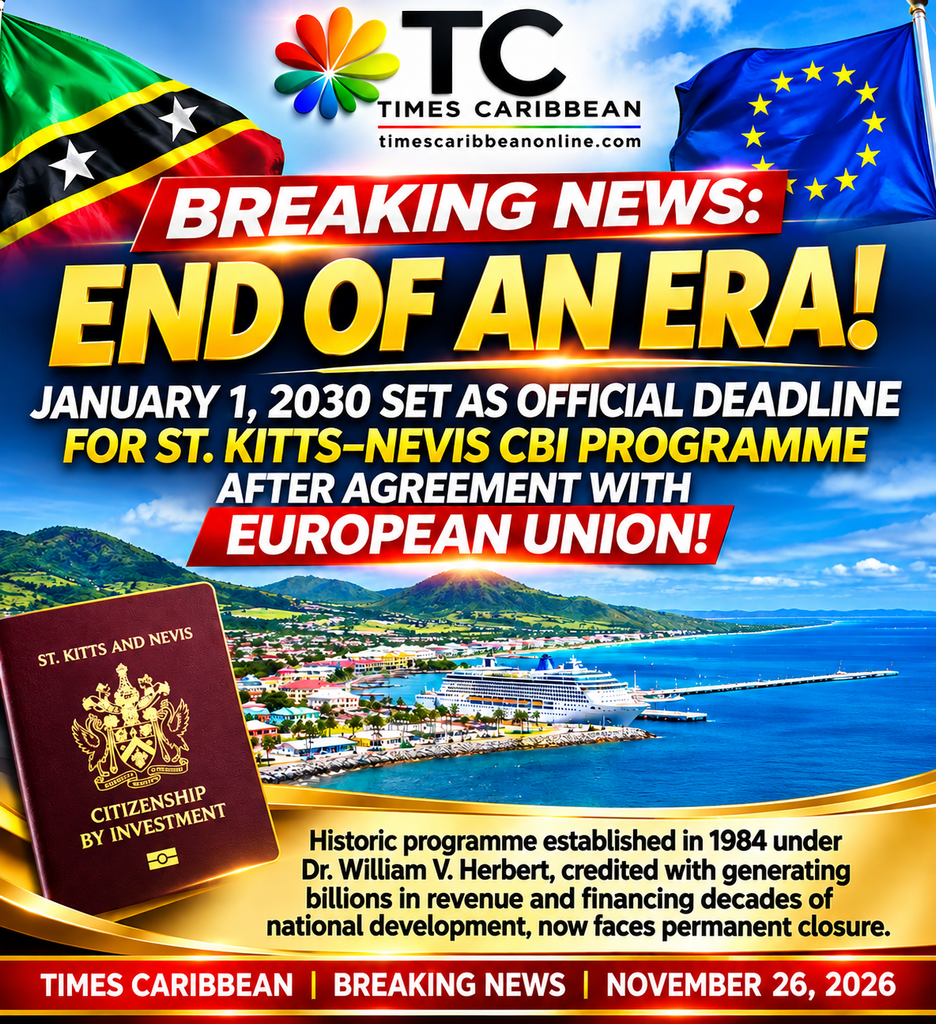
BREAKING NEWS: END OF AN ERA! JANUARY 1, 2030 SET AS OFFICIAL DEADLINE FOR ST. KITTS–NEVIS CBI PROGRAMME AFTER AGREEMENT WITH EUROPEAN UNION!

Historic programme established in 1984 under Dr. William V. Herbert, credited with generating billions in revenue and financing decades of national development, now faces permanent closure.
TIMES CARIBBEAN | BREAKING NEWS | NOVEMBER 26, 2026
BASSETERRE, ST. KITTS — The countdown has officially begun. After 42 years of transforming the economic and developmental landscape of St. Kitts and Nevis, the Federation’s pioneering Citizenship by Investment (CBI) Programme is now scheduled to come to an end on January 1, 2030.
The Prime Minister’s Office announced today that, following extensive negotiations with the European Union, the administration of Prime Minister Dr. Terrance Drew has reached an agreement for the orderly and responsible wind-down of the historic programme.
The announcement follows the Prime Minister’s November 13 national address and establishes a definitive timetable for the closure of what is widely recognised as the world’s oldest Citizenship by Investment Programme.
THE OFFICIAL CLOSURE TIMELINE
- January 31, 2029: Final day for accepting new CBI applications.
- December 31, 2029: Final deadline for processing all outstanding applications.
- January 1, 2030: Official closure of the Citizenship by Investment Programme under the announced agreement.
The Government confirmed that there will be no reduction in investment thresholds, pricing or due diligence standards during the transition.
FROM A GLOBAL PIONEER TO THE END OF AN ERA
Established in 1984, with distinguished Kittitian statesman Dr. William V. Herbert credited as a founding architect, the programme positioned St. Kitts and Nevis as a global pioneer in investment migration.
Over four decades, the programme became a major pillar of the Federation’s economy, with reported cumulative revenues exceeding EC$6 billion.
Its contribution extended far beyond government revenues. It helped reshape communities, modernise infrastructure, strengthen public finances and provide financial assistance to thousands of citizens and residents.
A LEGACY OF BILLIONS IN NATIONAL DEVELOPMENT
Among the major projects, social programmes and economic initiatives associated with CBI revenues and the fiscal capacity they helped create were:
- Construction of the second cruise pier at Port Zante.
- The Poverty Alleviation Programme (PAP).
- The PEACE Programme.
- Nevis Island Administration income support initiatives.
- Post-hurricane roof rehabilitation programmes.
- COVID-19 emergency income support programmes.
- Old Road Bay Road rehabilitation.
- Islandwide road rehabilitation and modernisation.
- Construction of the ferry terminal and East Bus Terminal.
- The repurchase of more than 700 acres of land associated with the land-for-debt swap.
- Repayment of the Federation’s IMF loan.
- Construction of the Nevis Treasury Building.
- Construction of the Newcastle Police Station.
- Construction of the Sandy Point Police Station.
- Construction of the Tabernacle Health Complex.
- Reconstruction of the Mary Charles Hospital in Molineux.
These initiatives represent part of an extensive developmental legacy spanning healthcare, transportation, tourism, national security, social protection, land ownership and economic stability.
For thousands of families, the programme’s impact was personal. It helped provide income support, employment opportunities, improved public services and assistance during periods of national and international economic uncertainty.
GOVERNMENT DEFENDS NEGOTIATED CLOSURE
The Drew administration described the negotiated timeline as providing the Federation with more than three years to manage the transition responsibly.
According to the Prime Minister’s Office, the agreement is intended not only to protect visa-free access to Europe but also to safeguard the Federation’s international banking relationships, correspondent banking arrangements and international reputation.
The Government also indicated that the European Commission stands ready to support economic diversification initiatives, including geothermal energy, digital connectivity and projects under the EU’s Global Gateway strategy.
The administration intends to complete existing CBI-funded projects while accelerating its Sustainable Island State Agenda.
THE BILLION-DOLLAR QUESTION: WHAT REPLACES CBI?
With the closure deadline now established, attention is expected to turn towards the Federation’s long-term economic sustainability.
What will replace the substantial revenues generated by CBI? How will existing social assistance programmes be financed? Can alternative industries generate sufficient revenue to maintain public services, infrastructure investment and economic stability?
These are questions that will increasingly dominate the national conversation.
While the Government has identified economic diversification as its preferred pathway, the financial scale, implementation timelines and revenue-generating potential of proposed alternatives will require careful public examination.
St. Kitts and Nevis pioneered an industry that subsequently spread across the Caribbean and beyond. Now, the nation that helped introduce investment migration to the world is preparing to exit the industry it helped establish.
Forty-two years of history. Billions in reported revenue. Generations of national development.
January 1, 2030, is now the announced closing date for one of the most consequential economic programmes in the history of St. Kitts and Nevis.
#TimesCaribbean #BreakingNews #StKittsNevis #CBI #EuropeanUnion #EconomicDevelopment #CaribbeanNews #EndOfAnEra
















Leave a comment
You must be logged in to post a comment.