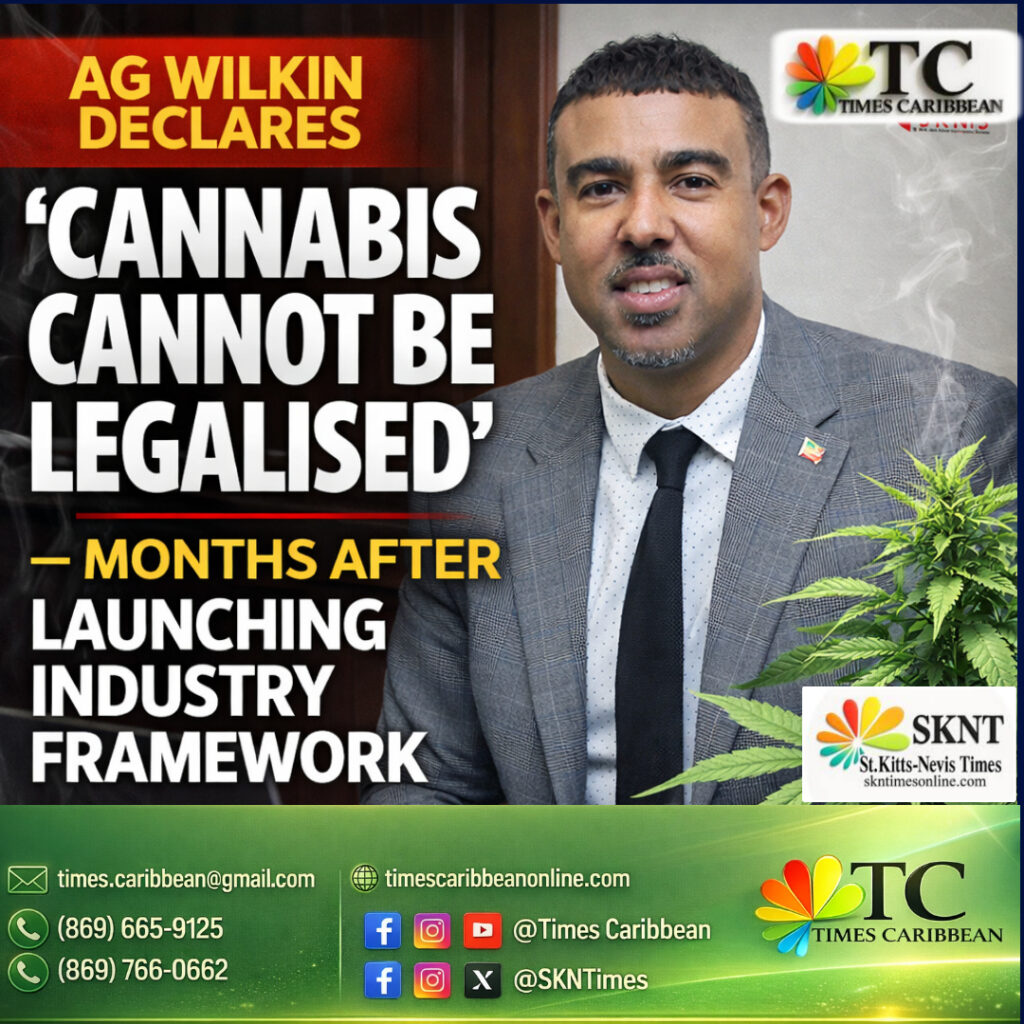
AG WILKIN DECLARES “CANNABIS CANNOT BE LEGALISED” — MONTHS AFTER LAUNCHING INDUSTRY FRAMEWORK
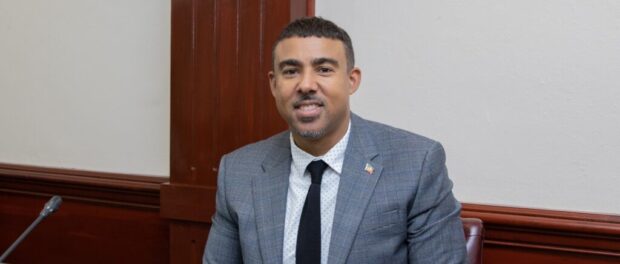
**LEGALIZE… OR LEGITIMIZE CONFUSION?
BASSETERRE, ST. KITTS — In a stunning and sharply polarizing declaration that has ignited national debate, Attorney General and Minister of Justice and Legal Affairs, Garth Wilkin, has effectively slammed the brakes on any expectation of full cannabis legalization in Saint Kitts and Nevis—less than a year after the government rolled out what many believed was the foundation of a thriving cannabis industry.
Delivering a detailed statement in the National Assembly on March 31, 2026, Wilkin made it unequivocally clear: full legalization of cannabis is off the table—for now.
And the reason? Not morality. Not public health. But money, banking, and international pressure.
“LEGALIZE AND LOSE EVERYTHING”: THE BANKING FEAR FACTOR
Wilkin’s warning was blunt—and chilling.
“If we were to legalize, our corresponding banking relationships would almost come to an end.”
In essence, the Attorney General argued that the Federation’s economic lifeline—its access to global banking—would be severed if cannabis were legalized for commercial, non-medicinal purposes.
He painted a grim scenario:
- International banks cutting ties
- Trade transactions collapsing
- Citizens unable to conduct basic overseas financial activities
The core issue lies in correspondent banking relationships, heavily tied to jurisdictions like the United States and Europe—where cannabis remains illegal at the federal or institutional level.
Wilkin’s conclusion:
Legal cannabis profits could trigger financial isolation.
FROM “THE TABLE IS SET” TO “NOT SO FAST”
The controversy cuts deeper because of what came just months earlier.
In April 2025, the government officially launched the Medicinal Cannabis Authority, complete with a 15-member board, regulatory framework, and bold declarations of economic opportunity.
At the time, Wilkin himself declared:
“The entire regime is now set… to create jobs, to create economic opportunities.”
The rollout included:
- The Cannabis Act
- Establishment of the Medicinal Cannabis Authority
- Licensing systems for cultivation and sales
- Public education campaigns
- Vision of cannabis lounges and industry growth
The message then?
A new economic frontier was opening.
The message now?
That frontier has strict, immovable boundaries.
A PATCHWORK POLICY: DECRIMINALIZED, REGULATED… BUT NOT LEGAL
Wilkin defended the government’s approach as “progressive but responsible.”
Current framework allows:
- Religious use (particularly for Rastafari)
- Freedom of conscience protections
- Possession of small quantities
- Cultivation of up to five plants
- A tightly controlled medicinal cannabis industry
These reforms stem from landmark legislation including the Rastafari Rights Recognition Act and Freedom of Conscience Act, which enshrined constitutional protections around cannabis use.
But here’s the contradiction critics are seizing on:
If individuals can legally grow, possess, and use cannabis—why can’t the country fully legalize and monetize it?
THE $QUESTION: WAS THE INDUSTRY EVER REAL?
This is where the issue becomes politically explosive.
Less than a year ago, the government:
- Established a national cannabis authority
- Promoted economic opportunities
- Signaled regional competitiveness with countries like Jamaica and Antigua
Now, the Attorney General is effectively saying:
There is a ceiling—and it cannot be broken without risking economic catastrophe.
Critics are already asking:
- Was the public misled about the scope of the cannabis industry?
- Were expectations of revenue and job creation overstated?
- Why build an authority if full commercialization is structurally impossible?
INTERNATIONAL REALITY VS NATIONAL AMBITION
To be clear, Wilkin’s argument is not without global precedent.
Small island states operating within fragile financial ecosystems are heavily dependent on external banking networks. Losing correspondent banking access has crippled economies before.
But that reality collides head-on with:
- Regional cannabis liberalization trends
- Public expectations of economic diversification
- The government’s own prior messaging
What emerges is a high-stakes balancing act between sovereignty and survival.
A GOVERNMENT CAUGHT BETWEEN REFORM AND RISK
Wilkin insists the government has struck the right balance:
Reform without recklessness. Progress without punishment.
But the optics are undeniable.
In under a year, the narrative has shifted from:
“Cannabis industry ready for takeoff”
to
“Full legalization could destroy the economy.”
That is not evolution.
That is a hard pivot.
THE BOTTOM LINE: A CONTROLLED INDUSTRY—OR A CONSTRAINED ONE?
St. Kitts and Nevis now finds itself in a peculiar position:
- Cannabis is partially legal
- The industry is partially operational
- The opportunity is partially realized
But full legalization—the move that could unlock major revenue streams—remains firmly locked behind international financial gatekeepers.
And until those global dynamics shift, one message rings loud and clear from the Attorney General:
Cannabis may be tolerated. It may be regulated. But it will not—cannot—be fully legalized.
SKN TIMES ANALYSIS:
This is not just a policy position.
This is a reality check.
The cannabis debate in St. Kitts and Nevis is no longer about ideology—it is about economic survival versus economic ambition.
And right now, survival is winning.
















Leave a comment
You must be logged in to post a comment.