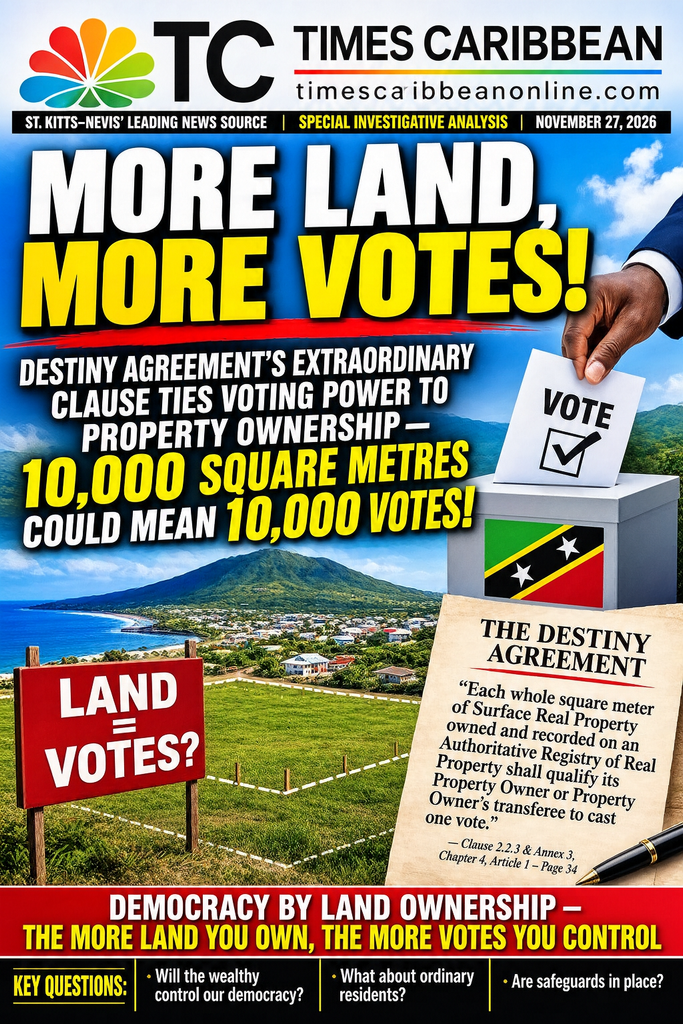
MORE LAND, MORE VOTES! DESTINY AGREEMENT’S EXTRAORDINARY CLAUSE TIES VOTING POWER TO PROPERTY OWNERSHIP — 10,000 SQUARE METRES COULD MEAN 10,000 VOTES!
TIMES CARIBBEAN | SPECIAL INVESTIGATIVE ANALYSIS | NOVEMBER 27, 2026
BASSETERRE, ST. KITTS AND NEVIS — One square metre. One vote. The more land you own, the more voting power you could exercise.
Among the most consequential provisions contained in the proposed Destiny Development Agreement is a system of governance that departs significantly from the familiar democratic principle of one person, one vote.
Under the proposed framework, voting power within the Special Sustainable Zone would be determined by qualifying property ownership rather than simply by individual residency.
According to the supplied text referencing Clause 2.2.3 and Annex 3, Chapter 4, Article 1, Page 34, the Code of Destiny expressly provides:
“Each whole square meter of Surface Real Property owned and recorded on an Authoritative Registry of Real Property shall qualify its Property Owner or Property Owner’s transferee to cast one vote.”
The implications are significant.
THE MORE LAND YOU OWN, THE MORE VOTES YOU CONTROL
Under the proposed arrangement, the distribution of voting power could look like this:
Land ownership vs. voting power
Illustrative examples under the proposed Destiny Code
100 m²
100 votes
1,000 m²
1,000 votes
5,000 m²
5,000 votes
10,000 m²
10,000 votes
100,000 m²
100,000 votes
Resident without qualifying land or transferred votes
0 votes
A wealthy individual or corporate entity owning 100,000 square metres could potentially exercise 1,000 times the voting power of a small property owner holding just 100 square metres.
Meanwhile, an ordinary resident who lives and works within Destiny but owns no qualifying property would have no automatic voting entitlement under the cited provision.
COULD ECONOMIC WEALTH TRANSLATE INTO GOVERNING POWER?
The proposed arrangement raises important questions about the concentration of decision-making authority within the Zone.
Major investors, developers and corporate landowners could potentially accumulate substantial voting power through property acquisitions, while residents with limited financial resources could exercise considerably less influence.
The framework reportedly also allows property owners to propose Zone laws and adopt bylaws without further parliamentary ratification, although new Zone laws and amendments would require approval by both legislative assemblies.
That distinction is important. So too are the safeguards governing the exercise of those powers.
FIVE QUESTIONS THAT DEMAND PUBLIC EXPLANATION
- Can a single corporation accumulate enough land to exercise majority voting control within Destiny?
- What safeguards exist to prevent excessive concentration of governing power among major property owners?
- How would ordinary residents and workers without qualifying property participate in decisions affecting their daily lives?
- Are there limits on the number of votes an individual or corporate entity can control?
- What mechanisms would allow residents to challenge decisions made by dominant property owners?
Supporters of property-weighted governance may argue that investors should exercise influence proportionate to their financial stake in the development. However, that approach also raises legitimate questions about representation, accountability and the rights of non-property-owning residents.
ONE PERSON, ONE VOTE — OR ONE SQUARE METRE, ONE VOTE?
The cited provision does not itself establish any change to voting rights in national elections. Its stated application concerns governance within Destiny.
But the distinction between national democracy and the proposed Zone governance system deserves thorough public examination.
As St. Kitts and Nevis considers the development’s potential economic benefits, citizens also deserve a clear explanation of its proposed governing structures, legislative safeguards and long-term implications for representation.
When land ownership determines voting power, how will the interests of those who own little or no land be protected?
That is a fundamental question the proposed Destiny Agreement must answer.
Document reference: Clause 2.2.3 and Annex 3, Chapter 4, Article 1 — Page 34. This analysis is based on the agreement excerpts supplied. The complete agreement, associated safeguards and final legislative provisions should be independently verified before publication.
#TimesCaribbean #DestinyProject #StKittsNevis #Governance #Democracy #PublicAccountability #Transparency
















Leave a comment
You must be logged in to post a comment.