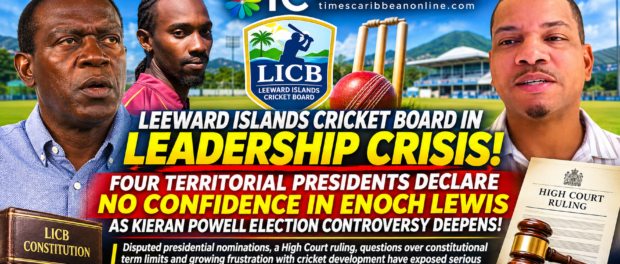
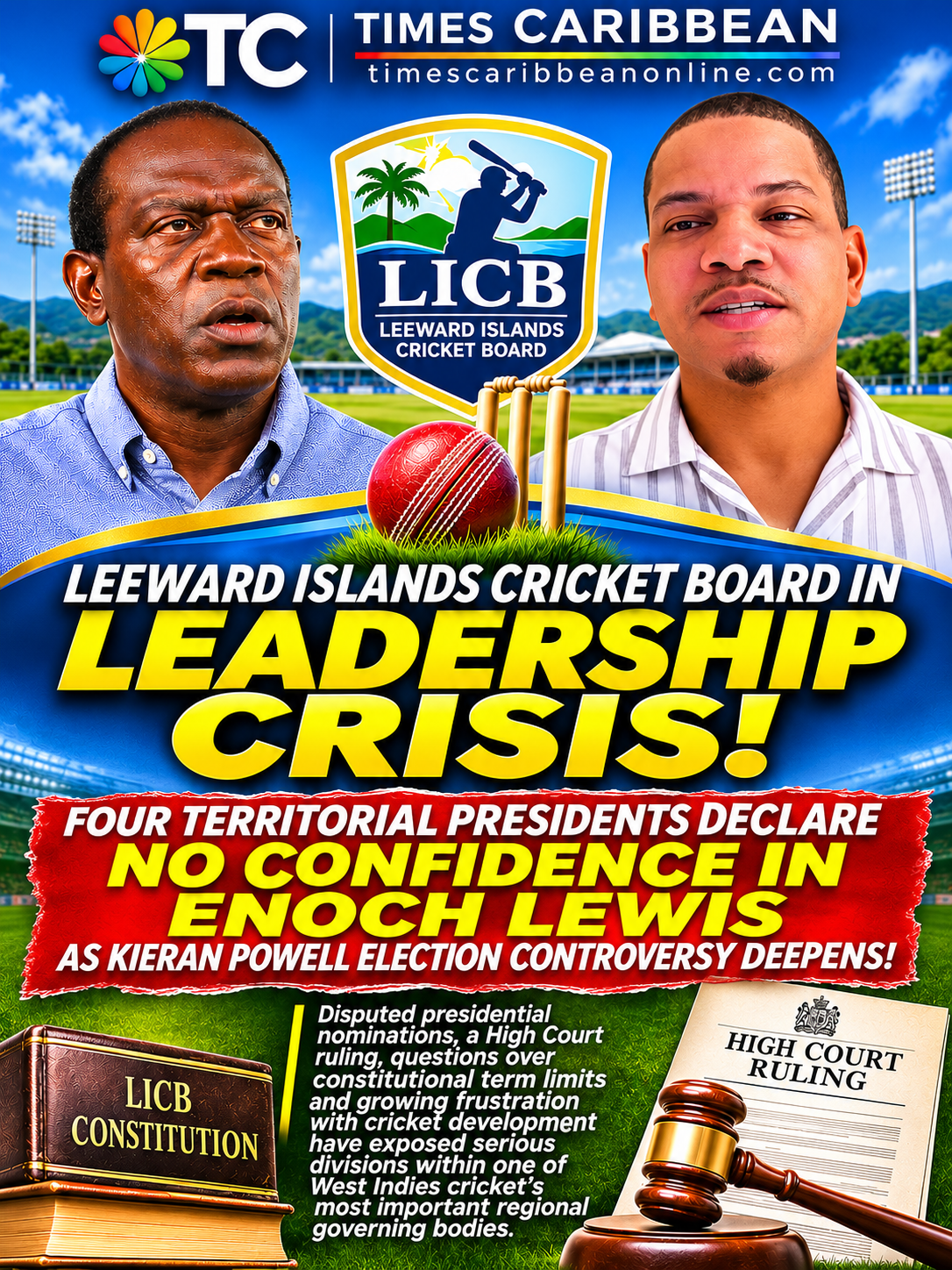
LEEWARD ISLANDS CRICKET BOARD IN LEADERSHIP CRISIS! FOUR TERRITORIAL PRESIDENTS DECLARE NO CONFIDENCE IN ENOCH LEWIS AS KIERAN POWELL ELECTION CONTROVERSY DEEPENS!
TIMES CARIBBEAN | SPECIAL INVESTIGATIVE CRICKET FEATURE
Sunday, November 22, 2026
BASSETERRE, ST. KITTS AND NEVIS — A deepening governance dispute within the Leeward Islands Cricket Board (LICB) has raised serious questions about democratic accountability, constitutional compliance and the future administration of cricket across eight Caribbean territories.
At the centre stands veteran cricket administrator Enoch Lewis, whose presidency, dating to 2016, is facing a significant challenge from territorial associations demanding answers about the organisation’s leadership and electoral procedures.
What began as a disagreement over nominations for the July 2026 presidential election has developed into a wider institutional standoff involving High Court proceedings, unsuccessful attempts to convene meetings and a reported declaration of no confidence from four territorial cricket presidents.
And the controversy goes well beyond who occupies the president’s chair.
It raises a fundamental question: Is the organisation responsible for developing the next generation of Leeward Islands cricketers operating with the openness, accountability and democratic standards expected of a modern sporting institution?
THE JULY ELECTION CONTROVERSY: HOW THE DISPUTE BEGAN
The immediate crisis emerged ahead of the LICB’s Annual General Meeting and elections scheduled for July 11, 2026.
Former West Indies opening batsman and Nevisian international Kieran Powell was expected to challenge Lewis for the presidency.
Anguilla Cricket Association President Dr Timothy Hodge was also seeking election to a vice-presidential position.
However, according to contemporaneous reporting by the Antigua Observer and other regional news organisations, both candidates were omitted from the final list of nominees circulated before the scheduled election.
The applicants alleged that Powell and Hodge had been properly nominated and that their exclusion was inconsistent with the LICB’s constitutional procedures.
In Hodge’s case, the controversy reportedly involved a disputed requirement for a separate letter accepting his nomination.
There were also allegations that election correspondence had been transmitted to an outdated email address, potentially affecting the timely processing of nomination documents.
The significance was considerable.
According to the July 13 Antigua Observer report, the exclusion of Kieran Powell would have left Lewis without a challenger for the presidency.
But the central allegation that nominations were improperly rejected has not been conclusively established by the court ruling examined in published reports.
HIGH COURT INTERVENTION: AN INJUNCTION GRANTED, THEN DISCHARGED
The dispute reached the High Court of Antigua and Barbuda after the Anguilla Cricket Association and Nevis Cricket Association President Carlisle Powell challenged the electoral process.
On July 10, Justice Jan Drysdale granted an interim injunction preventing the LICB from proceeding with its scheduled AGM and elections.
The temporary order preserved the situation while the parties prepared to address the contested issues.
However, the legal position changed substantially later that month.
Following a hearing on July 22, Justice Drysdale delivered a written ruling on July 27 discharging the injunction.
The court found that the applicants had failed to meet the obligation of full and frank disclosure required when seeking an injunction without the opposing party being heard.
According to the published account of the judgment, material non-disclosures and factual inaccuracies affected the original application.
The applicants were ordered to pay EC$6,000 in legal costs, while the court directed an inquiry into possible damages arising from the injunction.
That ruling is an essential part of the story.
The court’s decision favoured the LICB in relation to the injunction and permitted the organisation to proceed with its AGM and elections in accordance with its constitution.
But it should not be represented as a final judicial determination that every disputed nomination, constitutional interpretation or governance decision was correct.
Those are distinct questions.
Following the ruling, Lewis welcomed the decision as a vindication of due process and said the board wanted to concentrate on unity, accountability and opportunities for regional cricketers.
His response deserves to be recognised alongside the criticisms directed at his administration.
THE TEN-YEAR PRESIDENCY AND THE CONSTITUTIONAL QUESTION
One of the most consequential issues concerns the LICB’s 2025 constitutional reforms.
The board introduced changes providing for three-year presidential and vice-presidential terms and a maximum of two consecutive terms for the president.
The reforms were presented as a step towards stronger governance and democratic renewal.
But their application to the incumbent administration is disputed.
Lewis has been president since 2016 and was re-elected in June 2024 for another two-year term.
Opponents question whether a president who has already completed multiple consecutive terms can legitimately seek another term under the revised framework.
Supporters of the existing administration may argue that the reforms must be interpreted according to their commencement date, transitional arrangements and the rules governing terms previously served.
That distinction matters.
A constitutional term limit cannot be interpreted responsibly without examining the precise wording, its effective date and any transitional provisions.
The central unresolved questions are whether earlier terms count towards the new maximum, whether Lewis remains eligible under the governing documents and whether all member associations received adequate notice of the rules being applied.
An independent legal interpretation of the applicable constitutional provisions would help resolve this uncertainty.
OCTOBER: TERRITORIAL ASSOCIATIONS WITHHOLD PARTICIPATION
By October, the disagreement had developed into an operational challenge.
In an October 29 report by the Antigua Observer, Carlisle Powell disclosed that attempts to convene the LICB’s AGM and elections had encountered difficulties because several members were refusing to participate.
According to Powell, two virtual meetings had failed, while an earlier in-person meeting had been postponed during the legal dispute.
He maintained that the absence of dissatisfied members was deliberate and reflected a loss of confidence in the existing leadership.
The LICB comprises eight territorial members, with five reportedly required to establish the quorum necessary to conduct official business.
This created a significant governance difficulty.
Without sufficient participation, the board could struggle to conduct an election or other formal business, even after the court had removed the injunction.
Powell advocated restarting the nomination process, allowing candidates to submit fresh applications and giving the member associations an opportunity to rebuild confidence.
His position reflected a broader concern: an election may be procedurally possible, but achieving widespread confidence in its fairness is another matter.
FOUR TERRITORIES DECLARE NO CONFIDENCE
The crisis entered another phase in November.
Reports published on November 12 indicated that the presidents of four territorial cricket associations — Anguilla, Montserrat, Nevis and St. Maarten — had jointly submitted a declaration of no confidence in Enoch Lewis on October 31.
The declaration reportedly identified concerns involving the electoral process, constitutional compliance and the length of the incumbent president’s tenure.
The four territories represent half the LICB’s eight-member structure.
That makes their reported position particularly significant.
A coordinated declaration of no confidence from four territorial presidents is more than an isolated objection by a disappointed election candidate. It signals an institutional disagreement concerning the organisation’s direction.
Nevertheless, a declaration of no confidence does not automatically remove a president from office. Any removal or replacement must follow the applicable constitutional procedures.
The November reporting also referred to a further damages-and-costs award of EC$34,218.84 arising from the July proceedings.
That additional amount requires verification against the relevant court order before its legal and financial implications can be treated as conclusively established.
And as of this report, the published material reviewed does not conclusively establish the outcome of the disputed November electoral process.
A CRICKET DEVELOPMENT QUESTION THAT CANNOT BE IGNORED
While the administration and its critics disagree over elections, another concern deserves equal attention.
What is happening to cricket development across the Leeward Islands?
In his October interview, Carlisle Powell questioned the organisation’s record in providing regular competitions across different age groups.
He raised particular concerns about under-15, under-17 and under-19 cricket, alongside senior and women’s competitions.
The issue is important for St. Kitts, Nevis, Anguilla, Montserrat, Antigua and Barbuda, St. Maarten, the Virgin Islands and the wider Leeward Islands cricketing community.
Without consistent competitive opportunities, talented players can struggle to develop the experience necessary to progress into regional and international cricket.
However, a balanced assessment must also recognise the LICB’s reported achievements.
Following Lewis’s 2024 re-election, an Antigua Observer report highlighted debt reduction, the expansion of regional team participation and the development of women’s and youth cricket as achievements associated with his administration.
In April 2026, the board also announced the appointment of Charlene Martin as Women’s Coordinator, signalling continued attention to female participation and development.
These initiatives deserve consideration.
But they do not eliminate the need for independent assessment of the board’s current programmes, competition schedules, expenditure and measurable results.
The proper question is not whether the administration has accomplished anything.
It is whether its overall performance meets the expectations and needs of the eight territories it represents.
THE NEVIS CONNECTION: AN IMPORTANT REGIONAL DIMENSION
The involvement of Nevis gives this controversy particular importance for St. Kitts and Nevis.
Kieran Powell is an established former West Indies international, while Carlisle Powell is a longtime cricket administrator and president of the Nevis Cricket Association.
The tensions between Carlisle Powell and Lewis also predate the 2026 election controversy.
During 2024, the two publicly disagreed over plans to relocate the LICB’s operational base to Antigua.
Carlisle Powell questioned the consultation surrounding the decision, while Lewis argued that the move would strengthen opportunities for players by exposing them to more consistent competitive cricket.
Lewis subsequently defeated Carlisle Powell by six votes to two in the June 2024 presidential election.
That history demonstrates that the current controversy has emerged against a background of established disagreements over governance and strategic direction.
It also underscores why any long-term solution must involve more than resolving the latest nomination dispute.
THE QUESTIONS THE LICB MUST ANSWER
The available evidence points to several matters requiring transparent clarification.
First: What exact constitutional provisions governed the July 2026 nominations, and what were the documented reasons for excluding Kieran Powell and Dr Timothy Hodge?
Second: Were all territorial associations provided with accurate election notices, nomination requirements and sufficient time to complete the process?
Third: How do the 2025 term-limit reforms apply to Lewis’s presidency, particularly his service before the amendments?
Fourth: What formal response has the LICB given to the reported October 31 declaration of no confidence?
Fifth: What is the verified status of the AGM and presidential election following the July court ruling and the subsequent disagreements over participation?
Sixth: Can the board publish a comprehensive calendar of competitions and a detailed account of its developmental achievements across the eight member territories?
Seventh: What financial and governance procedures have been followed in connection with the litigation, including the approval of expenditure and the treatment of any damages or costs awards?
These questions are legitimate matters of governance oversight, not findings of misconduct against any individual.
WHY CRICKET WEST INDIES SHOULD PAY ATTENTION
The LICB is not an isolated organisation.
It operates within the broader structure of Cricket West Indies and contributes to the region’s system of player development, representation and administration.
Prolonged disagreements among territorial associations can create uncertainty in decision-making and undermine confidence in the institutions responsible for advancing the game.
That is why a transparent, constitutionally grounded resolution is important.
Cricket West Indies should encourage constructive dialogue and sound governance practices while respecting the LICB’s governing documents and the authority of its member associations.
An independently supervised electoral process, where constitutionally appropriate, may also help restore confidence.
THE BIGGER PICTURE: THE FUTURE OF LEEWARD ISLANDS CRICKET
The Leeward Islands have produced generations of distinguished cricketers who contributed enormously to the reputation of West Indies cricket.
From the legendary Sir Vivian Richards and Sir Andy Roberts to the accomplishments of more recent players, the sub-region has established a proud sporting identity.
That legacy must remain bigger than any administrative dispute.
Enoch Lewis is entitled to have his record assessed fairly, including the court decision that favoured the LICB and the contributions made during his presidency.
Kieran Powell, Dr Timothy Hodge, Carlisle Powell and the dissatisfied territorial associations are equally entitled to raise legitimate concerns and pursue constitutional avenues for resolving them.
The responsibility now rests with the organisation’s leadership and members to demonstrate that their processes are fair, their decisions are accountable and their priorities remain centred on cricket.
The real test of leadership is not simply winning an election. It is maintaining the confidence of the people and institutions an organisation exists to serve.
For Leeward Islands cricket, that confidence now requires careful rebuilding.
And the young cricketers across the islands deserve an administration that can direct its full attention towards their future.
TIMES CARIBBEAN — SPECIAL INVESTIGATIVE SPORTS FEATURE
Editorial disclosure: This feature draws on published court reporting, statements attributed to cricket administrators and contemporaneous regional news coverage. Disputed allegations are identified as such. No independent finding of personal wrongdoing is asserted. The complete governing documents, underlying court orders and any subsequently certified election results should be examined before final conclusions are reached.
















Leave a comment
You must be logged in to post a comment.