ANTIGUANS FEEL THE SQUEEZE AS U.S. TOURIST AND STUDENT VISAS DISAPPEAR UNDER NEW RESTRICTIONS
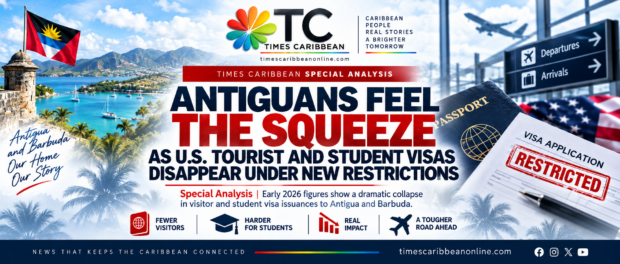
U.S. VISAS TO ANTIGUANS COLLAPSE TO NEAR ZERO AS WASHINGTON RESTRICTIONS BITE — BUT IS MIGRATION DIPLOMACY PART OF THE STORY?
TIMES CARIBBEAN SPECIAL ANALYSIS | State Department figures show visitor and student visas effectively disappearing in early 2026 as Antigua and Barbuda faces sweeping U.S. restrictions, a visa-bond regime and an unresolved dispute over third-country deportees
ST. JOHN’S, ANTIGUA — The numbers are extraordinary.
In January and February 2026, not a single B-1/B-2 visitor visa was recorded as issued to a national of Antigua and Barbuda by the United States.
No F-1 student visas.
No M-1 vocational student visas.
No J-1 exchange visas.
The contrast with one year earlier is dramatic. U.S. State Department figures reported by the Antigua Observer show that 249 B-1/B-2 visas were issued to Antigua and Barbuda nationals in January 2025 and another 186 in February 2025.
Across all non-immigrant categories, the State Department recorded 260 visa issuances in January 2025 compared with just one in January 2026 — a K-1 fiancé visa.
February tells a similar story: 204 visas across all categories in February 2025 compared with only seven in February 2026.
Those seven were two G-1 visas, one G-4 and four P-1 visas — categories generally associated with official or international-organisation representatives and qualifying athletes or entertainers.
That translates into an approximately 99.6 percent fall in total issuances for January and a 96.6 percent decline for February, according to the published data.
But the numbers require careful interpretation.
This is not simply evidence that hundreds of Antiguans went before American consular officers and were individually refused.
Something much bigger happened.
WASHINGTON CHANGED THE RULES
On January 1, 2026, Presidential Proclamation 10998 came into force.
Under that measure, the United States partially suspended visa issuance to Antigua and Barbuda nationals in some of the categories most heavily used by ordinary Caribbean travellers: B-1/B-2 business and tourist visas, F student visas, M vocational visas and J exchange visas, along with broad restrictions affecting immigrant visas.
Applicants can still submit applications and attend interviews, but the State Department explicitly says people covered by the proclamation may be ineligible for actual visa issuance or entry.
So the zero figure is not merely a snapshot of tougher interviewing.
It reflects a structural restriction.
And that distinction matters.
The latest State Department data therefore demonstrate the practical impact of Washington’s policy far more clearly than they demonstrate a sudden deterioration in the individual credibility of Antiguan applicants.
Indeed, immediately before the restrictions began, Antigua and Barbuda nationals were still receiving significant numbers of visas. State Department data cited by the Observer show 74 B-1/B-2 visas issued in November 2025 and 73 in December.
Then January arrived.
The tap effectively closed.
WHY WAS ANTIGUA TARGETED?
Washington’s publicly stated explanation is important because it differs from the political explanation repeatedly advanced by Prime Minister Gaston Browne.
In Proclamation 10998, the United States specifically stated of Antigua and Barbuda that the country had historically operated a Citizenship by Investment programme without a residency requirement.
On that basis, Washington placed Antigua and Barbuda among countries subject to partial restrictions while directing consular officers to reduce the validity of other non-immigrant visas where legally permitted.
The wider proclamation also cites concerns about identity management, information sharing, screening, vetting, national security and public safety across the countries affected.
Antigua and Barbuda has disputed the suggestion that its Citizenship by Investment Programme presents a security threat and has been lobbying Washington for reconsideration. Ambassador Sir Ronald Sanders entered discussions with U.S. officials almost immediately after the December 2025 announcement.
The United States also confirmed that visas valid before the January 1 effective date were not automatically cancelled by the proclamation.
That means the measure primarily affects people seeking new visas.
For young Antiguans hoping to study, families seeking visitor visas, first-time travellers and people whose visas expire, the distinction offers little comfort.
BROWNE SEES A DIFFERENT STORY
Prime Minister Gaston Browne has publicly suggested another factor may be at work: Antigua and Barbuda’s resistance to U.S. requests that it receive third-country nationals being removed from the United States.
Washington and St. John’s have been negotiating over such transfers.
Browne has said U.S. officials at one stage proposed that Antigua and Barbuda accept as many as 120 people annually — roughly 10 per month.
His government has instead indicated willingness to consider approximately 10 people annually, subject to strict vetting, documentation and security safeguards.
That is a huge gap.
Browne has argued publicly that accepting substantially larger numbers could create security and social challenges for a country of Antigua and Barbuda’s size.
He has also openly characterised pressure surrounding third-country deportees as coercive and warned that small Caribbean states should retain the sovereign right to determine whom they admit.
According to Browne’s interpretation, Washington’s visa restrictions are connected to that wider disagreement.
But an important distinction must be maintained.
The publicly available U.S. proclamation does not say that Antigua and Barbuda was sanctioned because it refused to accept 120 deportees.
Its stated rationale regarding Antigua and Barbuda centres on Citizenship by Investment and broader U.S. screening and national-security considerations.
Nor has either government publicly produced an agreement, diplomatic communication or other conclusive documentary evidence establishing that accepting more deportees would automatically lead Washington to remove the visa restrictions.
That alleged connection therefore remains Browne’s political assessment, not an established fact.
Still, the timing has naturally fuelled debate.
THE VISA-BOND PRESSURE
Antigua and Barbuda has simultaneously been placed under the U.S. visa-bond regime.
The State Department lists Antigua and Barbuda among countries subject to the programme, with implementation beginning January 21, 2026.
Under the initial pilot structure, consular officers could require eligible B-1/B-2 applicants to post refundable bonds of US$5,000, US$10,000 or US$15,000, with US$10,000 serving as the general benchmark in the State Department’s regulatory framework.
Washington has since moved to establish a permanent visa-bond programme under which consular officers may require a bond up to US$20,000.
The distinction is critical.
The money is not simply another visa application fee that everyone automatically pays.
A bond can be demanded from an applicant who is otherwise eligible for the covered visa, as a condition connected to visa issuance and compliance with the terms of admission.
And posting a bond does not itself guarantee approval.
Still, US$20,000 represents more than EC$54,000 at the long-standing EC-dollar/U.S.-dollar exchange rate.
For many Caribbean families, that is an enormous amount of money to have tied up merely to facilitate temporary travel.
THE HIDDEN COST OF APPLYING
There is another Caribbean reality behind the numbers.
Antigua and Barbuda does not host a full U.S. embassy providing the complete range of visa services. The U.S. diplomatic mission serving the Eastern Caribbean is in Bridgetown, Barbados, while the American presence in Antigua is a consular agency. The State Department identifies Bridgetown as a visa-issuing post providing full services.
That can mean airfare, accommodation, ground transport, meals and time away from work before the underlying visa expense is even considered.
For a family applying together, those costs multiply quickly.
Prime Minister Browne went so far in March as to advise citizens not to pursue U.S. visa applications unless their circumstances were urgent while the restrictive environment remained in place.
This is why the policy has consequences extending far beyond tourism.
The United States is one of the Caribbean’s principal destinations for education, medical care, business, family visits, shopping, air connections and diaspora engagement.
Restricted access therefore creates economic and social costs on both sides.
STUDENTS MAY FACE THE SHARPEST CONSEQUENCES
Perhaps the most consequential figure is not the collapse in tourist visas.
It is zero student visas.
No F-1.
No M-1.
No J-1 during January or February, according to the reported State Department figures.
A tourist can postpone a holiday.
A student offered a place at an American university may face a deadline.
A young athlete with an academic opportunity may have a narrow recruitment window.
An exchange participant may simply lose the programme.
That converts immigration policy into an education and human-capital issue for a country whose population is only a fraction of that of a major American city.
And unlike restrictions placed on a large state, measures affecting small Caribbean countries can touch a disproportionately large share of families through migration, education and diaspora networks.
WASHINGTON HAS GIVEN ITSELF ROOM TO REVIEW
There is one important opening.
Prime Minister Browne wrote directly to President Donald Trump in August requesting a review of both the restrictions and the visa-bond measures, while Antigua and Barbuda’s embassy sent a diplomatic note to the State Department requesting reconsideration.
The proclamation itself provides mechanisms for review and case-by-case exceptions.
There has also been movement elsewhere in U.S. immigration policy. A separate January 2026 pause affecting immigrant visas for nationals of dozens of countries was no longer in effect as of August 21 following a U.S. court order, according to the State Department.
That does not mean Antigua and Barbuda’s Proclamation 10998 restrictions have disappeared.
They have not.
But it demonstrates that the 2026 U.S. immigration landscape is still evolving through executive decisions, diplomatic engagement, regulation and litigation.
THE BIGGER QUESTION FOR THE CARIBBEAN
The Antigua and Barbuda case raises an uncomfortable regional question.
How much policy independence can very small states realistically exercise when dealing with a superpower controlling access to one of their citizens’ most important destinations?
The United States unquestionably has the sovereign authority to determine who enters its territory.
Antigua and Barbuda equally has the sovereign authority to decide whether it will accept third-country nationals removed from another state.
The tension begins when migration access, diplomatic cooperation, national security, citizenship programmes and geopolitical leverage intersect.
Browne describes that dynamic as pressure from a much larger power.
Washington describes its measures as tools designed to protect American national security and immigration integrity.
Both positions exist in the public record.
What the State Department numbers establish beyond political argument is the impact.
January 2025: 249 visitor visas.
January 2026: zero.
February 2025: 186.
February 2026: zero.
Those numbers represent one of the most dramatic disruptions to U.S. travel access faced by Antigua and Barbuda in recent memory.
And behind every statistic may be a student, family, businessperson, patient, athlete or first-time traveller discovering that a relationship between two governments can suddenly become intensely personal.
For Antigua and Barbuda, the diplomatic challenge now is not merely to complain about Washington’s policy.
It is to determine precisely what the United States requires, decide which demands can reasonably be met without compromising national sovereignty, challenge those it considers unjustified, strengthen any genuine weaknesses in passport and identity-security systems, and press relentlessly for normal visa access to be restored.
Because this is no longer an abstract diplomatic disagreement.
For ordinary Antiguans and Barbudans seeking a new U.S. tourist or student visa, the first published numbers of 2026 show just how firmly the door has narrowed.
TIMES CARIBBEAN | SPECIAL ANALYSIS
















Leave a comment
You must be logged in to post a comment.