EU GIVES FIVE CARIBBEAN COUNTRIES UNTIL 2028 TO PHASE OUT CBI PROGRAMMES OR RISK SCHENGEN VISA ACCESS
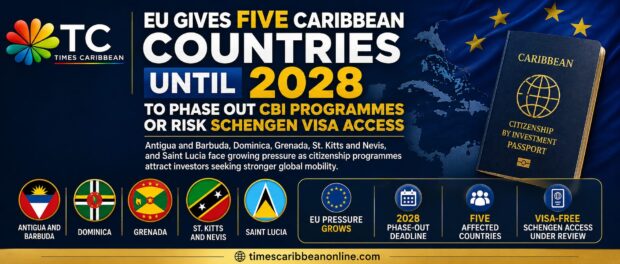
Antigua and Barbuda, Dominica, Grenada, St. Kitts and Nevis, and Saint Lucia face growing pressure as citizenship programmes attract investors seeking stronger global mobility
BASSETERRE, St. Kitts — The European Union has formally called on five Eastern Caribbean countries to phase out their Citizenship-by-Investment programmes by June 1, 2028, warning that continued operation could place their visa-free access to Europe’s Schengen Area at risk.
The countries affected are Antigua and Barbuda, Dominica, Grenada, St. Kitts and Nevis, and Saint Lucia.
Under the programmes, qualified foreign applicants can obtain citizenship after passing due-diligence checks and making an approved financial contribution, investing in real estate or supporting designated national development projects.
The European Commission’s position is based on its revised Visa Suspension Mechanism, which allows the EU to suspend visa-free travel where a country operates an investor citizenship programme granting nationality to persons without what Brussels considers a genuine connection to that country.
Formal deadline communicated
The Government of Antigua and Barbuda confirmed that a European Commission letter dated June 25, 2026, requested that its programme be phased out by June 1, 2028.
Antigua and Barbuda said similar correspondence was sent to Dominica, Grenada, St. Kitts and Nevis, and Saint Lucia. The proposed arrangement includes a 24-month transition period, reinforced applicant screening and the exclusion of persons subject to EU sanctions.
The warning represents one of the most serious challenges yet for an industry that has become an important source of government revenue across the Eastern Caribbean.
European officials have repeatedly raised concerns about the large number of passports issued, short processing periods and what they consider low rejection rates in some jurisdictions.
According to European Commission data, an estimated 107,625 passports have been issued through the five programmes. The countries collectively received 13,113 applications in 2023 and 10,573 in 2024.
The Commission has acknowledged that the five governments have introduced reforms, including stronger information-sharing arrangements, mandatory interviews, higher minimum investment requirements and plans for a regional regulator.
But Brussels maintains that investor citizenship programmes carry continuing security and migration-management concerns for the Schengen Area.
African demand could be affected
The EU’s position could also reshape demand from wealthy African investors, many of whom reportedly view Caribbean citizenship as a tool for easier international business travel, family security and more predictable global mobility.
That demand has grown as travellers from several African countries continue to experience high Schengen visa refusal rates.
European Commission figures show that the global refusal rate for short-stay Schengen visas stood at 14.6 per cent in 2025. However, applicants in several African markets faced considerably higher rates. Nigeria’s refusal rate was reportedly approximately 47.8 per cent.
Nigeria has emerged as an important source market for the investment migration industry. Official EU reporting showed that Nigerian nationals were among Grenada’s leading applicant groups in 2024, behind China in the partial figures submitted for that year. Industry reporting later indicated that Nigerians represented approximately 16 per cent of Grenada’s applications in 2025.
However, comprehensive nationality data for all five Caribbean programmes are not publicly available. It would therefore be inaccurate to conclude that Nigerians lead applications across every participating country.
Applicants generally invest at least US$200,000 under the region’s harmonised minimum pricing arrangement, although required contributions and total costs vary by programme, investment route and family size.
Should visa-free Schengen access be suspended, analysts expect demand from applicants primarily seeking easier European travel to weaken. The passports would still provide varying levels of international mobility, but their value would depend heavily on the remaining destinations available to citizens of each country.
Caribbean leaders preparing joint response
The five participating governments have rejected any sudden or unilateral closure of the programmes and are coordinating a diplomatic response.
Following a July 10 meeting in Dominica, regional leaders announced plans for a high-level mission to Brussels. They said future negotiations must recognise the economic vulnerabilities of small island developing states and the role CBI revenue plays in financing housing, healthcare, education, infrastructure, climate resilience and disaster recovery.
The leaders also highlighted the establishment of the Eastern Caribbean Citizenship by Investment Regulatory Authority, describing it as an important step towards harmonised oversight, stronger compliance and improved programme integrity.
Antigua and Barbuda Prime Minister Gaston Browne has maintained that his government will not abandon the programme without credible replacement revenue.
The participating states are expected to seek additional development financing, climate-resilience support, strategic investment and economic diversification assistance as part of their discussions with European officials.
For the Caribbean, the issue now extends far beyond passport sales.
It touches national sovereignty, international security, development financing and the future of visa-free mobility for hundreds of thousands of ordinary Caribbean citizens who obtained their nationality by birth.
The next phase of negotiations will determine whether the region can reach a compromise with Brussels—or whether Schengen visa-free access will become the price of keeping the programmes alive.

















Leave a comment
You must be logged in to post a comment.