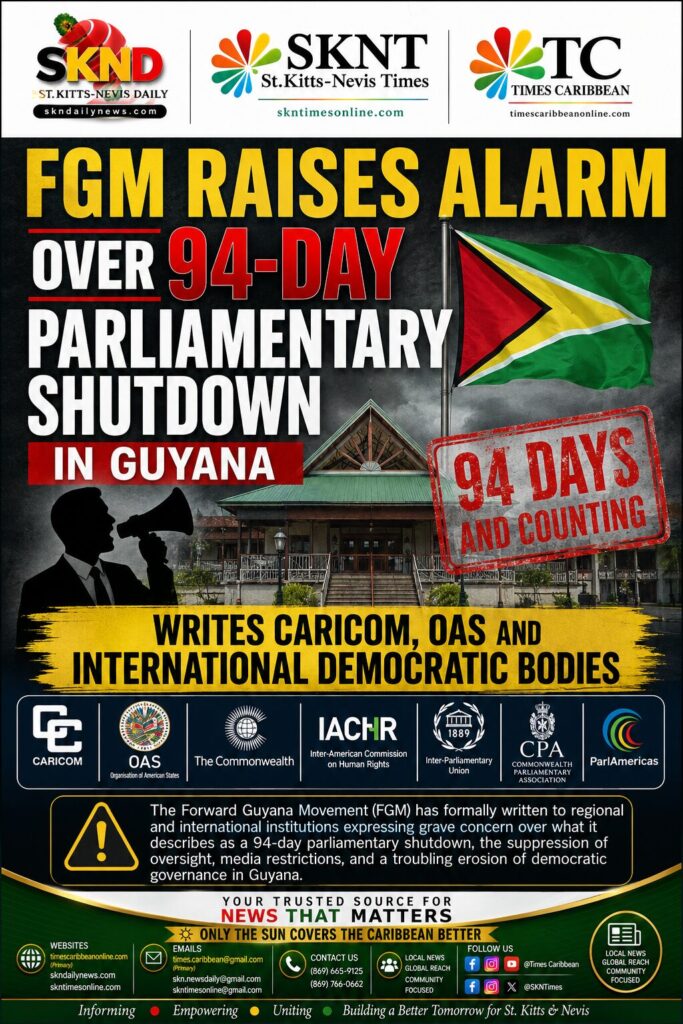
FGM Raises Alarm Over 94-Day Parliamentary Shutdown in Guyana, Writes CARICOM, OAS and International Democratic Bodies

GEORGETOWN, Guyana — The opposition-aligned has intensified concerns over the state of democratic governance in Guyana after formally petitioning several major regional and international organizations regarding what it describes as a prolonged parliamentary shutdown and growing threats to democratic accountability.
In a strongly worded communication dispatched on May 18, 2026, the movement’s leader, , reportedly wrote to regional and international institutions including , , , , , and outlining what it described as mounting democratic concerns inside Guyana.
According to the release, Parliament has not convened for a sitting since the passage of the 2026 National Budget on February 14, 2026 — a period now exceeding 90 days. The movement argues that no formal constitutional explanation or procedural justification has been publicly provided for the continued absence of parliamentary sittings.
FGM contends that the prolonged inactivity of the National Assembly undermines Guyana’s constitutional framework and weakens the principle of representative democracy by limiting the ability of elected representatives to scrutinize public spending, government policy, and executive decision-making during a period of unprecedented oil revenues and major state expenditure.
The movement also alleged what it described as a wider pattern of democratic erosion, including reported restrictions on media access to Parliament, suppression of parliamentary speech, and delays in establishing key parliamentary oversight bodies such as the Public Accounts Committee and Sectoral Committees.
According to the organization, the continued absence of these oversight mechanisms significantly weakens transparency and accountability at a time when Guyana’s rapidly expanding petroleum economy has placed the country under increasing regional and international scrutiny.
FGM reportedly asked the organizations to consider actions consistent with their democratic mandates, including public reaffirmations supporting regular parliamentary sittings, calls for the immediate reconvening of Parliament, and monitoring of democratic governance standards in Guyana.
The movement emphasized that its outreach should not be interpreted as a request for foreign interference, but rather as an appeal for regional and international institutions to uphold democratic standards and agreements to which Guyana has voluntarily committed itself.
“A Parliament that does not sit cannot effectively scrutinize public spending, represent the people, or hold power accountable. At a time of unprecedented oil wealth, democratic oversight in Guyana should be expanding, not disappearing,” said in the statement.
The development is expected to intensify political debate in as concerns continue to grow among critics, civil society voices, and opposition groups regarding governance, transparency, and institutional accountability amid the country’s ongoing oil-driven economic transformation.
















Leave a comment
You must be logged in to post a comment.