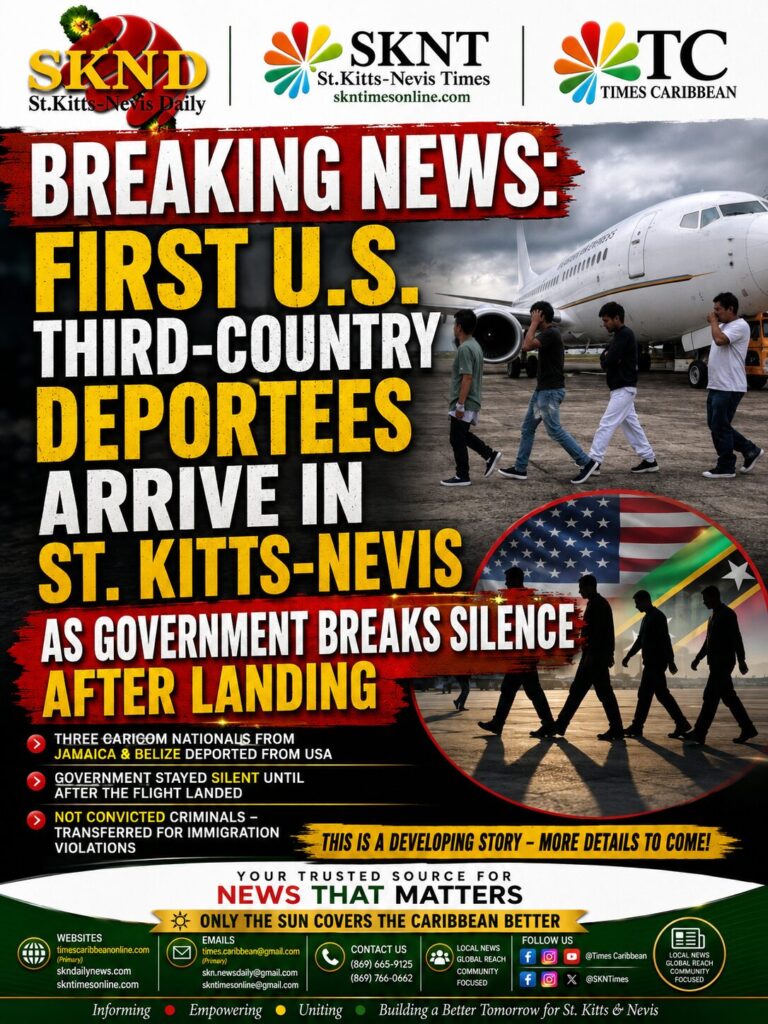
BREAKING NEWS: FIRST U.S. THIRD-COUNTRY DEPORTEES ARRIVE IN ST. KITTS-NEVIS AS GOVERNMENT BREAKS SILENCE AFTER LANDING

BASSETERRE, ST. KITTS — St. Kitts and Nevis has officially received its first group of third-country nationals transferred from the United States under a controversial migration agreement that has sparked intense public debate, regional scrutiny, and growing national concern.
In a development that many citizens say unfolded under a cloud of secrecy, the Government of St. Kitts and Nevis remained publicly silent about the imminent arrival of the individuals until after the flight reportedly landed in the Federation on Tuesday morning, May 19, 2026.
Only after the individuals had already arrived did the government release an official statement confirming that three nationals from CARICOM member states — Jamaica and Belize — had been transferred from the United States to St. Kitts and Nevis under a Memorandum of Understanding (MOU) signed with Washington.
The revelation immediately ignited public discussion across social media and political circles, with many residents questioning why the country was not informed earlier about the pending arrival of the deportees and demanding greater transparency surrounding the agreement.
Government Confirms Transfer
In its statement, the government said the transfer was conducted under an MOU concerning “certain third-country nationals who are citizens of CARICOM Member States.”
Authorities emphasized that the individuals were not transferred because of criminal convictions, but rather due to immigration violations in the United States.
According to the government, the United States provided “biographical, medical, and criminal background information” prior to the transfer, while local immigration, law enforcement, and national security agencies were fully engaged in the process.
The statement also noted that the individuals would receive the immigration status and legal accommodation ordinarily applicable to CARICOM nationals within the Federation and that the arrangement came at “no cost” to the Government of St. Kitts and Nevis.
Public Concern Intensifies
Despite the assurances, the announcement has intensified public unease over the wider implications of the agreement and the government’s handling of the issue.
Critics argue that the administration’s delayed disclosure created an atmosphere of suspicion and uncertainty, especially given the highly sensitive nature of migration and national security matters.
Some citizens have also raised concerns about whether the public has been fully informed about the long-term scope of the agreement, including whether additional flights or larger transfers could follow in the coming months.
Questions are also being raised about the consultation process leading up to the signing of the MOU and whether Parliament or the broader public was adequately briefed before the arrangement took effect.
Regional and Political Ramifications
The issue of third-country deportee transfers has become increasingly sensitive across the Caribbean, particularly as the United States intensifies immigration enforcement measures and seeks regional cooperation on migrant processing and relocation.
Observers note that while the government insists the transferred individuals are CARICOM nationals and not convicted criminals, the optics surrounding deportee arrivals remain politically delicate in a small island nation where concerns over security, employment, housing, healthcare, and social services already dominate public discourse.
Analysts say the controversy could quickly evolve into a major political issue depending on how transparently the administration manages future transfers and communicates with the public.
Government Appeals for Calm
In its statement, the government urged citizens to rely on official sources for accurate information and reaffirmed its commitment to “the responsible management of migration matters,” adherence to international obligations, and the maintenance of public safety and national security.
However, as news of the arrivals spread rapidly Tuesday morning, many residents continued demanding greater clarity on the full details of the agreement, the number of potential future arrivals, and the broader obligations St. Kitts and Nevis may have undertaken under the arrangement with the United States.
For now, one thing is clear: the arrival of the Federation’s first U.S. third-country deportees has opened a new and highly sensitive chapter in the national conversation on immigration, sovereignty, transparency, and public trust.
















Leave a comment
You must be logged in to post a comment.