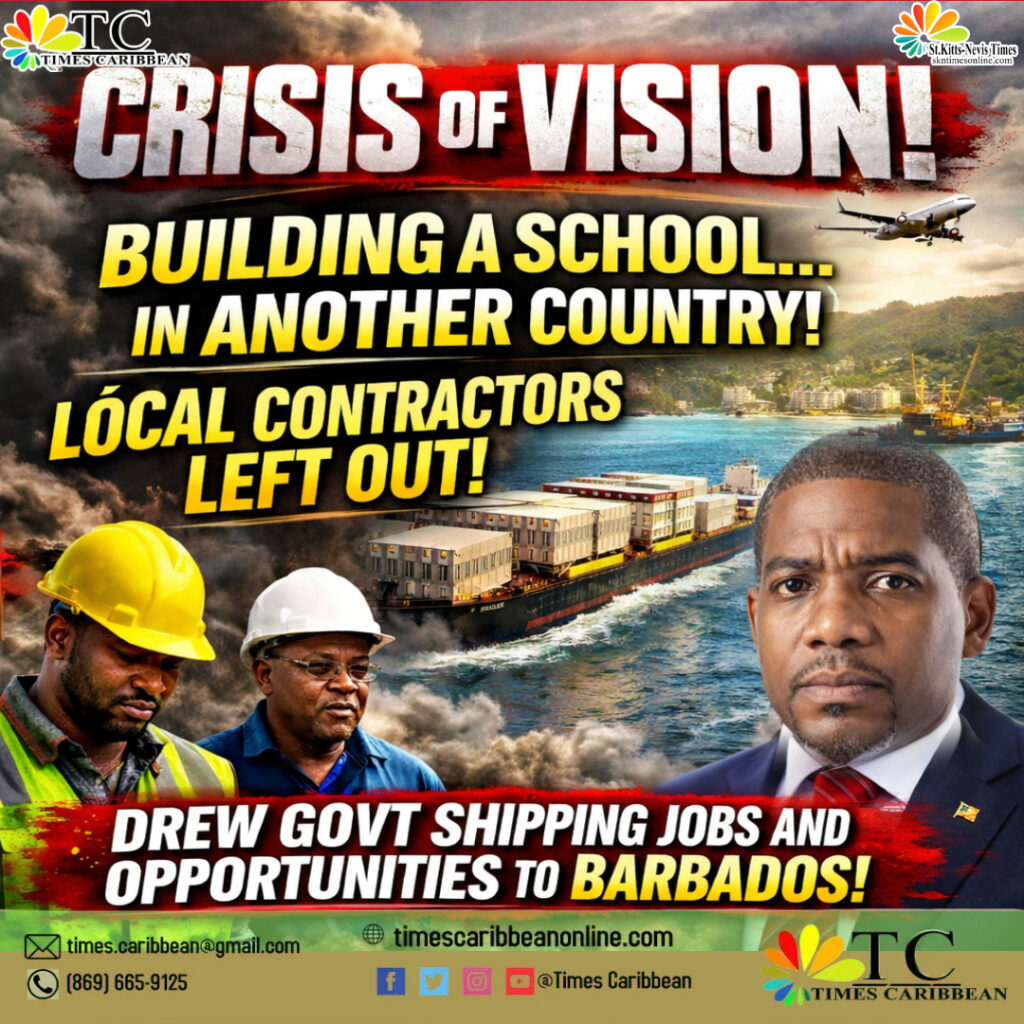
CRISIS OF VISION: BUILDING A SCHOOL… IN ANOTHER COUNTRY- LOCAL CONTRACTORS LEFT OUT-Drew Govt Shipping Jobs and Opportunities to Barbados!
VISION BANKRUPTCY? $270M BHS SCHOOL PLAN EXPORTED TO BARBADOS AS LOCAL ECONOMY STARVES
SKN Times Commentary
“Where there is no vision, the people perish.”
Few moments in the recent political history of St. Kitts and Nevis have illustrated the truth of that ancient warning more starkly than the stunning revelation made by Prime Minister Dr. Terrance Drew and his administration this week regarding the long-promised Basseterre High School (BHS) reconstruction project.
After years of announcements, groundbreakings, press conferences, and political promises surrounding what has been described as a $270 million national education project, the nation has now been told something almost unimaginable:
The school will largely be constructed in Barbados and then shipped to St. Kitts for assembly.
If true, it represents not merely a controversial decision — but potentially one of the most economically reckless development strategies ever proposed in the Caribbean.
A Slap in the Face to Local Industry
At a time when the local economy is widely described by business leaders as slow and struggling, the Drew administration appears prepared to export more than $200 million in economic activity out of St. Kitts and Nevis.
That money could have fueled:
- Hundreds of construction jobs
- Dozens of local subcontractors
- Engineering and architectural firms
- Hardware suppliers and logistics companies
- Concrete plants, trucking companies, and heavy equipment operators
Instead, the government’s plan appears to send the bulk of that economic stimulus to Barbados.
For local contractors, tradesmen, labourers, and small businesses already grappling with reduced economic activity, the announcement has landed like a direct insult.
Echoes of the East Coast Housing Project
Critics note that this is not the first time the government has exported major development spending overseas.
The controversial $750 million NHC East Coast housing project, widely associated with Trinidadian construction interests, already raised concerns about how much local participation would actually occur.
Now, with the BHS project, observers say the pattern appears even more pronounced.
Two major state-driven projects — potentially approaching $1 billion combined — could see huge portions of spending leaving the federation’s economy.
A Construction Method That Raises Eyebrows
The concept of constructing a $270 million secondary school in one country and shipping it in sections to another has raised serious questions within regional construction circles.
Prefabricated components are used globally in certain projects. But building an entire large-scale national school facility overseas and transporting it by sea for assembly is virtually unheard of at this scale.
Even more troubling, several individuals within Barbados’ construction sector have reportedly indicated no visible evidence of such a massive manufacturing operation currently underway.
That raises uncomfortable questions:
- Where exactly is this construction taking place?
- Which facilities in Barbados are producing these structures?
- What is the contractor’s track record for delivering projects of this magnitude using such a method?
A Local Solution Ignored
Perhaps the most frustrating aspect of the situation for many industry professionals is that St. Kitts and Nevis already possesses the technical capacity to build the school locally.
The federation has a roster of experienced contractors and engineers capable of executing major projects, including:
- Lennox Warner & Partners
- Evcon Ltd (Trevor Isaac)
- Bailey Construction
- B. C. Audain & Associates
- Allie Construction
- Skeete & Associates
- Pelican Construction
- Prime Construction (Travail Buchanan)
- Jorge Alberti
- Rock & Dirt Construction
- Vaughn’s Construction
Together, these firms represent thousands of skilled workers, tradesmen, engineers, and technicians.
With the right leadership and coordination, government could easily have formed a national contractors consortium — allowing multiple firms to collaborate on what should be one of the most important nation-building projects in decades.
Instead, the opportunity to stimulate local employment, expand technical capacity, and circulate hundreds of millions within the domestic economy appears to be slipping away.
A Political Distraction?
Some observers now question whether the Barbados construction narrative is something else entirely.
With elections approaching and years passing without visible construction progress at the BHS site, critics speculate that the offshore fabrication story may simply be a political attempt to explain delays.
If that is the case, it raises a deeper concern:
Is the BHS project actually ready for construction at all?
Or has the nation been sold yet another development promise that remains far from implementation?
Leadership and Vision
Major national projects are not merely about concrete and steel.
They are about economic vision.
They are about national development strategy.
They are about whether a government understands how public investment can stimulate local industries and strengthen a country’s economic base.
When leadership lacks creativity, innovation, and strategic thinking, the consequences can be severe.
Economic opportunities are lost.
Local capacity is sidelined.
National confidence erodes.
And the people pay the price.
If the current plan proceeds as described, the BHS project may ultimately be remembered not as a symbol of educational progress — but as a case study in how visionary leadership was absent at the very moment the country needed it most.
















Leave a comment
You must be logged in to post a comment.