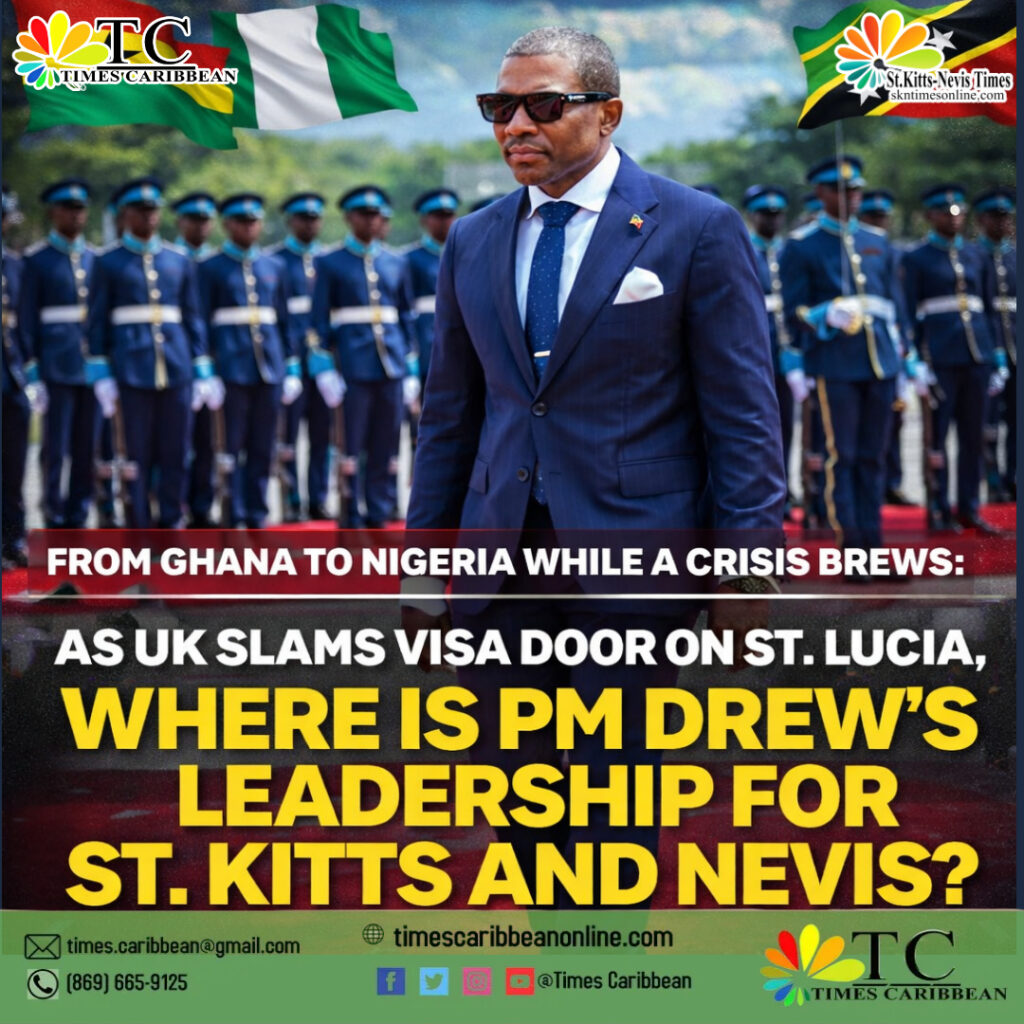
FROM GHANA TO NIGERIA WHILE A CRISIS BREWS: AS UK SLAMS VISA DOOR ON ST. LUCIA, WHERE IS PM DREW’S LEADERSHIP FOR ST. KITTS AND NEVIS?

As the diplomatic shockwaves from the United Kingdom’s sudden visa restrictions on St. Lucian nationals ripple across the Caribbean, an uncomfortable question is being whispered — and increasingly shouted — in St. Kitts and Nevis:
Where is the leadership from Prime Minister Dr. Terrance Drew?
While regional alarm grows following London’s decision to impose visa requirements on St. Lucia effective March 5, 2026, the Prime Minister of St. Kitts and Nevis remains thousands of miles away, enjoying official engagements and festivities in Ghana, even as he prepares for yet another overseas trip — this time to Nigeria — next week.
For many concerned citizens watching the situation unfold, the optics could not be more troubling.
A Region on Edge
The UK’s visa crackdown on St. Lucia did not occur in a vacuum.
It follows a pattern that the Caribbean should know all too well. In July 2023, Britain abruptly imposed similar visa restrictions on Dominican nationals, citing concerns over asylum claims.
Now St. Lucia joins that list.
And the inevitable question looms large over Basseterre:
Could St. Kitts and Nevis be next?
The fear is not hypothetical. The federation has already experienced the painful consequences of international immigration crackdowns before.
In 2014, Canada abruptly revoked visa-free access for citizens of St. Kitts and Nevis, citing concerns surrounding the country’s Citizenship-by-Investment (CBI) programme and passport security. That same year, the United States issued a Financial Crimes Enforcement Network (FinCEN) advisory, placing intense scrutiny on the federation’s financial and citizenship systems.
The reputational damage from those developments lingered for years.
Many believe the lessons from that period should have permanently sharpened the diplomatic reflexes of any administration in Basseterre.
Yet today, as the region faces what some analysts are describing as a new era of tightening immigration barriers against Caribbean passports, the leadership silence from St. Kitts and Nevis is deafening.
Frequent Flyer Diplomacy
Prime Minister Drew’s government has in recent months embarked on what critics describe as an unprecedented whirlwind of overseas travel.
From international conferences to diplomatic visits across multiple continents, the administration’s calendar has increasingly been dominated by foreign engagements.
This latest trip to Ghana — followed by a planned return to Africa next week for engagements in Nigeria — comes immediately after a series of CARICOM-related meetings and regional diplomatic tours.
International diplomacy is of course a critical responsibility of any head of government.
But citizens now ask a more pointed question:
At what point does frequent flying begin to look like an absence of focus at home?
A Moment Demanding Leadership
The Caribbean is entering a potentially dangerous moment.
Across Europe and North America, domestic politics are shifting sharply toward tighter immigration controls. Caribbean nationals — historically able to travel relatively freely to the United Kingdom — may soon find those privileges disappearing one country at a time.
Premier of Nevis Mark Brantley has already warned that the region should treat the St. Lucia decision as a warning shot.
“When your neighbour’s house is on fire, wet your own,” Brantley cautioned — a proverb reminding Caribbean societies that danger next door is often danger approaching.
For St. Kitts and Nevis, the stakes are even higher.
The country’s passport has long been intertwined with the Citizenship-by-Investment programme, a programme that already sits under intense scrutiny from international regulators.
If visa restrictions were ever imposed on St. Kitts and Nevis by the United Kingdom or Europe, the economic consequences could be profound.
Citizens Plead: Focus on Home
Many citizens are now urging Prime Minister Drew to demonstrate urgency.
The call is not for diplomatic theatrics, but for visible leadership and engagement.
Concerned citizens say the Prime Minister should urgently:
• Engage with CARICOM and OECS leaders to assess the implications of the UK’s policy shift
• Open diplomatic dialogue with London and Brussels regarding Caribbean travel access
• Address the nation directly on the risks facing regional passports
• Strengthen international confidence in St. Kitts and Nevis’ regulatory and immigration systems
In simpler terms, citizens are asking the Prime Minister to settle down for a moment and get to work on the ground at home.
Or as one critic bluntly put it:
“Give the airlines a break for now.”
A Test of Statesmanship
Moments like this often define governments.
They reveal whether leaders recognize the early warning signs of geopolitical change — or whether they notice the storm only after it arrives at their own doorstep.
The United Kingdom’s decision against St. Lucia may yet prove to be a single, isolated immigration measure.
But if it is not — if it represents the beginning of a wider tightening against Caribbean passports — then the region is facing a profound challenge.
And for St. Kitts and Nevis, the time to prepare is not after the fire spreads.
It is now.
















Leave a comment
You must be logged in to post a comment.