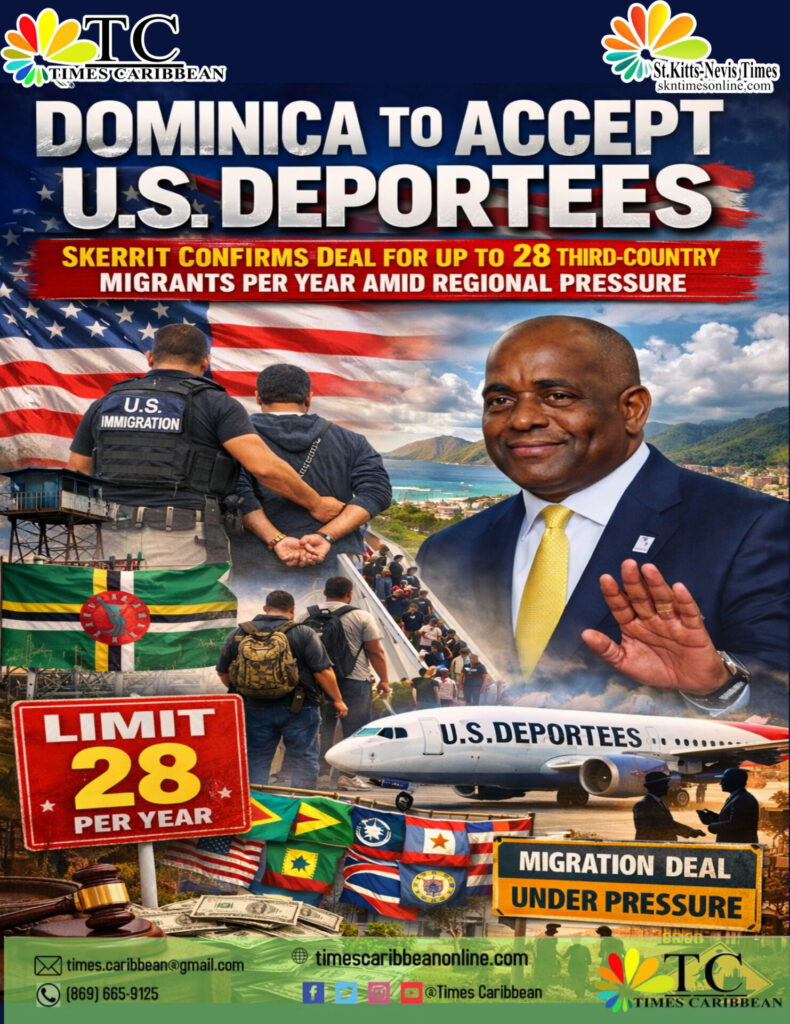
DOMINICA TO ACCEPT U.S. DEPORTEES: SKERRIT CONFIRMS DEAL FOR UP TO 28 THIRD-COUNTRY MIGRANTS PER YEAR AMID REGIONAL PRESSURE

By Times Caribbean News Desk
Roseau, Dominica — Prime Minister Roosevelt Skerrit has confirmed that his administration is preparing to sign an agreement with the United States that will allow a limited number of deportees to be relocated to Dominica each year, as Washington intensifies pressure on Caribbean nations to participate in a controversial “third-country deportation” program.
Speaking to reporters following discussions at last week’s Caribbean Community leaders’ summit hosted in St. Kitts and Nevis, Skerrit revealed that the arrangement being finalized would permit no more than 28 deportees annually, a figure he emphasized was far smaller than the numbers circulating in public speculation.
“Seven people per quarter. We have four quarters in a year. So, in a year, there will be 28,” Skerrit explained. “It is not the hundreds or the thousands that people are saying.”
U.S. Push for Regional Cooperation
The proposed arrangement comes amid mounting diplomatic pressure from the administration of Donald Trump, which has been urging Caribbean governments to accept migrants and foreign nationals deported from the United States who cannot easily be returned to their countries of origin.
U.S. officials argue that many of those slated for relocation are individuals detained for visa overstays or minor immigration violations, rather than serious criminal offenses, and therefore pose minimal security risks to host countries.
Still, the policy has sparked heated debate across the Caribbean, where governments are weighing humanitarian, economic, and national security implications.
Skerrit sought to reassure Dominicans that the arrangement would be carefully managed and limited in scale.
“It’s not the hundreds that people are saying, or the thousands,” he reiterated. “The truth is Dominica needs thousands of people more, if you were to ask me.”
Dominica Seeking Support from IOM
To facilitate the process, the government has approached the International Organization for Migration to help coordinate logistics, housing, and integration support for the deportees.
According to Skerrit, negotiations with Washington also include financial provisions to ensure that Dominica does not bear the cost of accommodating deportees.
“We’re hoping to finalize the agreement for signing this week,” he said. “And the financial aspect of it is something we have discussions with so that we’re not out of pocket.”
Officials also suggested that some deportees may only remain temporarily in Dominica, potentially returning to their home countries once arrangements are made.
Wider Regional Talks Underway
Dominica is not alone in discussions with Washington. Several members of the Organisation of Eastern Caribbean States, as well as countries like Guyana and Belize, have reportedly been approached by U.S. officials about similar agreements.
However, larger Caribbean nations such as Jamaica, Trinidad and Tobago, Suriname, and Barbados have either declined to comment publicly or indicated that they are only preparing for potential discussions.
Governments across the region have insisted that any relocation program must be fully financed by the United States, including accommodation, transportation, and social support.
Labor Shortages a Key Factor
Skerrit also framed the issue through the lens of Dominica’s chronic labor shortages, arguing that skilled migrants could contribute positively to the island’s economy.
“The reality is we are a small population,” he said. “There are a number of skills we need in the country.”
He noted that as Dominica develops, many locals are moving away from certain types of work, creating gaps in critical sectors.
“In many cases, people who provide professional services are trying to satisfy five or six clients at a time because there simply aren’t enough skilled workers,” the prime minister said.
According to Skerrit, carefully integrating migrants with technical skills into Dominican society could boost productivity and economic development.
“If we could bring in people who have skills and immerse them in society with those skills, then that would certainly add value for our society,” he said.
A Divisive Issue Across the Caribbean
The proposal, however, is likely to remain controversial.
Across the Caribbean, critics argue that accepting deportees from outside the region could create security concerns and social tensions, while supporters say the program may help address demographic decline and workforce shortages.
Skerrit urged citizens to approach the matter with balance.
“In everything we have to look at the potential positive side of it and not appear to be xenophobic as a society,” he said. “Our first reaction cannot simply be to say no.”
As negotiations continue, Dominica’s agreement could become a blueprint for how smaller Caribbean nations navigate Washington’s expanding deportation agenda, potentially reshaping migration policy across the region.
















Leave a comment
You must be logged in to post a comment.