ALL EYES ON ST. KITTS & NEVIS: CARICOM AT 50: UNITY ON TRIAL AS GEOPOLITICS, HAITI CRISIS AND U.S. PRESSURE COLLIDE IN BASSETERRE
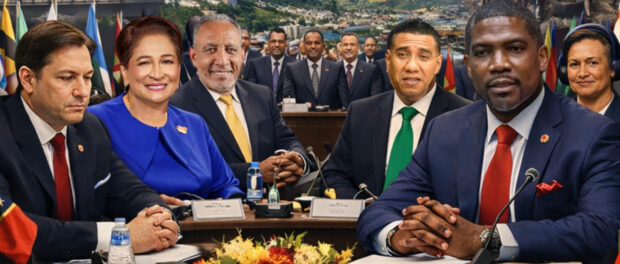
BASSETERRE, ST. KITTS — The Caribbean is watching. The diaspora is watching. And this week, the geopolitical powers of the hemisphere are watching too.
As the 50th Regular Meeting of the Conference of Heads of Government of the Caribbean Community (CARICOM) convenes in the Federation of St. Kitts and Nevis, the summit arrives not merely as a ceremonial milestone — but as a defining stress test for regional unity in a fractured world.
At the center of it all stands host Prime Minister Terrance Drew, navigating his most consequential diplomatic moment since assuming office.
This is no ordinary gathering.
This is CARICOM at 50 — under pressure.
TRINIDAD & TOBAGO: A FRACTURE IN THE FAMILY?
Regional observers are closely monitoring the posture of Kamla Persad-Bissessar of Trinidad and Tobago.
Recent remarks from Port of Spain questioning CARICOM’s relevance and criticizing what was described as “inappropriate meddling” in member states’ domestic affairs have unsettled the regional architecture.
Is this summit a reset moment — or the beginning of a more visible ideological split within the bloc?
Trinidad and Tobago remains one of CARICOM’s economic heavyweights. Any strategic distancing could weaken collective bargaining power at a time when the Caribbean must negotiate as a unified front on trade, energy security, climate financing, and migration.
The question echoing across conference corridors is simple:
Will Trinidad recalibrate — or redefine its relationship with CARICOM?
THE U.S. FACTOR: WASHINGTON IN THE ROOM
Adding another layer of complexity is the anticipated presence of U.S. Secretary of State Marco Rubio.
Washington’s growing diplomatic and security footprint in the Caribbean has not gone unnoticed, particularly amid shifting global alliances and heightened regional security concerns.
Will the United States seek firmer alignment from CARICOM states on:
- Haiti stabilization strategies
- Migration enforcement
- Security cooperation
- Competition with China’s expanding regional influence
And perhaps most critically:
Will CARICOM leaders assert autonomy — or accommodate American strategic interests?
The Caribbean has historically walked a diplomatic tightrope between global powers. At this summit, that balancing act becomes visible.
HAITI: MORAL DUTY OR POLITICAL LIABILITY?
No issue looms larger than Haiti.
As gang violence, political instability, and humanitarian collapse persist, CARICOM’s credibility as a regional body is under scrutiny.
Haiti is not an external crisis. It is a member state.
Sources suggest the Haitian delegation may press for stronger regional guarantees and clarity on migration policies — including recent public positions taken by Prime Minister Drew declining participation in certain U.S.-linked migrant relocation arrangements.
Will Haiti demand solidarity?
Will CARICOM offer concrete solutions beyond carefully worded communiqués?
And will regional leaders confront the uncomfortable truth — that prolonged instability in Haiti threatens the economic and security fabric of the wider Caribbean?
History will judge how CARICOM responds.
LEADERSHIP TEST: DREW UNDER THE MICROSCOPE
For Prime Minister Drew, this summit represents a leadership crucible.
Still relatively new on the CARICOM stage, he now hosts:
- Powerful regional counterparts
- A high-level U.S. delegation
- A restless Haitian leadership
- A skeptical Caribbean public
Diplomacy at this level requires composure, strategic vision, and the ability to unify divergent voices.
Can Drew leverage this moment to elevate St. Kitts and Nevis as a mature diplomatic actor?
Or will the summit expose fault lines in regional cohesion?
In geopolitics, perception often matters as much as policy.
UNITY OR DIVISION? CARICOM AT A CROSSROADS
At 50 years old, CARICOM faces existential questions:
- Can it evolve beyond symbolic unity?
- Can it enforce regional agreements?
- Can it present a coordinated economic and security strategy?
- Can it stand firm amid global pressure?
This meeting in Basseterre is more than ceremonial pageantry. It is a referendum on Caribbean self-determination.
If leaders emerge aligned, the Caribbean strengthens its bargaining power on the world stage.
If divisions deepen, external actors will fill the vacuum.
COMMENTARY: A REGION DECIDES ITS FUTURE
The Caribbean today stands between competing currents:
- Sovereignty versus dependency
- Solidarity versus nationalism
- Collective strength versus individual survival
The 50th CARICOM summit could be remembered as:
- The moment unity was reaffirmed
or - The week cracks in the regional foundation became undeniable
For the people of the Caribbean — from Port of Spain to Port-au-Prince, from Bridgetown to Basseterre — the stakes are not abstract.
They are economic.
They are security-related.
They are existential.
The coming days will reveal whether CARICOM at 50 is a mature geopolitical force — or a bloc struggling to define itself in a shifting world order.
One thing is certain:
History is being written in St. Kitts and Nevis this week.
And the Caribbean is watching.

















Leave a comment
You must be logged in to post a comment.