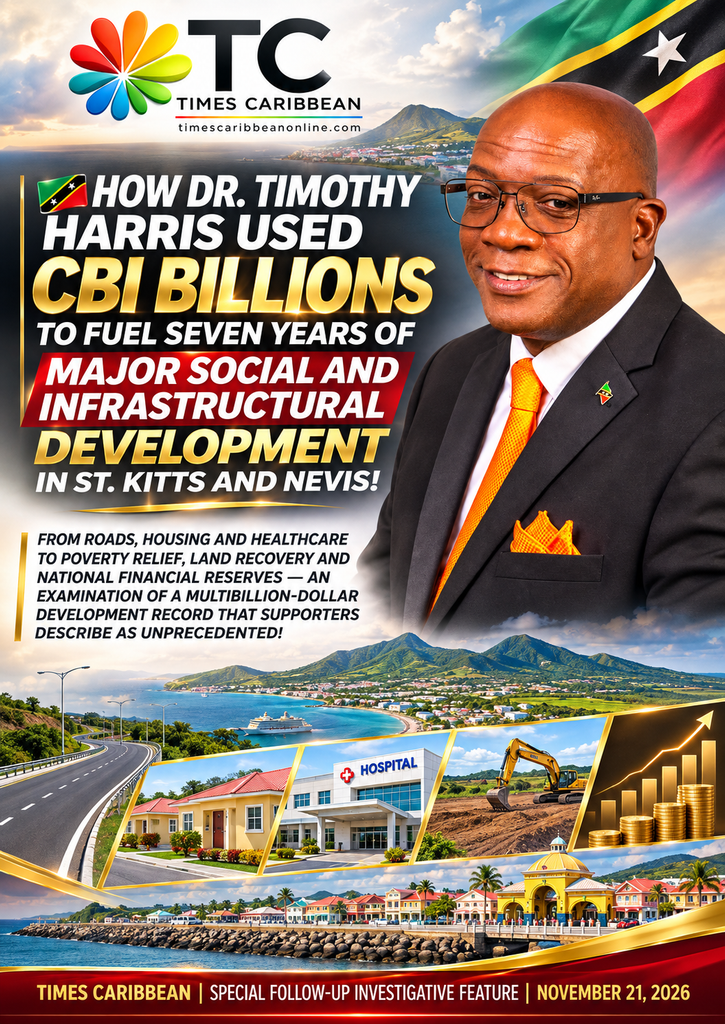
HOW DR. TIMOTHY HARRIS USED CBI BILLIONS TO FUEL SEVEN YEARS OF MAJOR SOCIAL AND INFRASTRUCTURAL DEVELOPMENT IN ST. KITTS AND NEVIS!
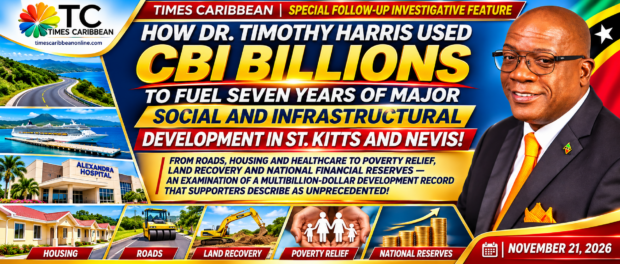
FROM ROADS, HOUSING AND HEALTHCARE TO POVERTY RELIEF, LAND RECOVERY AND NATIONAL FINANCIAL RESERVES — AN EXAMINATION OF A MULTIBILLION-DOLLAR DEVELOPMENT RECORD THAT SUPPORTERS DESCRIBE AS UNPRECEDENTED!
TIMES CARIBBEAN | SPECIAL FOLLOW-UP INVESTIGATIVE FEATURE | NOVEMBER 21, 2026
BASSETERRE, ST. KITTS — Billions in Citizenship by Investment revenue. Hundreds of millions directed toward public infrastructure, social protection and economic development. And a national financial position that attracted favourable recognition from the International Monetary Fund.
Between February 2015 and August 2022, the Dr. Timothy Harris-led Team Unity administration presided over a period of substantial public investment, supported by the Federation’s internationally marketed Platinum Brand Citizenship by Investment (CBI) programme.
But what did those extraordinary revenues actually deliver?
An examination of government budgets, audited public accounts, IMF assessments and official project records identifies major investments in roads, housing, healthcare, public utilities, debt management and assistance to vulnerable households.
The evidence documents substantial expenditure and identifiable public assets, although not every project was financed directly by CBI.
THE BILLIONS THAT HELPED FINANCE A DEVELOPMENT EXPANSION
According to figures presented by Nevis Premier Mark Brantley in April 2022, approximately EC$2.79 billion in CBI receipts was collected between 2015 and 2021. The period includes the opening weeks of 2015 before Harris assumed office.
The National Audit Office separately confirmed that approximately EC$543 million entered federal government revenue through the Citizenship by Investment Unit in 2021 alone.
The figures reflect different reporting bases, but establish the programme’s extraordinary fiscal importance.
CBI revenue gave the government considerable financial capacity to fund development, support essential services and maintain fiscal reserves.
ROADS, LAND AND INFRASTRUCTURE: VISIBLE INVESTMENTS
One of the administration’s major infrastructure commitments was the EC$69 million Island Main Road Rehabilitation Programme, designed to improve transportation, road safety and connectivity throughout St. Kitts.
Additional investment went into Old Road Bay rehabilitation, while the EC$4 million East Line Bus Terminal, opened in December 2018, delivered a modern public transportation facility in Basseterre.
Perhaps one of the most consequential land-policy initiatives was the government’s reported expenditure of approximately EC$200 million to redeem some 400 acres of land associated with earlier debt arrangements.
The initiative returned land to public ownership, creating opportunities for future housing, land distribution and development.
Tourism infrastructure also expanded.
The approximately US$48 million second cruise pier at Port Zante, completed in 2019, increased capacity to accommodate cruise vessels. It was financed principally through a syndicate of local institutions, including US$5 million in financing from the CBI-linked Sugar Industry Diversification Foundation (SIDF).
It therefore forms part of Team Unity’s development record, although its entire cost cannot be classified as direct CBI expenditure.
HOUSING, POVERTY RELIEF AND SUPPORT FOR ORDINARY FAMILIES
Beyond concrete and construction, the government directed substantial resources toward household welfare.
The Poverty Alleviation Programme, launched in December 2018, provided eligible lower-income households with EC$500 monthly assistance.
By May 31, 2021, the government reported EC$70.3 million processed in payments under the initiative.
The Hurricane Relief Programme also supported residents affected by severe weather, with EC$38.5 million in expenditure recorded for 2018.
Housing development received attention through the National Housing Corporation and the Unity Housing Solutions Programme, backed by an EC$50 million Social Security loan facility.
That arrangement supported affordable housing development, although the financing was a loan rather than a direct CBI grant.
The administration also reported EC$17.5 million in compensation payments to former sugar workers and beneficiaries, another significant direct household-support measure.
NEVIS RECEIVED MAJOR DEVELOPMENT SUPPORT
The development record extended across both islands.
Premier Brantley publicly identified approximately EC$62.2 million in SIDF allocations for Nevis projects during Team Unity’s early years.
Among the reported allocations were EC$13.5 million for electricity generation, EC$10 million for an athletics track, EC$9 million for Alexandra Hospital improvements, EC$7.7 million for geothermal development support, EC$6.5 million for Treasury Building reconstruction and EC$6 million for pier development.
Other allocations supported water infrastructure, airport improvements and sporting facilities.
These commitments provide identifiable examples of CBI-linked development financing, although some SIDF funds may have accumulated before 2015 and the allocations do not establish final project costs.
THE IMF FINDING THAT DESERVES ATTENTION
An important independent assessment came in October 2021.
The International Monetary Fund acknowledged that a significant portion of St. Kitts and Nevis’ substantial CBI earnings had been saved, helping reduce public debt below the regional target of 60% of GDP and accumulate sizeable government deposits.
The National Audit Office subsequently recorded approximately EC$640 million in federal government cash and cash equivalents at December 31, 2021.
That balance was not exclusively CBI revenue, nor does it establish the amount available when Harris left office eight months later.
Nevertheless, the IMF’s assessment confirms that the administration’s fiscal approach included savings and debt reduction alongside spending.
Those reserves provided financial resilience during a period when the COVID-19 pandemic severely disrupted Caribbean economies.
Team Unity also announced an EC$120 million pandemic stimulus package, combining direct support, financing measures and concessions for households and businesses.
THE DEVELOPMENT LEGACY — AND WHAT THE EVIDENCE ESTABLISHES
The central finding is significant.
The Harris-led administration’s record cannot be reduced simply to billions collected through citizenship investment.
Government accounts and official records identify major spending on infrastructure, housing, public services, household support, Nevis development and financial reserves.
Some investments produced durable physical assets. Others delivered measurable payments to households or improved government liquidity.
Their benefits were not limited to the year in which the money was spent.
However, a complete assessment of long-term value must distinguish completed projects from announced initiatives, direct CBI spending from loan financing, and actual outcomes from projected economic benefits.
A comprehensive CBI-to-project reconciliation covering February 2015 through August 2022 remains necessary to establish the exact allocation of every dollar.
THE BIGGER PICTURE
The historical evidence supports a substantial development record financed in important part by exceptional CBI revenues, with identifiable public assets, social programmes and financial reserves.
Whether that record was unprecedented in every category requires comparison with earlier administrations, while the full economic returns on individual investments deserve continuing examination.
But the projects, payments and fiscal achievements documented during those seven years are an important part of the Federation’s development history.
The CBI billions did more than generate government income. They helped finance a wide-ranging programme of public investment and social support whose effects extended beyond Team Unity’s time in office.
TIMES CARIBBEAN | SPECIAL INVESTIGATIVE REPORT
Based on official budget statements, National Audit Office reports, International Monetary Fund assessments and published government financial disclosures.
















Leave a comment
You must be logged in to post a comment.