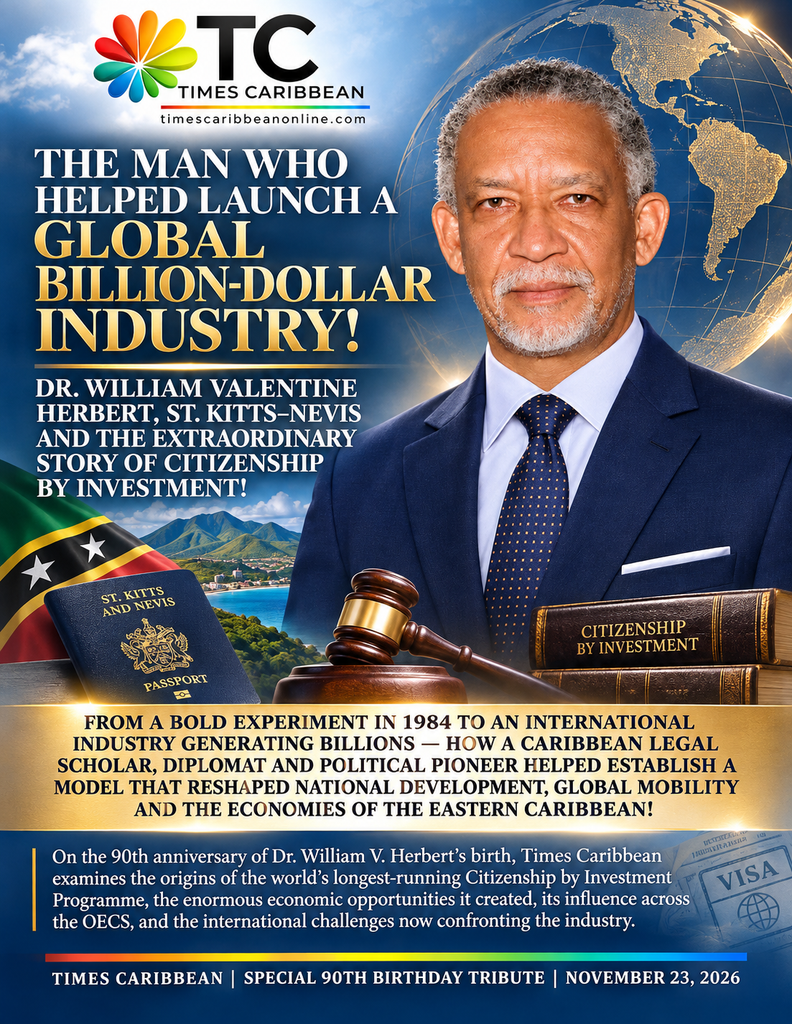
THE MAN WHO HELPED LAUNCH A GLOBAL BILLION-DOLLAR INDUSTRY! DR. WILLIAM VALENTINE HERBERT, ST. KITTS–NEVIS AND THE EXTRAORDINARY STORY OF CITIZENSHIP BY INVESTMENT!
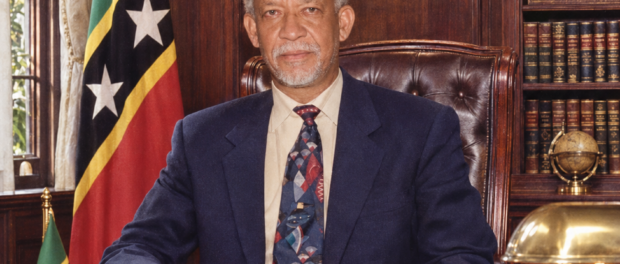
FROM A BOLD EXPERIMENT IN 1984 TO AN INTERNATIONAL INDUSTRY GENERATING BILLIONS — HOW A CARIBBEAN LEGAL SCHOLAR, DIPLOMAT AND POLITICAL PIONEER HELPED ESTABLISH A MODEL THAT RESHAPED NATIONAL DEVELOPMENT, GLOBAL MOBILITY AND THE ECONOMIES OF THE EASTERN CARIBBEAN!
On the 90th anniversary of Dr. William V. Herbert’s birth, Times Caribbean examines the origins of the world’s longest-running Citizenship by Investment Programme, the enormous economic opportunities it created, its influence across the OECS, and the international challenges now confronting the industry.
TIMES CARIBBEAN | SPECIAL INVESTIGATIVE HISTORICAL & ECONOMIC FEATURE | NOVEMBER 23, 2026
BASSETERRE, ST. KITTS — Before citizenship by investment became an international industry, before Caribbean governments began collecting hundreds of millions of dollars through investor-citizenship programmes, and long before wealthy individuals could choose from competing national programmes offering alternative citizenship, an extraordinary idea was taking shape in the newly independent Federation of St. Kitts and Nevis.
At the centre of that story stood a Kittitian attorney, political pioneer and diplomat: the late Dr. William Valentine “Billy” Herbert.
His name deserves examination not simply because of his association with one of the most consequential economic initiatives in the Federation’s history, but because the programme he helped establish became the foundation for an international business connecting governments, investors, developers, financial institutions and immigration professionals across several continents.
What began as an innovative approach to attracting foreign investment would eventually influence the economic strategies of several small island developing states.
It was an idea born in St. Kitts and Nevis.
And its implications reached far beyond the Caribbean.
On November 23, 2026, as the Federation marks the 90th anniversary of Herbert’s birth, the historical record offers an opportunity to examine how a little-known provision in a 1984 citizenship law helped create a new form of international economic activity.
It is also an opportunity to ask a difficult question: What happens when a small country develops a commercially valuable international model but ultimately depends on larger countries to determine whether that model can survive?
1. DR. WILLIAM HERBERT: THE MAN BEHIND THE ORIGINAL IDEA
Dr. William Valentine Herbert was much more than a diplomat.
A British-trained legal scholar and founding figure of the People’s Action Movement (PAM), Herbert participated in the political and constitutional developments surrounding St. Kitts and Nevis’ transition to independence.
Following independence in September 1983, he represented the Federation internationally, including as its first Permanent Representative to the United Nations.
His legal background, international exposure and involvement with the new nation’s leadership placed him close to the discussions about how a resource-constrained state could attract investment.
Academic researcher Kristin Surak, author of The Golden Passport: Global Mobility for Millionaires, identifies Herbert as a central figure behind the original investor-citizenship legislation.
Drawing on historical research, interviews and cabinet records, Surak describes discussions that were already underway in November 1983 over the possibility of granting citizenship to foreigners who invested substantially in the country.
The initial discussions reportedly considered a minimum investment of US$50,000, together with registration fees payable to the government.
Subsequent arrangements contemplated investment through qualifying property purchases or government bonds.
The concept was remarkably different from the systems operating today.
At that time, St. Kitts and Nevis had only recently acquired the sovereign authority to determine its own citizenship framework as an independent country.
The proposed programme represented an attempt to use that newly acquired authority to attract foreign capital.
Herbert’s role was significant. But the historical distinction matters: the programme was established through legislation and the decisions of the PAM administration led by Prime Minister Dr. Kennedy Simmonds, rather than through an individual acting alone.
Surak’s research nevertheless places Herbert among the principal figures behind the original initiative. dokumen.pub +1
2. FEBRUARY 1984: THE BIRTH OF AN INTERNATIONAL CONCEPT
On February 23, 1984, the National Assembly approved the legislative proposal permitting qualifying foreign investors to acquire citizenship.
The Saint Christopher and Nevis Citizenship Act, No. 1 of 1984, established the legal foundation for what would become the Federation’s Citizenship by Investment Programme.
Section 3(5) created a route through which individuals who had invested substantially in St. Kitts and Nevis could be registered as citizens, subject to government approval and prescribed requirements.
The original provision did not confer voting rights through that route.
That distinction is important. The government was seeking to attract investors by extending citizenship, but the original legislation also drew boundaries between investor citizenship and electoral participation.
It was an unusual approach to economic development.
Rather than relying exclusively on borrowing, taxation, grants or conventional investment incentives, the government created an additional way to attract capital using an authority available only to sovereign states: the ability to confer nationality.
This made St. Kitts and Nevis a pioneer of the modern formal CBI model.
The European Parliamentary Research Service, in a study of investment migration programmes, explicitly traces contemporary CBI schemes to the legislation introduced by St. Kitts and Nevis in 1984.
That independent recognition establishes the Federation’s place in the industry’s history. IFC Review +2
3. THE INTERNATIONAL CONNECTION: HERBERT, MEGUID AND ALGHANIM
Herbert’s contribution also highlights the significance of international relationships in the earliest stages of the programme.
A 2024 Times Caribbean historical account identified Dr. Aldi Meguid and Sir Kutayba Alghanim as important figures associated with the diplomatic and economic discussions surrounding Herbert’s initiative.
According to that account, Meguid served as an economic adviser connected to the Federation’s early United Nations mission, while Alghanim contributed to its international economic relationships.
The report also attributed to former Prime Minister Sir Kennedy Simmonds an acknowledgment of Herbert’s leading role in originating the CBI concept.
Although the individual contributions of these figures would benefit from more extensive archival examination, the account points toward an important characteristic of the early programme: its origins were connected to diplomacy, private investment networks and government economic planning.
Herbert was not simply operating in a domestic political environment.
He was engaging with international networks at a time when capital, migration and global investment were becoming increasingly interconnected.
Those connections helped position the Federation to develop an investment strategy that depended on attracting participants from outside its traditional economic markets. Times Caribbean Online
4. THE ORIGINAL BUSINESS MODEL: TURNING SOVEREIGN AUTHORITY INTO INVESTMENT
To understand the programme’s international influence, it is necessary to understand what made its structure different.
Traditional foreign direct investment generally involves a company or individual placing capital into a business, factory, hotel or other productive activity.
The investor expects a commercial return.
Citizenship by investment introduced another benefit into the investment decision: the possibility of acquiring an additional nationality.
For some international investors, this offered mobility, family-planning advantages, business flexibility or an alternative place of residence.
For the receiving country, it offered an opportunity to attract financial resources without relying entirely on conventional taxation or external borrowing.
The potential exchange was straightforward:
A qualifying foreign investor would contribute to the country’s development under a legal framework, and the state could confer citizenship following the applicable approval process.
Importantly, this did not mean citizenship was granted automatically merely because someone paid money. The state retained legal authority over the decision.
But a broader commercial opportunity emerged.
If nationality could provide value to investors, and investment could deliver revenue to governments, professional firms could build businesses around facilitating the process.
What started as a government initiative could support an international market for legal advice, investment planning, property development, applicant screening and immigration services.
That was the foundation of an industry.
5. THE EARLY YEARS: A PIONEERING IDEA THAT TOOK TIME TO DEVELOP
One of the lesser-known aspects of this story is that the original programme did not immediately become a major national revenue generator.
Historical research suggests that investor-citizenship applications remained relatively limited during the 1980s and 1990s.
The modern international marketing system had not yet developed.
Neither had the extensive professional infrastructure now associated with such programmes.
In September 2013, former Prime Minister Dr. Denzil Douglas publicly discussed Herbert’s involvement in the original programme, stating that its administration had been heavily concentrated around Herbert and his associates during the early years.
Douglas also raised concerns about the records and administrative arrangements inherited when his government assumed office in 1995.
Those were the former prime minister’s assessments, not findings of an independent audit. Nevertheless, they demonstrate how different the early arrangements were from the institutions and regulatory systems established subsequently.
The original programme was pioneering, but it was not identical to the modern industry.
Indeed, one of the major lessons from its development is that inventing a commercially valuable concept and building the institutions needed to operate it successfully are two distinct achievements.
Herbert was associated with the first.
Successive governments, administrators, legal professionals and international firms would later develop the second. SKNVibes +2
6. THE 2006 TRANSFORMATION: WHEN AN IDEA BECAME AN INTERNATIONAL INDUSTRY
The programme entered a fundamentally different phase during the administration of Prime Minister Dr. Denzil Douglas.
By the mid-2000s, St. Kitts and Nevis faced difficult economic circumstances.
The historic sugar industry had closed in 2005, leaving the country searching for new sources of economic activity and revenue.
Citizenship by investment offered an alternative.
Beginning in 2006, the government worked with international investment-migration firm Henley & Partners to restructure and expand the existing programme.
The changes helped transform what had been a relatively limited arrangement into a more formal international system.
Applications became more detailed. Professional intermediaries assumed a larger role. Investment options were reorganised. Dedicated administrative structures and more developed screening procedures emerged.
The Sugar Industry Diversification Foundation, commonly known as the SIDF, became an important part of the programme’s financial model.
Under that arrangement, qualifying applicants could make contributions connected to the country’s economic diversification, while other applicants could invest in approved real estate.
International marketing also expanded.
A programme that had existed for more than two decades without becoming a dominant revenue source was now being presented to a global investor market.
Research published by the European Parliament identifies the restructuring beginning in 2006 as a defining stage in the development of the modern CBI industry.
That chronology is essential to understanding the programme’s legacy.
Herbert and the Simmonds administration helped establish the legal foundation in 1984. The Douglas administration and its partners subsequently helped develop the modern commercial and administrative model from 2006 onward. European Parliament +2
7. FROM A SMALL CARIBBEAN STATE TO BILLIONS IN REVENUE
REPORTED ST. KITTS–NEVIS CBI RECEIPTS, 2008–2025
EC$6.5 billion
Approximately US$2.41 billion, using the EC dollar’s longstanding fixed exchange rate of EC$2.70 to US$1.
In his November 13, 2026 national address, Prime Minister Dr. Terrance Drew stated that the Federation’s CBI Programme had generated approximately EC$6.5 billion between 2008 and 2025.
According to the prime minister, this represented roughly half of the cash collected by the federal government over that period.
The figure provides an indication of the programme’s extraordinary fiscal significance.
For a small country with a population measured in tens of thousands, generating billions of Eastern Caribbean dollars through a specialised international investment programme represented a major expansion of the government’s financial resources.
These were revenues that could support public expenditure, development programmes, financial reserves and economic activity.
The figure also gives substance to claims about the scale of the economic model associated with Herbert’s original initiative.
It is important, however, to distinguish gross programme receipts from the amount ultimately available for public spending. Programme administration, marketing, investment arrangements and other financial obligations affect how gross inflows translate into net economic benefits. WINNFM 98.9 +1
The IMF figures reveal the scale of the boom
The International Monetary Fund’s 2026 assessment provides a clearer picture of how substantial CBI became in relation to the country’s entire economy.
CBI revenue as a percentage of St. Kitts and Nevis’ GDP, IMF 2026 Staff Report
These figures demonstrate the magnitude of the programme’s contribution during the early 2020s.
In 2022, CBI receipts were equivalent to more than one-quarter of the Federation’s annual economic output.
Using IMF nominal GDP estimates, that translates into approximately EC$671 million in CBI revenue for that year alone.
The corresponding estimates are approximately EC$542 million in 2021 and EC$620 million in 2023.
Taken together, those three years represented approximately EC$1.83 billion in recorded CBI revenue.
This calculation uses IMF GDP and CBI-revenue series and is not an independently audited total of programme receipts.
The numbers also reveal a second, less comfortable reality: the programme became enormously important to national finances, leaving the government exposed to changes in international demand and regulation. International Monetary Fund +1
8. HOW CBI HELPED TRANSFORM THE ST. KITTS AND NEVIS ECONOMY
The impact of CBI must be assessed against the economic conditions of the Federation before the programme became a major revenue source.
St. Kitts and Nevis had long depended on sugar, tourism, external assistance and a relatively narrow range of economic activities.
The closure of the sugar industry created substantial challenges.
Land, employment, public finances and the future of agricultural communities were all affected by the transition.
CBI did not eliminate those problems. But it provided an alternative financing mechanism at a time when diversification was becoming increasingly important.
Public debt and financial reserves
The Federation entered the 2010s with a particularly heavy public debt burden.
By 2010, public debt had approached 160% of GDP.
A debt restructuring programme, the exchange of debt for land and substantial CBI inflows were among the factors that subsequently helped improve the country’s fiscal position.
By 2016, the debt ratio had fallen significantly.
Research by Surak and assessments by international financial institutions identify CBI receipts as an important element in the country’s fiscal recovery.
This was not exclusively a CBI achievement: debt restructuring and other economic adjustments also mattered. But the availability of non-tax revenue gave the government greater flexibility than it otherwise would have possessed. IMF eLibrary +2
Tourism, construction and real estate
CBI also created opportunities for property developers and tourism investors.
Government-approved real estate became one of the qualifying investment channels.
That allowed developers to market projects to international buyers whose decisions were influenced by both the property investment and the possibility of acquiring citizenship.
Over time, CBI-linked developments contributed to the financing environment for luxury resorts, residential properties and tourism-related construction.
During a 2019 Caribbean Investment Summit address, then Prime Minister Dr. Timothy Harris associated the programme with developments including Park Hyatt, Four Seasons residences, Ramada and Wyndham projects.
Such statements demonstrate how governments presented CBI as a vehicle for attracting development capital.
However, the financing and operational history of each project must be evaluated separately. An approved or marketed development is not automatically evidence of a completed project, permanent employment or a positive net economic return.
That is an important distinction when assessing the programme’s lasting value. SKNIS
Housing, public infrastructure and social programmes
CBI revenue also expanded the potential resources available for government spending.
Across different administrations, programme proceeds have been associated with infrastructure development, housing initiatives, social assistance, economic diversification and fiscal support during difficult periods.
For families and communities, the significance of public investment is not simply reflected in the government accounts.
It may be reflected in improved housing, access to public facilities, road networks, education, employment and social support.
But rigorous historical accounting requires more than general statements that CBI financed national development.
The key questions are how much was collected, how much was spent, which projects received funding and what long-term benefits resulted.
A comprehensive public accounting of programme revenue and expenditure by administration, project and year would allow citizens to evaluate those claims with greater precision.
9. THE REGIONAL REVOLUTION: HOW THE OECS FOLLOWED ST. KITTS AND NEVIS
Perhaps the most significant international legacy of the original St. Kitts and Nevis programme is the development of similar investment-citizenship arrangements elsewhere in the Eastern Caribbean.
Over time, four other independent OECS countries established or modernised programmes built around the same underlying principle.

St. Kitts and Nevis — 1984
Established the pioneering formal investor-citizenship framework that became the reference point for subsequent programmes.

Dominica — 1993
Introduced an economic citizenship programme, subsequently modernised and expanded into a major source of national development financing.

Grenada — 2013 modern programme
Established its modern programme after an earlier economic citizenship arrangement in the 1990s.

Antigua and Barbuda — 2013
Developed its own investor-citizenship system with contributions to national development, real estate and other approved options.

Saint Lucia — 2015 legislation
Established a CBI framework, with its programme becoming operational in 2016.
The adoption of CBI across these countries marked a major development in regional economic policy.
Small states were able to raise revenue and attract investment without depending entirely on their traditional exports or conventional development financing.
The model became particularly relevant to countries facing natural disasters, declining agricultural sectors, expensive infrastructure requirements and constrained fiscal resources.
The OECD’s Caribbean Development Dynamics 2026 report confirms that CBI programmes have helped several Caribbean countries finance national development, strengthen public finances and, in some cases, reduce debt.
But the same report identifies risks from heavy reliance on short-term contributions and investment flows.
The results were therefore significant, but not uniform. European Parliament +1
Dominica: Citizenship revenue and national resilience
Dominica became one of the countries where CBI developed into a major source of public financing.
The programme has been associated with investments in public infrastructure, housing, climate resilience and other national development priorities.
In 2023, the IMF reported that CBI revenue had approached 30% of GDP in recent years, supporting investment and responses to economic shocks.
Dominica’s development strategy has included resilient infrastructure and major projects aimed at improving connectivity and energy security.
Yet the IMF’s June 2026 assessment also warned that the country’s substantial dependence on CBI flows creates vulnerabilities, including pressure on external accounts from projects requiring significant imported materials and equipment.
The Dominica experience illustrates both sides of the model: the ability to mobilise development resources and the difficulty of sustaining large commitments when revenue is uncertain. International Monetary Fund +1
Grenada: Hundreds of millions in annual receipts
Grenada’s modern CBI Programme has also generated substantial revenue.
IMF data show government CBI revenue equivalent to approximately 14.7% of GDP in 2024, or about EC$554 million.
For a small economy, that represents a significant financial resource.
The figures also demonstrate the programme’s volatility.
The IMF’s subsequent estimates indicated a substantial decline in CBI revenue during 2025.
Grenada therefore provides another important lesson: a programme can raise hundreds of millions in one period without guaranteeing comparable revenue in the next. International Monetary Fund +1
Antigua and Barbuda and Saint Lucia: Additional development options
Antigua and Barbuda and Saint Lucia expanded the number of independent OECS countries offering investor citizenship.
Their programmes provided additional channels for raising government contributions and attracting investment.
They also introduced competition into the regional market.
Governments began competing on investment thresholds, programme features, application processing and the attractiveness of their citizenship offerings.
That competition created opportunities, but it also increased pressure to maintain common standards.
By the 2020s, the five countries were confronting a shared question: how could they protect the economic benefits of investor citizenship while ensuring their programmes met the expectations of international security and financial authorities?
The answer increasingly required regional cooperation rather than individual national policies.
10. FROM THE OECS TO THE WORLD: A CARIBBEAN MODEL GOES GLOBAL
The importance of the St. Kitts and Nevis innovation becomes even clearer when viewed internationally.
Over subsequent decades, programmes allowing qualifying investors to obtain citizenship emerged in jurisdictions outside the Caribbean, including European and Middle Eastern countries.
Malta and Cyprus developed prominent investor-citizenship arrangements, although their programmes subsequently faced major legal and regulatory challenges.
Türkiye also developed a significant citizenship-by-investment programme.
The international industry expanded around government programmes, legal expertise, compliance procedures, private investment, real estate and specialised advisory services.
Professional firms began operating across borders, connecting prospective applicants to participating jurisdictions.
For many clients, the attraction was not necessarily immediate relocation.
It was the possibility of obtaining another citizenship as part of long-term personal, family or commercial planning.
The growth of these programmes also generated political and legal debate concerning nationality, economic inequality, national security and the responsibilities associated with citizenship.
It is important not to confuse CBI with residence-by-investment programmes, commonly described as golden visas. Investor-residence arrangements existed in different forms before the modern CBI model and do not necessarily confer citizenship.
Nevertheless, the Caribbean’s 1984 innovation became an important reference point for the international market in direct investor citizenship.
A multibillion-dollar industry
At the Caribbean Investment Summit in May 2018, Prime Minister Timothy Harris described the global CBI industry as generating an estimated US$2 billion annually across participating jurisdictions.
That was an estimate attributed to the prime minister in 2018, not an independently verified figure for 2026.
The absence of a universally audited global revenue series makes it difficult to establish a precise current annual total. Different studies also measure different things, including government receipts, real estate investment, application fees and professional-service revenue.
Still, the cumulative revenues reported by St. Kitts and Nevis and other participating countries support the description of CBI as a multibillion-dollar international industry.
What is particularly notable is the country’s role in establishing the modern framework.
Many developing states import economic models created elsewhere.
In this case, St. Kitts and Nevis provided a model that other countries subsequently studied, adopted or adapted.
That is a significant historical distinction. SKNIS +2
11. THE BILLION-DOLLAR QUESTION: WHAT DID CITIZENSHIP BY INVESTMENT ACTUALLY ACHIEVE?
The economic history of CBI cannot be measured by revenue alone.
A comprehensive assessment requires examination of how those revenues were managed and whether they generated lasting benefits.
Consider the difference between two hypothetical investments of EC$100 million.
One is used to finance recurrent expenditure, with benefits largely confined to the period in which the money is spent.
The other finances productive infrastructure or economic activity that continues generating measurable benefits for decades.
Both may be legitimate uses of public resources.
But their long-term effects are different.
This distinction is central to evaluating the legacy of the programme.
CBI receipts helped successive administrations support national expenditure and development. At the same time, heavy reliance on unpredictable inflows created fiscal exposure.
The IMF’s May 2026 assessment illustrates the problem.
2025 fiscal deficit
11.7% of GDP
IMF 2026 assessment
2025 public debt
58.4% of GDP
IMF 2026 assessment
Government deposits, equivalent to 20.8% of GDP in 2023, had declined to 7.2% by 2025.
The IMF linked the deterioration in government finances partly to the sharp reduction in CBI revenue, while also identifying increased expenditure during the preceding revenue boom.
That raises important questions about whether enough of the extraordinary receipts were preserved or invested in durable economic assets.
Those questions apply across administrations, not simply to the government currently in office. International Monetary Fund +1
The unanswered accountability questions
An independent assessment of four decades of CBI would need to establish the programme’s total receipts from 1984 to the present, distinguish government income from private investment, and calculate the net proceeds remaining after programme-related costs.
It would also need to determine how much money financed public infrastructure, national debt obligations, education, healthcare, housing and other services.
Equally important is the question of results.
How many permanent jobs were created? How many approved development projects were completed and remain operational? What economic benefits accrued separately to St. Kitts and Nevis? How much of the revenue was saved during the years of exceptionally high receipts?
And how did governments prepare for the possibility that the programme’s income might eventually decline?
These are legitimate public-finance questions.
They do not diminish the value of Herbert’s innovation.
They help establish whether the wealth subsequently generated from that innovation was converted into sustainable national development.
12. THE INTERNATIONAL DEBATE: WHEN ECONOMIC SOVEREIGNTY MEETS GLOBAL SECURITY
The success of CBI also exposed a fundamental tension in the international system.
Sovereign states possess the legal authority to determine who qualifies for their citizenship, subject to their domestic laws and international obligations.
But the practical international value of a passport depends substantially on the travel and entry policies of other countries.
A St. Kitts and Nevis passport may provide access to foreign destinations without advance visa requirements because those destinations have agreed to permit such travel.
Those arrangements can change.
Consequently, while a government controls its nationality legislation, it does not unilaterally control the international mobility advantages associated with that nationality.
This distinction has become increasingly important as the European Union and other international partners examine investor-citizenship programmes.
European authorities have raised concerns about due diligence, identity verification, security screening and citizenship granted without a substantial connection to the receiving country.
Regional governments, meanwhile, have argued that properly regulated CBI programmes are legitimate development-financing mechanisms for small states facing unusually difficult economic circumstances.
Both positions deserve examination.
The concerns of international partners cannot be dismissed simply because the programmes generate revenue.
Equally, the developmental interests of small sovereign states cannot be understood without acknowledging the limited financing opportunities available to many island economies.
The challenge is finding an approach that protects legitimate economic interests, financial integrity and international cooperation.
The stakes are considerable. EUR-Lex +2
13. NOVEMBER 2026: A HISTORIC TURNING POINT FOR HERBERT’S CREATION
The 90th anniversary of William Herbert’s birth arrives at a particularly consequential moment.
On November 13, 2026, Prime Minister Dr. Terrance Drew announced that St. Kitts and Nevis would undertake an orderly wind-down of its Citizenship by Investment Programme.
The announcement followed discussions with the European Union concerning revised visa-suspension rules and the future of investor-citizenship programmes in five Eastern Caribbean countries.
The European Commission had communicated a proposed phase-out by June 1, 2028, while indicating potential consequences for visa-free Schengen access if concerns were not addressed.
The government’s position was that preserving international mobility, correspondent banking relationships and the Federation’s broader economic interests required a negotiated transition.
In explaining the decision, Drew emphasised the potential consequences for banking, trade and remittances if international financial relationships were damaged.
The government also pointed to reforms already introduced to strengthen background screening and programme oversight.
The proposed wind-down has generated disagreement.
Nevis Premier Mark Brantley has expressed opposition to ending the programme and questioned the proposed timetable, arguing that CBI revenue has supported important public services and national development.
The disagreement reflects competing assessments of the economic and diplomatic risks confronting the Federation.
What is confirmed is that the programme has not already closed.
In an official statement dated November 14, 2026, the Citizenship Unit confirmed that applications would continue to be accepted and processed until a final deadline was established.
The precise transition timetable remained subject to further agreement and announcement. SKNIS +2
The regional response: A common regulatory framework
The five Eastern Caribbean countries offering CBI programmes have also pursued a coordinated regulatory approach.
In September 2025, they signed an agreement establishing the Eastern Caribbean Citizenship by Investment Regulatory Authority, known as ECCIRA.
The framework is intended to strengthen common standards, oversight, compliance and public confidence.
Its establishment represents a major institutional change from the earliest investor-citizenship arrangements associated with Herbert.
Where the original programme depended heavily on relatively small administrative structures, the modern regional system has moved toward formalised screening, shared standards and regulatory cooperation.
The authority’s official documentation indicates that operational preparations were continuing in late 2026.
Whether regional regulation will ultimately satisfy international partners remains an important issue.
But the initiative demonstrates how far the industry has evolved since the pioneering legislation of 1984. OECS +1
14. THE LEGACY OF DR. WILLIAM HERBERT: MORE THAN A CITIZENSHIP PROGRAMME
There is something particularly significant about the relationship between Herbert’s legal career and the industry he helped originate.
Herbert was involved in the processes through which St. Kitts and Nevis established itself as an independent constitutional state.
He participated in political institution-building, constitutional discussion and the development of the Federation’s international diplomatic identity.
Citizenship by investment emerged from that same historical period.
The connection is not accidental.
Independence gave the Federation control over an important attribute of sovereignty: its nationality.
The 1984 initiative demonstrated one way in which that authority could be connected to economic development.
Herbert’s contribution therefore sits at the intersection of constitutional law, national independence, diplomacy and international commerce.
His career illustrates how legal scholarship and political ideas can influence economic policy.
It also demonstrates that innovation does not require a large country, a major financial centre or an industrial economy.
A small Caribbean nation can develop an idea with consequences far beyond its geographical boundaries.
But the industry’s subsequent evolution also shows that pioneering an idea is not the same as controlling its future.
Once international demand increased and other countries entered the market, the original model became subject to competition, changing regulations and geopolitical pressures.
The industry no longer belonged exclusively to the country in which the modern framework began.
Its development involved many governments, legal professionals, private firms and international institutions.
This is why historical recognition must distinguish between Herbert’s foundational role and the collective work through which CBI became a mature international industry.
Both are part of the story.
15. NINETY YEARS AFTER HIS BIRTH: A PIONEER WHOSE IDEA STILL SHAPES THE CARIBBEAN
Dr. William Valentine Herbert disappeared at sea in June 1994, alongside his wife Cheryl and others aboard the vessel Maxi II.
His disappearance left a major chapter of the Federation’s political and diplomatic history unfinished.
He did not live to witness the full commercial expansion of the programme he helped establish.
He did not see the enormous revenues recorded during the early 2020s.
He did not witness the emergence of five Caribbean CBI jurisdictions working toward a shared regulatory framework.
Nor did he live to observe the international debate that now surrounds the future of the industry.
Yet the historical connection remains.
The 1984 programme helped establish the legal and conceptual foundation for a new category of international investment migration.
In subsequent decades, that model generated substantial government revenues, influenced development strategies and supported economic activity across parts of the Caribbean.
Its effects extended to Europe, the Middle East and other international markets.
And its history continues to raise profound questions about sovereignty, citizenship, economic development and the relationship between small states and powerful international partners.
On the anniversary of Herbert’s birth, those questions make his contribution especially relevant.
The story of CBI is not solely the story of government revenue.
It is the story of how an independent Caribbean country explored an unconventional use of its sovereign authority to address economic challenges.
It is also the story of how that innovation developed into an international market, bringing important benefits alongside serious governance and sustainability questions.
A concept established in Basseterre in 1984 became part of a global multibillion-dollar industry.
The debate over its future continues.
But whatever direction the industry takes, the historical record will continue to identify St. Kitts and Nevis as a pioneer of the modern citizenship-by-investment model.
And Dr. William Valentine Herbert will remain an important figure in the story of its creation.
On his 90th birth anniversary, Times Caribbean honours his contributions to constitutional development, diplomacy, political institution-building and economic innovation.
His life remains part of the Federation’s national history.
His association with the origins of CBI remains part of its international economic history.
HAPPY HEAVENLY 90TH BIRTHDAY, DR. WILLIAM VALENTINE HERBERT. 🇰🇳
TIMES CARIBBEAN — Preserving Caribbean History. Examining Economic Development. Documenting the People and Ideas That Shaped Our Region.
RESEARCH NOTE
This feature draws on historical reporting, academic research by Kristin Surak, the original 1984 citizenship-law framework, IMF country assessments, the OECD’s 2026 Caribbean development analysis, regional regulatory documentation and official government statements through November 23, 2026. Historical statements about Herbert’s individual contribution are distinguished from established legislative history; revenue figures are attributed to the reporting institutions or officials. The article is a documentary and economic analysis, not an independent audit of CBI receipts or expenditure.
















Leave a comment
You must be logged in to post a comment.