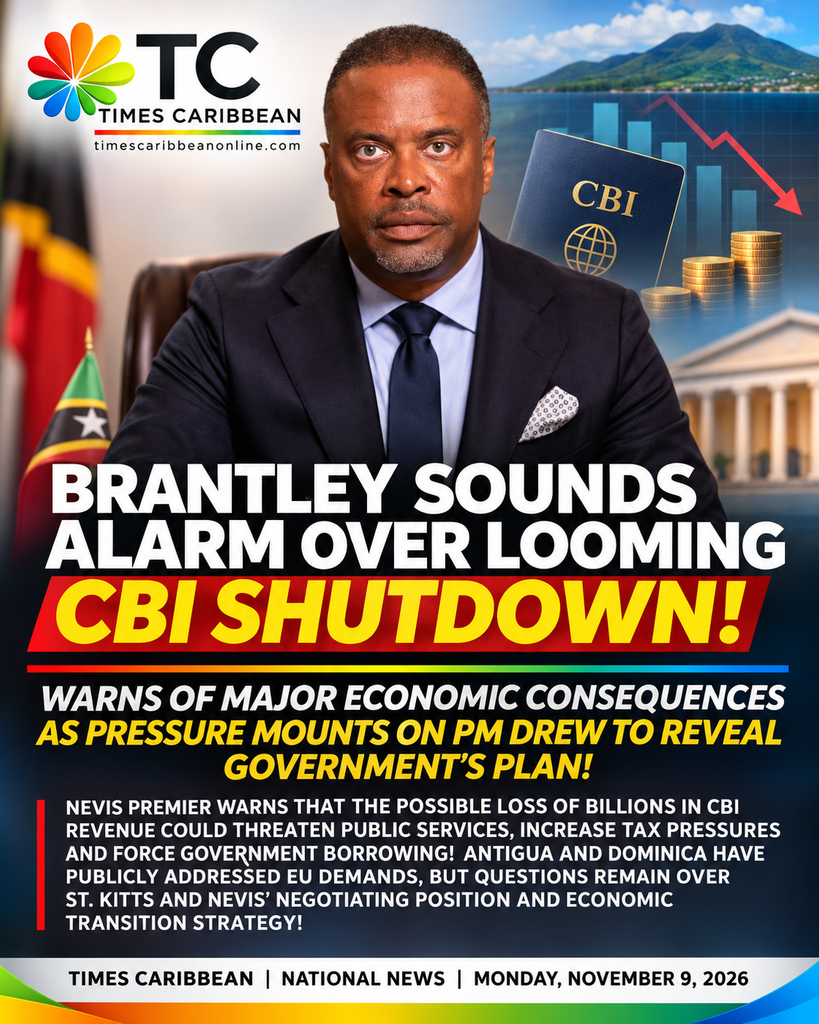
NEVIS PREMIER BRANTLEY SOUNDS ALARM OVER LOOMING CBI SHUTDOWN! WARNS OF MAJOR ECONOMIC CONSEQUENCES AS PRESSURE MOUNTS ON PM DREW TO REVEAL GOVERNMENT’S PLAN!
NEVIS PREMIER WARNS THAT THE POSSIBLE LOSS OF BILLIONS IN CBI REVENUE COULD THREATEN PUBLIC SERVICES, INCREASE TAX PRESSURES AND FORCE GOVERNMENT BORROWING! ANTIGUA AND DOMINICA HAVE PUBLICLY ADDRESSED EU DEMANDS, BUT QUESTIONS REMAIN OVER ST. KITTS AND NEVIS’ NEGOTIATING POSITION AND ECONOMIC TRANSITION STRATEGY!
BASSETERRE, ST. KITTS, November 9, 2026 (TIMES CARIBBEAN) — A potentially historic economic reckoning is approaching St. Kitts and Nevis, and Premier of Nevis and Federal Opposition Leader, Hon. Mark Brantley, is warning that the consequences of losing the country’s longstanding Citizenship by Investment (CBI) Programme could be felt in virtually every household across the Federation.
With the European Union pressing five Eastern Caribbean nations to phase out their investment citizenship programmes by June 2028, Brantley has raised serious questions about whether St. Kitts and Nevis is adequately prepared for the possible disappearance of one of its most important sources of government revenue.
And as neighbouring Antigua and Barbuda and Dominica publicly outline their engagements with European authorities, growing attention is turning towards Prime Minister Dr. Terrance Drew and the details of his administration’s negotiations.
The question is no longer simply whether CBI can survive. It is what happens to the national economy if it does not.
BRANTLEY: WE CAN SURVIVE — BUT AT WHAT PRICE?
Speaking during his October 27 press conference, Brantley acknowledged that St. Kitts and Nevis could exist without CBI revenue. But he cautioned that survival and maintaining the country’s present standard of living are two very different things.
“The answer is yes, you can always survive, but at what price?” Brantley declared.
He questioned whether citizens could continue enjoying the same level of government services, public assistance and economic benefits if a major source of non-tax revenue disappeared.
For decades, CBI proceeds have provided significant financial support to the Federation, helping successive administrations fund development projects and government obligations without relying entirely on taxation.
Brantley warned that eliminating this revenue source without a credible replacement could leave policymakers facing painful decisions.
Higher taxes. Greater borrowing. Increased pressure on public spending.
He also raised concerns about the possibility of renewed dependence on international lending institutions, recalling the Federation’s previous experience with debt restructuring and land-for-debt arrangements.
His warning was unmistakable: losing CBI without an effective economic transition could fundamentally change the relationship between government finances and ordinary citizens.
ANTIGUA AND DOMINICA SPEAK — WHERE IS ST. KITTS AND NEVIS’ DETAILED POSITION?
The contrast between regional governments has become an important dimension of the unfolding debate.
Antigua and Barbuda publicly acknowledged receiving formal correspondence from the European Commission in June requesting that its programme be phased out by June 1, 2028.
Prime Minister Gaston Browne has since discussed the proposed deadline and his government’s request for a longer transition period.
Dominica’s government issued a formal statement on October 28 outlining the EU’s position, the potential economic implications, and ongoing discussions about transitional financial and technical assistance.
Both governments have acknowledged the challenges associated with replacing revenue that has become deeply embedded in their national development strategies.
In St. Kitts and Nevis, Prime Minister Drew did address the CBI issue during his November 5 media roundtable, acknowledging the international pressures and outlining his government’s economic diversification objectives.
He said his administration was gathering additional information before issuing a further statement on its response.
However, the precise details of the Federation’s exchanges with the European Union, any requested concessions, and a comprehensive fiscal transition arrangement have not yet been publicly outlined.
That distinction matters.
With November 12 identified as an important deadline for regional responses to European authorities, citizens have legitimate reasons to seek a clearer explanation of their government’s position.
DREW SAYS GOVERNMENT HAS BEEN PREPARING
The Prime Minister has maintained that his administration recognised the risks associated with excessive dependence on CBI shortly after taking office in 2022.
During his November 5 roundtable, Drew stated that CBI accounted for almost 70 percent of the national budget when his administration assumed office.
He said the government was targeting a reduction to below 20 percent in 2026 and less than 10 percent in 2027, while pursuing economic diversification and exploring bridging finance.
Those figures represent the Prime Minister’s stated position and targets, rather than independently verified final outcomes.
Drew also raised concerns about possible financial blacklisting associated with investment citizenship programmes, describing the potential consequences as even more serious than restrictions on visa-free travel.
No confirmed financial-blacklisting decision against St. Kitts and Nevis was identified in the government’s statement.
The administration insists that its diversification agenda is intended to protect the Federation from precisely the type of economic disruption now being contemplated.
But Brantley’s concerns place the adequacy, timing and measurable results of those preparations under closer scrutiny.
FIVE YEARS, NOT TWO — BRANTLEY CALLS FOR MORE TIME
Brantley has advocated a stronger, coordinated regional negotiating position, urging governments to seek at least five years to adjust their economies rather than accept the proposed two-year transition.
He argued that countries deeply dependent on CBI receipts cannot simply replace such substantial revenue within a limited period without significant economic consequences.
The Premier also warned against underestimating the importance of European visa-free access.
Under revised EU rules, the operation of certain investor citizenship schemes can provide grounds for suspending visa-free travel privileges.
Such a development could affect ordinary passport holders, not merely individuals who obtained citizenship through investment.
For Brantley, that creates a difficult economic and diplomatic dilemma: preserve CBI revenue while risking important international travel privileges, or negotiate a responsible transition that protects both citizens and the economy.
He has also urged greater engagement with the Caribbean diaspora and existing economic citizens to attract sustainable investment that does not depend on continuously issuing new citizenships.
A NATIONAL ECONOMIC QUESTION THAT DEMANDS CLEAR ANSWERS
St. Kitts and Nevis now faces an issue whose implications extend far beyond the Citizenship by Investment Unit.
Government revenue, public investment, borrowing requirements, development projects and the financing of essential services could all be affected by the programme’s eventual discontinuation.
The European Union has communicated a proposed phase-out timetable, but a final, publicly confirmed closure arrangement for St. Kitts and Nevis has not been established.
Nevertheless, Brantley’s warning highlights the urgency of preparing for that possibility.
What revenue will replace CBI? How much financial support could be negotiated from international partners? What would happen to government expenditure? And what safeguards will protect ordinary Kittitians and Nevisians from additional economic pressures?
These are questions that deserve specific, measurable answers.
As regional negotiations approach another significant deadline, the Federation needs more than assurances that diversification is underway.
It needs clarity about the financial realities, the diplomatic options and the plans being developed to protect its economic future.
Brantley’s central question remains powerfully relevant:
“If not CBI, then what?”
And with the country’s economic future potentially facing one of its most consequential transitions in decades, the answer could shape life in St. Kitts and Nevis for generations.
TIMES CARIBBEAN — REGIONAL NEWS | NATIONAL DEVELOPMENT | ECONOMIC AFFAIRS
















Leave a comment
You must be logged in to post a comment.