U.S. VISA CRACKDOWN SENDS SHOCKWAVES THROUGH CARIBBEAN ENTERTAINMENT INDUSTRY
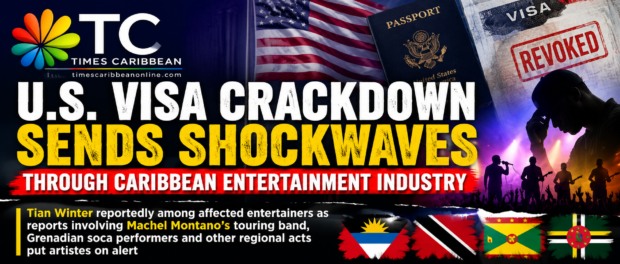
Tian Winter reportedly among affected entertainers as reports involving Machel Montano’s touring band, Grenadian soca performers and other regional acts put artistes on alert
A widening debate over U.S. visas and Caribbean entertainers is gripping the regional music industry, with reports of visa revocations, denials and increased scrutiny raising serious concerns for artistes, musicians, DJs and promoters who depend heavily on the American entertainment market.
And the full picture may never become public.
Under Section 222(f) of the U.S. Immigration and Nationality Act, individual visa records are generally confidential. That means the U.S. Department of State does not normally publish a comprehensive public list explaining whose visa has been denied or revoked and why.
As a result, much of what is known about individual Caribbean cases has emerged through regional media reports, statements or comments attributed to entertainers themselves, and information circulating within the entertainment industry.
Still, several cases have now attracted significant regional attention.
TIAN WINTER AMONG ANTIGUAN ENTERTAINERS REPORTEDLY AFFECTED
One of the most prominent names to emerge is Antiguan soca star Tian Winter.
WIC News reported in July that Winter was among several entertainers from Antigua and Barbuda whose U.S. visas had reportedly been revoked after they were summoned to the U.S. Embassy in Bridgetown, Barbados. The publication said authorities had not publicly disclosed the reasons behind the reported actions.
Other Antiguan entertainers were also reportedly affected, although their names have not been officially released.
There is an important qualification.
Antigua News Room subsequently reported that Winter appeared to question the report concerning his own visa status. With U.S. authorities providing no public details on the individual case, the precise circumstances surrounding Winter therefore remain unclear.
That distinction is important because a visa denial, cancellation or revocation can arise under different circumstances and should not automatically be interpreted as proof that an individual violated U.S. immigration law.
MACHEL MONTANO BAND VISA REPORTS ATTRACT ATTENTION
Trinidad and Tobago has also been pulled into the growing conversation.
A widely circulated social-media post attributes comments to soca superstar Machel Montano discussing visa difficulties involving members of his touring band, including reported revocations or denials that affected travel to the United States.
The individual band members and the specific immigration grounds involved have not been publicly detailed by U.S. authorities.
Montano himself continues to advertise several U.S. appearances on his official 2026 tour schedule, including dates in Boston, Houston and Brooklyn.
The distinction therefore matters: reports involving members of a touring ensemble should not be interpreted as meaning that the headline artiste himself has lost authorization to travel or perform in the United States.
GRENADIAN SOCA ARTISTES ALSO NAMED IN REPORTS
Reports circulating from Grenada have added another layer of concern.
Several Grenadian soca artistes have reportedly encountered visa problems amid allegations that some performers had previously undertaken performances in the United States while travelling on visitor visas rather than appropriate employment-related authorization.
However, those reports remain largely based on social-media and entertainment-industry accounts.
No authoritative public list naming the Grenadian artistes involved or officially confirming the circumstances of each case has been located.
Similar online claims have circulated involving Dominican bouyon performers, but these too should be treated as developing reports rather than established findings against any named artiste.
THE RULE ITSELF IS CLEAR
Whatever uncertainty exists over individual cases, the underlying U.S. immigration rule is considerably clearer.
The U.S. Department of State specifically lists employment and paid performances, or professional performances before a paying audience, among activities that are not permitted on ordinary visitor visas.
A B-1 business visa similarly does not generally authorize a visitor to enter the United States to perform skilled or unskilled employment.
Instead, U.S. immigration law provides dedicated categories for qualifying entertainers.
The P-1B classification, for example, applies to qualifying members of internationally recognized entertainment groups, while P-2 and P-3 categories cover certain artists and entertainers participating in approved exchange or culturally unique programmes. The O-1 category may apply to individuals who meet the required standard of extraordinary ability or achievement.
For Caribbean artistes accustomed to travelling regularly between island festivals and major diaspora events in cities such as New York, Miami, Boston, Washington and Atlanta, those distinctions are becoming increasingly important.
CARIBBEAN MUSIC HAS SEEN THIS BEFORE
The present anxiety also has historical precedent.
In 2010, several of Jamaica’s best-known dancehall performers were caught up in a major U.S. visa controversy.
Billboard reported at the time that the U.S. Embassy in Kingston initiated procedures involving the visas of performers including Beenie Man, Bounty Killer, Mavado and Aidonia.
Mavado and Beenie Man later regained access to the United States, demonstrating that visa circumstances can change and that a revocation does not necessarily amount to a permanent exclusion.
For today’s soca, bouyon, reggae and wider Caribbean entertainment industries, that history is suddenly relevant again.
A MAJOR WARNING FOR ARTISTES AND PROMOTERS
The United States remains one of the most commercially important markets for Caribbean music.
Miami Carnival, Labor Day celebrations, Caribbean festivals, club appearances and major diaspora concerts generate substantial opportunities for performers from across the region.
But the growing visa controversy is sending a strong message to management teams and promoters.
Having permission to visit the United States is not necessarily the same as having authorization to work or perform there.
Artistes and their representatives may increasingly have to make certain that the visa classification and immigration documentation being used correspond precisely with the activities planned during the trip.
And amid heightened U.S. immigration enforcement, relying on what may have happened without difficulty in previous years could carry significantly greater risk.
For now, the Caribbean entertainment industry is watching closely.
The reports are mounting. The scrutiny appears to be intensifying. And for regional artistes whose careers depend heavily on the U.S. market, getting the paperwork right has become more important than ever.
















Leave a comment
You must be logged in to post a comment.