CONCRETE, CONTRACTS AND CONTINUITY: TEAM UNITY’S IMPRESSIVE CAPITAL PROJECT RECORD COMPARED WITH THE DREW ADMINISTRATION
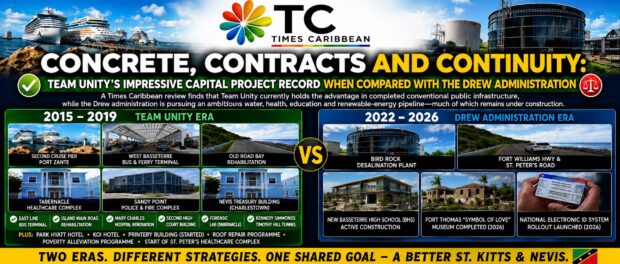
A Times Caribbean review finds that Team Unity currently holds the advantage in completed conventional public infrastructure, while the Drew administration is pursuing an ambitious water, health, education and renewable-energy pipeline—much of which remains under construction.
By Times Caribbean Editorial Desk
August 5, 2026
Buildings do not have party cards. Roads do not vote.
And when governments present their development records, the fairest measurement is not the number of announcements, ceremonies or architectural renderings. It is what was completed, what remains under construction, what was privately financed and what taxpayers actually received.
A Times Caribbean review of major projects pursued during the first Team Unity delivery period, broadly covering 2015 to 2020, and the St. Kitts-Nevis Labour Party administration of Prime Minister Dr. Terrance Drew from August 2022 to August 2026, reveals two noticeably different development models.
Team Unity concentrated heavily on ports, roads, public transportation facilities, community healthcare, security infrastructure and government buildings.
The Drew administration has placed greater emphasis on water security, climate-resilient healthcare, education, renewable energy and digital public infrastructure.
But there is an important distinction.
Team Unity’s strongest argument rests largely on projects that were physically completed and placed into use. The Drew administration’s strongest argument rests on two major completed projects and a broader portfolio that is still being built, mobilised or implemented.
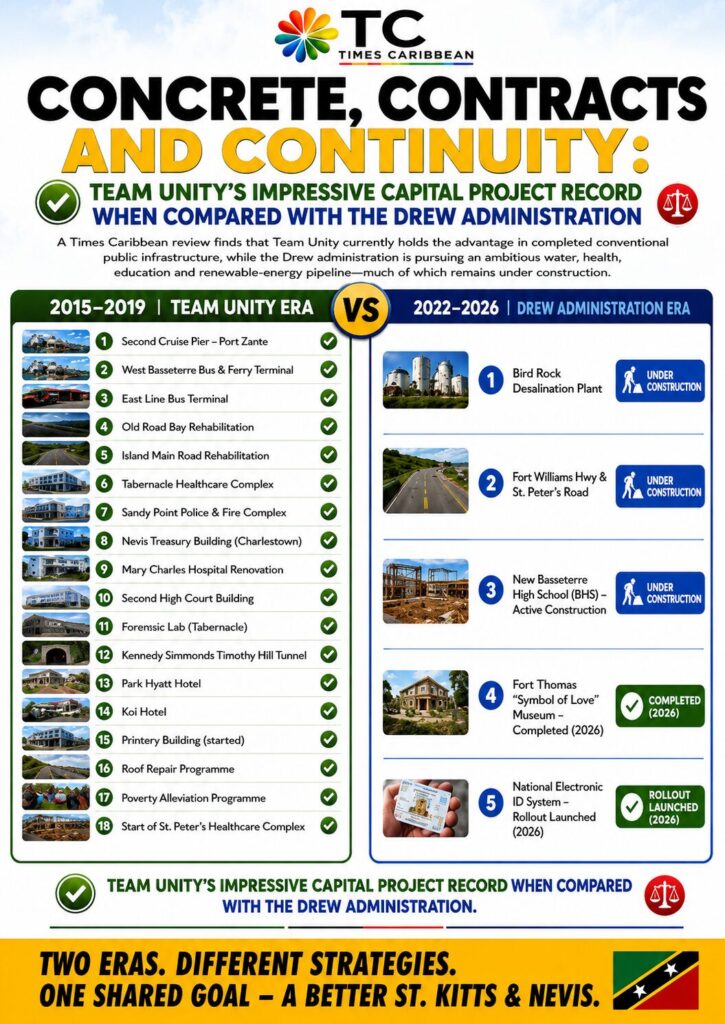
THE TEAM UNITY DELIVERY PERIOD
The most visible public capital project completed during the Team Unity period was the second cruise pier at Port Zante.
The approximately US$48 million, or EC$129 million, pier was completed in 2019. Financing reportedly included contributions from the St. Kitts-Nevis-Anguilla National Bank, the Social Security Board, the Sugar Industry Diversification Foundation and the private-sector TDC Group. It significantly expanded the Federation’s capacity to accommodate larger cruise vessels simultaneously.
That was a major delivery.
The administration also completed or substantially advanced several transportation projects.
The East Line Bus Terminal opened in December 2018, while the approximately EC$2.3 million West Line Bus Terminal was completed and opened in 2020. The Basseterre Ferry Terminal was also upgraded, improving the movement of passengers between St. Kitts and Nevis.
These were not glamorous megaprojects. But they were practical facilities used daily by commuters, bus operators and inter-island passengers.
Road rehabilitation was another central feature.
Phase One of the Island Main Road Rehabilitation Project, covering approximately 6.3 miles at a reported cost of around EC$21 million, was completed in February 2019. Phase Two, involving approximately 24 additional miles, began in May 2019 and continued beyond that year. Government estimates placed the wider road programme at roughly EC$69 million.
The Old Road Bay Rehabilitation Project also requires more careful accounting than is sometimes presented politically.
Official records placed its projected cost at approximately EC$31.8 million—not EC$15 million. Construction advanced during the Team Unity period and the relocated 1.2-kilometre roadway was nearing completion in 2021. It should therefore be treated as a Team Unity project whose delivery extended beyond the narrow 2015–2019 window.
COMMUNITY, SECURITY AND GOVERNMENT FACILITIES
Several smaller but important public facilities were also delivered.
The Tabernacle Health Centre, constructed at an estimated EC$2.4 million, provided expanded community healthcare services for residents across the north-eastern corridor of St. Kitts. The Mary Charles Hospital in Molineux was reconstructed and expanded, with additional services and equipment introduced.
The administration also completed the forensic laboratory in Tabernacle, expanded court facilities through a second High Court chamber and pursued the Sandy Point Police and Fire Complex. The Sandy Point facility, however, was completed later in the Team Unity period and should not be presented as a project finished by 2019.
In Nevis, the modern Treasury and Inland Revenue Department complex in Charlestown was officially opened in January 2020.
The facility cost approximately EC$11.2 million, with reported support of EC$6.5 million from the Sugar Industry Diversification Foundation. This was principally a Nevis Island Administration project, delivered during the period when the Concerned Citizens Movement was part of the federal Team Unity coalition.
Construction of a new Government Printery building also began in 2019. However, projects that were merely started should not be counted alongside completed assets.
The same applies to the St. Peter’s Health Centre. Construction began under Team Unity, but the unfinished facility remained on the federal capital programme years later, with remobilisation included among the government’s 2026 priorities.
PRIVATE INVESTMENT IS NOT PUBLIC CAPITAL SPENDING
Team Unity supporters frequently include the Park Hyatt St. Kitts and KOI Resort among the administration’s major achievements.
Both were significant tourism investments. But both were privately financed hotels—not taxpayer-funded public infrastructure.
Park Hyatt construction began in February 2014, before Team Unity entered office, and the hotel opened in November 2017. Team Unity can reasonably claim credit for facilitating its completion and opening, but not for originating the development.
KOI Resort opened in February 2020 with approximately 102 rooms. It strengthened the Federation’s accommodation inventory, but it should be listed separately as private-sector investment completed during the Team Unity era.
The Timothy Hill tunnel presents a similar question of continuity. It opened in May 2016 following years of planning and construction that crossed administrations. The government in office at completion deserves recognition, but major national projects often belong to more than one political period.
And that matters.
A responsible comparison must distinguish between conceiving a project, financing it, starting it and finally opening it.
SOCIAL PROGRAMMES SHOULD NOT BE COUNTED AS CAPITAL PROJECTS
The Poverty Alleviation Programme and the post-hurricane roof repair initiative were major social interventions.
The roof programme reportedly assisted more than 2,000 households, while the Poverty Alleviation Programme provided monthly financial support to qualifying families.
But neither programme created a permanent public capital asset in the traditional sense. They should be evaluated as social-protection programmes, not added to a list of roads, hospitals, ports and government buildings.
Mixing recurrent social spending with capital construction can inflate a government’s project record and make comparisons unreliable.
THE DREW ADMINISTRATION: WATER AND ROADS LEAD THE COMPLETED RECORD
The Drew administration’s strongest completed capital achievement is arguably the Bird Rock Desalination Plant.
The EC$50 million facility was designed to produce approximately two million gallons of potable water daily. Construction began following a July 2024 groundbreaking and the plant was commissioned in February 2026. It has been presented as a central component of the government’s response to persistent water shortages affecting Basseterre and surrounding communities.
This is a major public asset. It directly addresses one of the country’s most pressing quality-of-life and economic-development challenges.
The second clearly completed flagship project is the rehabilitation of the F.T. Williams Highway East and the St. Peter’s Main Road.
The approximately EC$31 million project was officially opened in November 2025. It included road resurfacing, drainage improvements, pedestrian infrastructure and upgrades along one of the most heavily travelled corridors in St. Kitts.
These two projects give the Drew administration tangible completed assets on which it can stand.
But several other projects regularly promoted as part of its record remain unfinished.
BASSETERRE HIGH SCHOOL: ACTIVE CONSTRUCTION, NOT YET A COMPLETED ASSET
Construction of the new Basseterre High School began in June 2025 at the historic Victoria Road campus.
By July 2026, official updates reported significant progress on the climate-resilient, modern school complex. The project is now beyond the announcement stage. Work is visibly taking place.
Still, the school is not yet complete.
Its history also crosses administrations. Team Unity pursued an earlier Basseterre High School project at a different location. The National Audit Office recorded approximately EC$11 million in project-management fees paid during 2021, but no completed school emerged from that phase. The Drew administration later changed the site and restarted the project.
For the current government, the political test will be straightforward: complete the campus, keep it within an accountable budget and place students inside it.
Until then, it remains an active construction project rather than a completed achievement.
THE NEW JNF GENERAL HOSPITAL
The proposed new Joseph N. France General Hospital is potentially the most consequential federal capital project of the Drew era.
Designs for a climate-smart hospital were publicly unveiled in February 2025. The project site was formally handed over in December 2025, with construction activity expected to advance during 2026 through cooperation involving the Government of St. Kitts and Nevis, Taiwan and the Overseas Engineering and Construction Company.
The hospital is important. Few would dispute that.
But it is not yet open. It should therefore be described as a major project under construction, not as healthcare infrastructure already delivered to the public.
Modernisation at the existing JNF General Hospital—including CT and MRI services, building repairs and equipment upgrades—can be credited separately as health-system improvements.
NEVIS GEOTHERMAL AND AIRPORT PROJECTS REQUIRE PROPER CREDIT
Two of the largest projects frequently associated with the 2022–2026 national development period are the Nevis geothermal project and the expansion of the Vance W. Amory International Airport.
However, both are led primarily by the Nevis Island Administration under Premier Mark Brantley and the Concerned Citizens Movement. They should not be presented solely as achievements of the federal SKNLP administration.
In May 2026, the Nevis Island Administration announced the signing of a drilling contract covering up to two production wells and one injection well for the geothermal programme. International support associated with the wider initiative has been placed at approximately US$71.6 million, with drilling expected to begin around September 2026 and electricity generation targeted for a later stage.
That means the project is significant and well advanced institutionally. But as of August 5, 2026, the geothermal plant is not yet producing electricity.
The Vance W. Amory International Airport expansion officially broke ground on July 2, 2026. Plans include extending the runway to approximately 5,500 feet and constructing or upgrading the terminal, fire hall, fuel farm and other aviation facilities. It remains an early-stage construction project.
Federal cooperation deserves acknowledgement where it exists. Political ownership, however, must remain accurate.
FORT THOMAS AND THE ELECTRONIC ID SYSTEM
The Fort Thomas “Symbol of Love” development is another project that has sometimes been incorrectly listed as completed.
The approximately US$30 million heritage and tourism development is a private foreign investment. Groundbreaking took place in October 2025, but the project remains under development. It is neither completed nor a conventional government-funded capital project.
The National Electronic Identification System represents a different kind of infrastructure.
Government plans targeted the issuance of thousands of electronic identification cards during 2026 as part of a wider digital-governance programme. This can reasonably be classified as digital public infrastructure, but it should not be confused with a completed road, school or hospital.
THE HEAD-TO-HEAD VERDICT
On the evidence available as of August 5, 2026, Team Unity has the stronger record in terms of the number and variety of completed conventional public capital projects.
The second cruise pier, transportation terminals, community health facilities, government buildings, court and security facilities and substantial road works created a broad inventory of physical assets that were completed or placed into service during its governing period.
Some projects crossed administrations. Some were NIA-led. Some private hotels have also been incorrectly blended into the public-project list.
But even after those adjustments, the completed record remains substantial.
The Drew administration has delivered two particularly important projects: the Bird Rock Desalination Plant and the F.T. Williams Highway East–St. Peter’s Main Road rehabilitation.
Its wider programme may eventually prove transformational. A completed Basseterre High School, a new national hospital, reliable water production, electronic identification and renewable-energy infrastructure would represent a major national shift.
But “would” is doing important work in that sentence.
The school is under construction. The new hospital is under construction. The geothermal project is approaching drilling. The Nevis airport expansion has only recently broken ground. The Fort Thomas development remains a private project in progress.
TWO DIFFERENT ERAS
Team Unity’s development model was more visible and conventional: build the pier, repair the road, open the terminal, construct the public facility.
The Drew administration’s model is more systems-oriented: secure water, modernise healthcare, rebuild education infrastructure, digitise government and transition toward renewable energy.
That is a legitimate strategic difference.
But strategies must eventually become functioning assets.
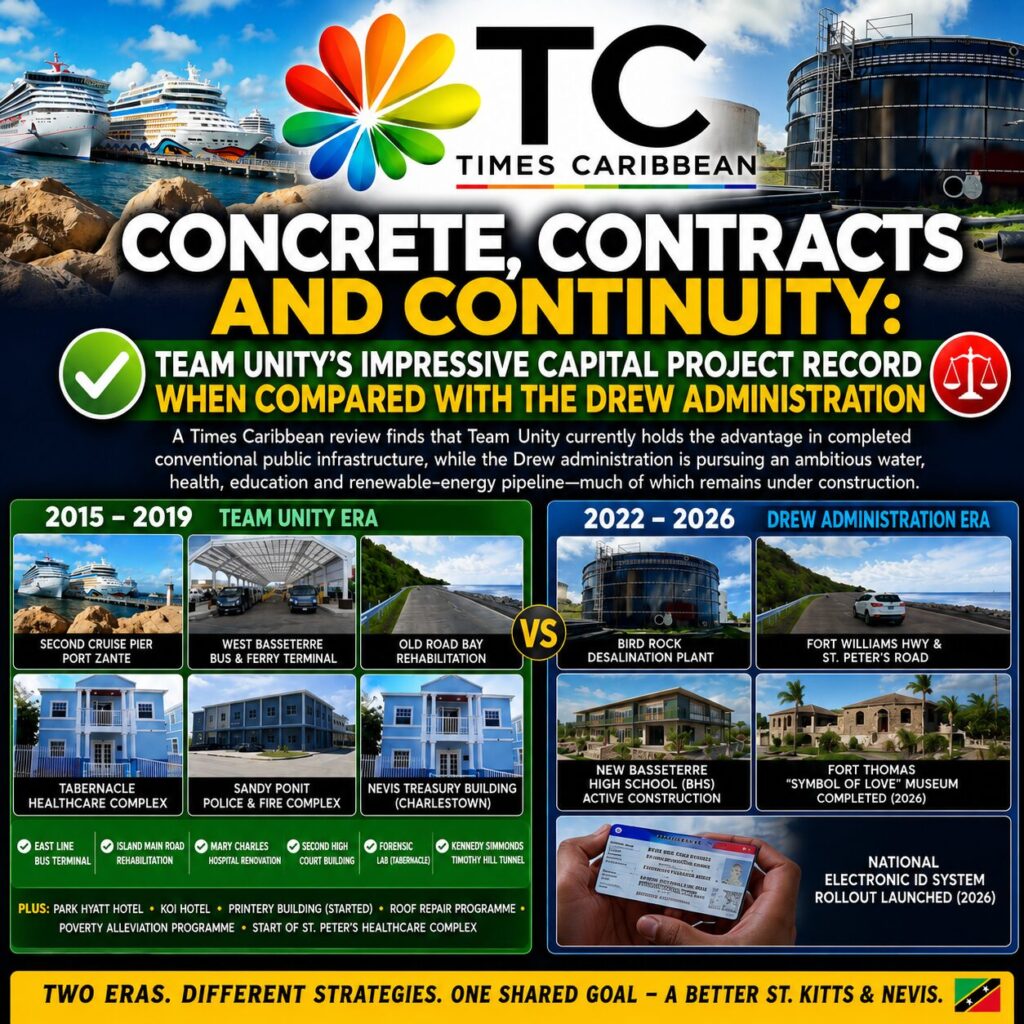
The fairest conclusion is therefore clear: Team Unity currently leads on completed public capital infrastructure, while the Drew administration possesses an ambitious and potentially consequential project pipeline that has not yet been fully converted into completed national assets.
That assessment could change as projects open.
For now, the record should be presented honestly.
Private investment is not government construction. A groundbreaking is not a completion. A social programme is not a capital asset. And a project led by the Nevis Island Administration should not be claimed exclusively by whichever party controls the Federal Government.
Renderings attract attention.
Completed projects build a country.
















Leave a comment
You must be logged in to post a comment.