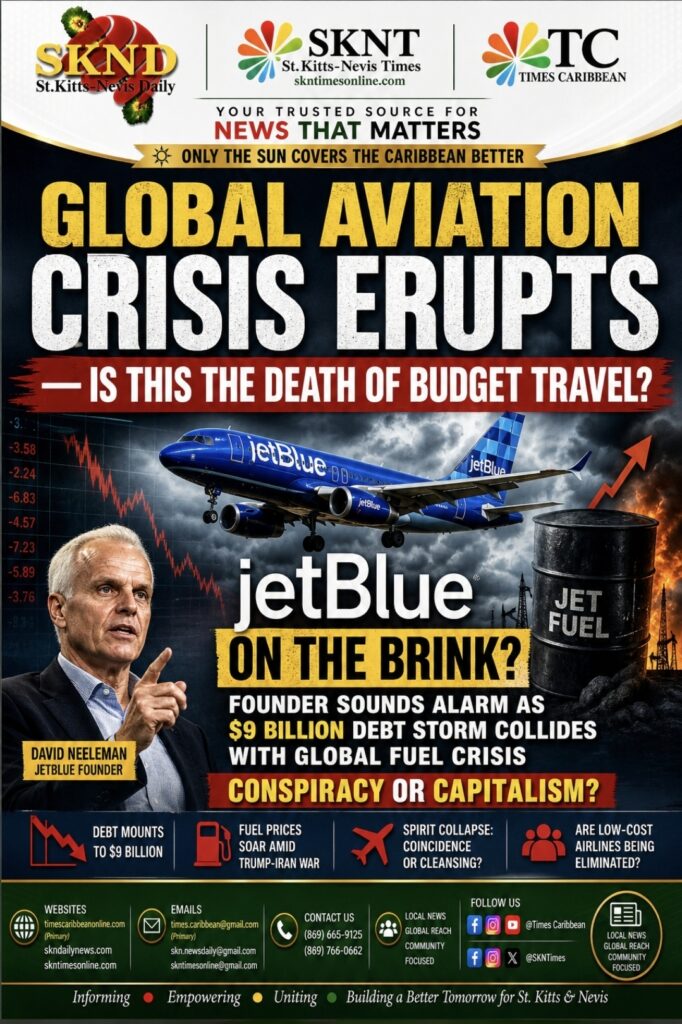
GLOBAL AVIATION CRISIS ERUPTS — IS THIS THE DEATH OF BUDGET TRAVEL?JETBLUE ON THE BRINK? FOUNDER SOUNDS ALARM AS $9 BILLION DEBT STORM COLLIDES WITH GLOBAL FUEL CRISIS — CONSPIRACY OR CAPITALISM?
TIMES CARIBBEAN | SKN TIMES | ST. KITTS-NEVIS DAILY
✈️ GLOBAL AVIATION CRISIS ERUPTS — IS THIS THE DEATH OF BUDGET TRAVEL?
JETBLUE ON THE BRINK? FOUNDER SOUNDS ALARM AS $9 BILLION DEBT STORM COLLIDES WITH GLOBAL FUEL CRISIS — CONSPIRACY OR CAPITALISM?
BASSETERRE / NEW YORK / GLOBAL AVIATION DESK — A seismic shockwave is rippling across the global airline industry tonight as David Neeleman, founder of JetBlue Airways, has issued a chilling warning: the airline could be heading toward bankruptcy as early as 2026.
But beneath the headline lies a far deeper—and more unsettling—question:
Is this merely economic collapse… or the calculated dismantling of low-cost aviation as we know it?
THE NUMBERS BEHIND THE PANIC: A FINANCIAL CLIFF EDGE
Neeleman’s assessment is not vague speculation—it is rooted in brutal financial projections:
- Projected losses of up to $1.3 billion in 2026
- Debt potentially surging to $9 billion
- Interest payments climbing toward $800 million annually
At the heart of the crisis?
Jet fuel.
With prices reportedly spiking toward $4.50 per gallon, the cost structure of airlines—especially low-cost carriers—has been fundamentally destabilized.
And this is not happening in isolation.
THE GEOPOLITICAL TRIGGER: FUEL SHOCK FROM GLOBAL CONFLICT
The aviation industry is now caught in the crosshairs of a broader geopolitical crisis. The ongoing Iran-related conflict has disrupted global oil flows and nearly doubled jet fuel costs, delivering what analysts describe as the largest shock to airlines since COVID-19.
Fuel alone typically accounts for roughly a quarter of airline operating costs—meaning even modest increases can devastate margins.
For airlines like JetBlue—operating on thinner margins than legacy giants—the impact is existential.
FOUNDER VS CEO: A HOUSE DIVIDED
In a dramatic twist, JetBlue’s current leadership is pushing back.
CEO Joanna Geraghty has publicly insisted:
- The airline is NOT considering bankruptcy in 2026
- It maintains strong liquidity and access to financing
But insiders and analysts are not fully reassured.
Geraghty herself admitted the environment is “more challenging than expected”, especially due to fuel costs.
Translation?
The storm is real—even if the collapse is being denied.
SPIRIT COLLAPSES — COINCIDENCE OR CONSOLIDATION?
Now comes the most explosive development.
With reports of low-cost rival Spirit Airlines collapsing or on the brink, the industry is entering a dangerous phase of forced consolidation.
Analysts have long warned:
- Smaller carriers face disproportionate risk in fuel shocks
- Larger airlines have deeper reserves and pricing power
- Financial pressure could eliminate budget competitors entirely
Neeleman himself revealed that major carriers are unwilling to acquire JetBlue due to its debt burden, leaving bankruptcy or restructuring as the only realistic paths.
THE BIG QUESTION: IS THIS A “CLEANOUT” OF LOW-COST AIRLINES?
Let’s be clear—there is no confirmed evidence of a coordinated plan to eliminate budget airlines.
But the pattern is raising eyebrows:
- Fuel shocks disproportionately hurting low-cost carriers
- Regulatory barriers blocking mergers (e.g., past JetBlue–Spirit deal)
- Major airlines positioned to dominate if smaller rivals collapse
The result?
A natural consolidation that could look—to the average traveler—like a systematic purge.
WHAT THIS MEANS FOR THE CARIBBEAN
For the Caribbean, the stakes are enormous.
Low-cost airlines like JetBlue and Spirit have been:
- Critical lifelines for affordable travel
- Key drivers of tourism flows
- Essential connectors for diaspora communities
If these carriers weaken or disappear:
- Airfares could skyrocket
- Tourism-dependent economies could take a hit
- Regional mobility could become a luxury, not a right
FINAL ANALYSIS: COLLAPSE, OR RESET?
JetBlue is not bankrupt—yet.
But the warning signs are flashing red:
- Mounting debt
- Surging fuel costs
- Weak acquisition prospects
- Industry-wide consolidation pressures
What we may be witnessing is not just one airline’s struggle—
but a structural shift in global aviation economics.
And if the low-cost model falls… the entire travel landscape changes.
BOTTOM LINE
This is bigger than JetBlue.
This is about who controls the skies in the next decade.
And tonight, one thing is clear:
**The era of cheap travel is under serious threat.**
















Leave a comment
You must be logged in to post a comment.