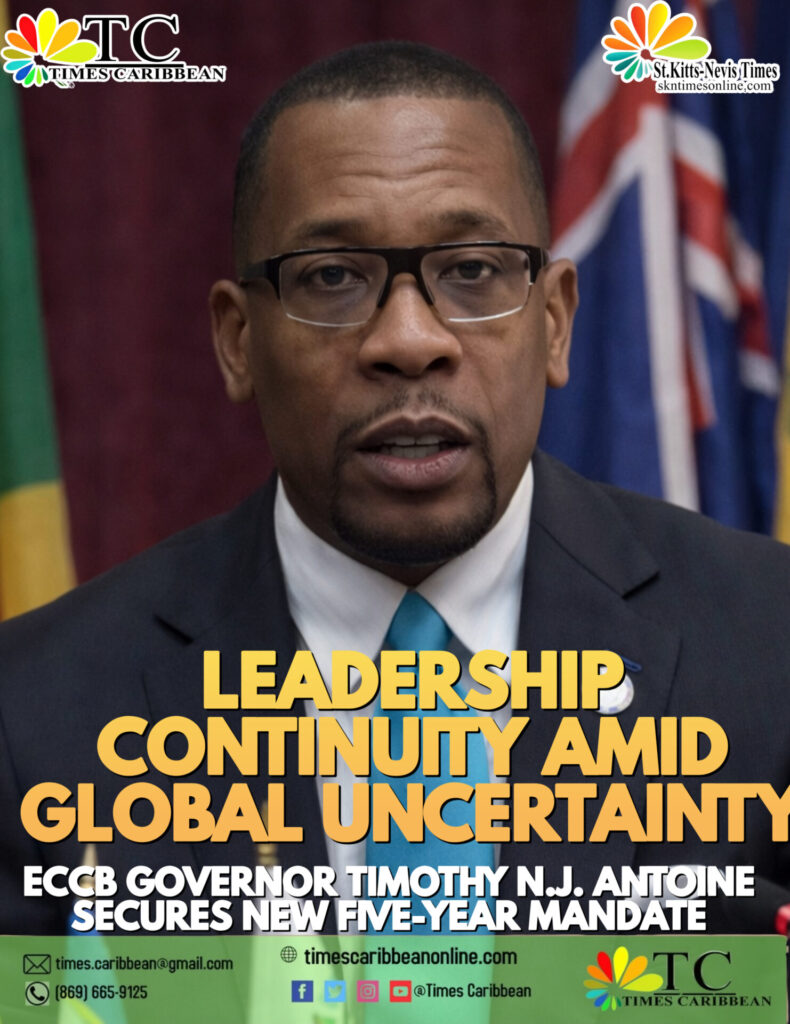
LEADERSHIP CONTINUITY AMID GLOBAL UNCERTAINTY: ECCB GOVERNOR TIMOTHY N.J. ANTOINE SECURES NEW FIVE-YEAR MANDATE

By Times Caribbean News Desk
In a decisive move that signals stability at the heart of the Eastern Caribbean’s financial system, the Monetary Council of the Eastern Caribbean Central Bank (ECCB) has confirmed the re-appointment of Mr. Timothy N.J. Antoine as Governor for another five-year term, effective 1 February 2026.
The announcement, made following the 112th Meeting of the Monetary Council, places “Leadership Continuity and Institutional Stability” at the forefront of regional economic strategy — a clear message that, in uncertain global times, steady stewardship matters.
A Strategic Vote of Confidence
The Council’s communique underscored the urgency of coordinated and bold policy action as small island states navigate rising global interest rates, climate vulnerability, debt pressures, and shifting trade dynamics.
By renewing Antoine’s contract, the Council has effectively delivered a vote of confidence in his leadership during a period marked by pandemic recovery, financial sector reform, digital transformation, and climate-risk advocacy.
For the eight member countries of the Eastern Caribbean Currency Union (ECCU), the decision is more than procedural. It is strategic.
Why Continuity Matters Now
The Eastern Caribbean operates one of the world’s longest-standing currency unions among small states. Stability of the EC dollar — long pegged to the US dollar — remains foundational to investor confidence and economic predictability.
In this environment, leadership changes at the central bank could introduce uncertainty. Instead, the Monetary Council opted for continuity — signaling that policy direction will remain steady as the region pursues:
- Financial system resilience
- Sustainable debt management
- Economic diversification
- Climate adaptation financing
- Digital payment modernization
The Council emphasized that durable growth and resilience require synchronized regional action — and such coordination depends heavily on stable institutional leadership.
The Bigger Picture
Antoine’s renewed mandate comes at a pivotal juncture. Global economic fragmentation, geopolitical tensions, climate shocks, and energy price volatility continue to test small island economies disproportionately.
The ECCB has increasingly positioned itself not merely as a regulator of liquidity and banking supervision, but as a policy advocate for resilience-building, financial inclusion, and digital innovation.
Leadership continuity, therefore, is not symbolic — it is functional.
A Region Watching Closely
For governments, investors, commercial banks, and citizens across the ECCU, this renewal removes speculation and affirms policy steadiness. It also raises expectations: with continuity comes accountability for delivery.
As the region pursues “bold and coordinated policy action,” the coming five years will likely define the next phase of Eastern Caribbean financial modernization and economic restructuring.
One thing is now certain: the Monetary Council has chosen consistency over experimentation.
And in volatile times, consistency can be a powerful signal of strength.
















Leave a comment
You must be logged in to post a comment.