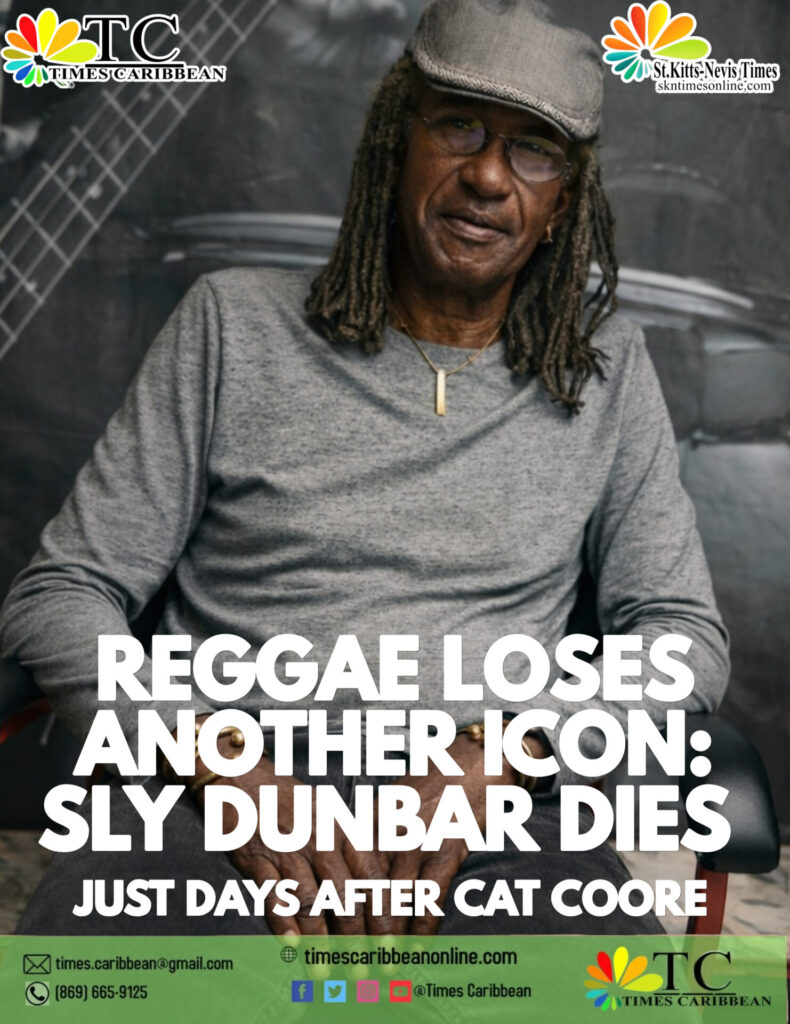
REGGAE LOSES ANOTHER ICON: SLY DUNBAR DIES JUST DAYS AFTER CAT COORE

TIMES CARIBBEAN | ANALYSIS
The drumbeat that helped carry reggae, dancehall, and Caribbean music onto the world stage has fallen silent.
Lowell Fillmore Sly Dunbar, the drummer extraordinaire, producer, and co-founder of the revolutionary Taxi Records label, has died at age 73—just days after the Caribbean mourned the loss of another cultural giant, Cat Coore. The timing is cruel, the symbolism heavy: two pillars of reggae’s global architecture gone within the same week.
Sly’s wife, Thelma Dunbar, confirmed to The Gleaner that he passed away at home early this morning.
“About 7 o’clock this morning I went to wake him up and he wasn’t responding. I called the doctor and that was the news,” she said, her voice breaking under the weight of loss.
It was a quiet exit for a man whose rhythms once thundered across continents.
THE MAN WHO REDEFINED THE DRUMS
To call Sly Dunbar a drummer is to understate his impact. He was a sonic architect—an innovator who reshaped Caribbean music from the inside out. Alongside the late Robbie Shakespeare, Sly formed the legendary rhythm section Sly & Robbie, arguably the most recorded and influential duo in modern music history.
Sly did not simply keep time—he changed it. He fused traditional reggae patterns with funk, R&B, jazz, electronic textures, and futuristic studio experimentation. In doing so, he dragged reggae out of predictability and into perpetual reinvention.
From roots reggae to dub, from dancehall to pop, Sly’s fingerprints are everywhere:
- Bob Marley & The Wailers
- Peter Tosh
- Grace Jones
- Black Uhuru
- Dennis Brown
- Jimmy Cliff
- International pop, hip-hop, and rock productions that borrowed Jamaican rhythm as global currency
His drum patterns were not background elements—they were lead characters.
TAXI RECORDS: A CULTURAL POWERHOUSE
Through Taxi Records, Sly helped build more than a label; he built a movement. Taxi was fearless, experimental, and commercially savvy, balancing street credibility with international reach. It gave voice to new sounds while preserving reggae’s rebellious soul.
Taxi Records helped usher in the digital dancehall era while maintaining roots integrity—no easy feat in a genre constantly wrestling with tradition versus innovation. That balance is part of Sly Dunbar’s enduring genius.
A WEEK OF MOURNING FOR REGGAE
The death of Sly Dunbar coming so soon after Cat Coore’s passing feels less like coincidence and more like a cultural reckoning. Cat Coore gave reggae its melodic conscience and spiritual depth through Third World. Sly Dunbar gave it its pulse, its muscle, its forward momentum.
Together—though often in different spaces—they helped ensure reggae was not frozen in time, but alive, adaptive, and global.
THE SILENCE AFTER THE RHYTHM
Sly Dunbar’s passing leaves an enormous void—not just in Jamaica, but across the entire Caribbean and the global Black diaspora. His work scored protests, parties, revolutions, love songs, and spiritual awakenings. His rhythms outlived trends and outpaced borders.
Reggae today exists as a global language because of architects like Sly Dunbar—men who understood that culture must move, evolve, and challenge itself to survive.
Now, the drums are quiet.
But the rhythm?
The rhythm will never die.
— 30 —
















Leave a comment
You must be logged in to post a comment.