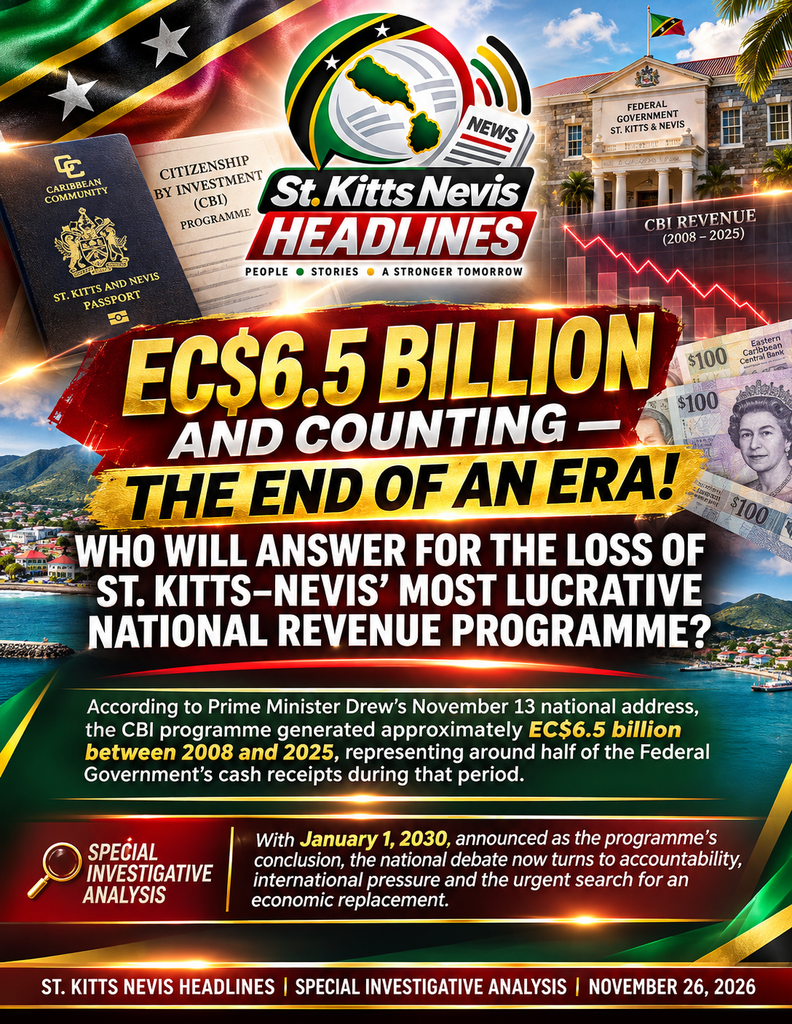
EC$6.5 BILLION AND COUNTING — THE END OF AN ERA! WHO WILL ANSWER FOR THE LOSS OF ST. KITTS–NEVIS’ MOST LUCRATIVE NATIONAL REVENUE PROGRAMME?

CBI generated approximately half of Federal Government cash receipts between 2008 and 2025 — yet serious questions remain about the negotiations, political narratives and economic strategy surrounding its announced closure.
ST. KITTS NEVIS HEADLINES | SPECIAL INVESTIGATIVE ANALYSIS | NOVEMBER 26, 2026
BASSETERRE, ST. KITTS — Six billion, five hundred million dollars.
That is the staggering amount of revenue generated by the St. Kitts and Nevis Citizenship by Investment (CBI) Programme between 2008 and 2025, according to figures presented by Prime Minister Dr. Terrance Drew during his November 13 national address.
Approximately half of the Federal Government’s cash receipts during that period came from citizenship-related revenue.
Now, with January 1, 2030, identified as the scheduled conclusion of the historic programme, the Federation faces one of the most consequential economic transitions since independence.
And the questions are mounting.
FROM BILLIONS IN REVENUE TO A COUNTDOWN TO CLOSURE
Established in 1984, the CBI Programme became a cornerstone of the Federation’s economic transformation, supporting national development across successive political administrations.
From public infrastructure and road rehabilitation to housing, tourism investment, social assistance, income support and government operations, citizenship-related revenue helped reshape the economic landscape of St. Kitts and Nevis.
The impending closure raises an unavoidable question:
What will replace the billions?
Citizens deserve more than assurances about economic diversification. They deserve a comprehensive, costed and credible national economic transition plan that explains how public services, employment, infrastructure development and social programmes will be sustained without the historic revenue stream.
THE PRISON PROJECT NARRATIVE: EU DOCUMENTS TELL A MUCH BIGGER STORY
Attempts to associate the European Union’s position primarily with the controversial prison development project deserve closer examination.
Official European Commission documents confirm that Brussels had been engaging all five Eastern Caribbean countries operating CBI programmes since 2020.
Those countries are St. Kitts and Nevis, Antigua and Barbuda, Dominica, Grenada and Saint Lucia. EUR-Lex+1
The European Union’s concerns were regional and international in scope, encompassing citizenship eligibility, security screening, investment requirements and the implications of granting citizenship to applicants without meaningful connections to the issuing country.
More significantly, the European Commission’s 2025 report confirms that operating such citizenship programmes can itself constitute grounds for suspending visa-free travel under the revised European framework. EUR-Lex
That distinction matters.
Vanuatu lost its European visa-free privileges following concerns over its citizenship programme. Malta’s investor citizenship arrangements were also successfully challenged before the European Court of Justice in April 2025. Neither case depended on the St. Kitts prison development project. European Parliament+1
The documentary evidence points towards a fundamental international policy shift, rather than a response exclusively to one development project in St. Kitts.
EIGHT KEY INVESTIGATIVE FINDINGS
An examination of official European documents and government statements highlights eight important findings:
- European Commission engagement with Eastern Caribbean CBI jurisdictions dates back to 2020.
- Revised European visa suspension provisions target investor citizenship programmes themselves.
- All five Eastern Caribbean CBI jurisdictions have faced similar European policy concerns.
- Malta and Vanuatu encountered European opposition independently of developments in St. Kitts and Nevis.
- Increasing investment thresholds and strengthening due diligence did not eliminate Europe’s broader policy objections.
- None of the European documents reviewed establishes the St. Kitts prison project as the determining cause of the regional phaseout position.
- The number of prison-project citizenship approvals issued under successive administrations remains a legitimate subject for public disclosure and independent scrutiny.
- Domestic regulatory reforms, however beneficial, do not necessarily resolve Europe’s fundamental opposition to transactional citizenship.
EC$6.5 BILLION: THE ENORMOUS ECONOMIC CHALLENGE AHEAD
CBI contribution to Federal Government cash receipts, 2008–2025
EC$6.5 billion
CBI revenueApproximately 50%
Other government receiptsApproximately 50%
Revenue period
18 years
Scheduled programme closure
January 1, 2030
Source: Prime Minister’s November 13 national address and November 26 SKNIS announcement.
The magnitude of the historical contribution cannot be overstated.
While annual CBI receipts have fluctuated significantly, the programme provided successive governments with considerable financial flexibility to undertake development projects and respond to national emergencies.
Its scheduled closure raises questions about future government expenditure, taxation, borrowing, employment, investment and the sustainability of existing social assistance programmes.
The Drew administration has outlined economic diversification, renewable energy, foreign direct investment and workforce development as components of its transition strategy. The Prime Minister has also acknowledged the dangers of excessive dependence on CBI revenue.
But the public deserves detailed financial projections showing when these alternative industries will generate meaningful government revenue and how much they are realistically expected to contribute.
A development vision must be accompanied by measurable economic targets.
THE COUNTDOWN TO JANUARY 2030
The Prime Minister’s Office officially announced on November 26, 2026, that an agreement had been reached with the European Union establishing the following transition timetable:
| Date | Programme milestone |
|---|---|
| January 31, 2029 | Final day for new CBI applications |
| December 31, 2029 | Conclusion of all application processing |
| January 1, 2030 | Scheduled permanent programme closure |
The government maintains that the negotiated arrangement protects the Federation’s international reputation, banking relationships and European visa-free travel privileges while allowing time for economic diversification. SKNIS
THE NATION DESERVES ANSWERS, NOT POLITICAL NARRATIVES
With EC$6.5 billion in historical revenue at the centre of this national discussion, several fundamental questions demand answers.
- Could a stronger, unified Caribbean negotiating position have secured a different outcome?
- What alternatives to permanent closure were formally presented?
- What specific financial assistance has Europe committed to supporting the economic transition?
- How many citizenship approvals associated with the prison project were issued before and after August 2022?
- What is the government’s projected revenue shortfall after 2029?
- Can existing social programmes be sustained without additional taxation or borrowing?
- Where is the comprehensive, independently assessable economic transition plan?
These are not merely political questions.
They concern the economic security of every Kittitian and Nevisian.
THE VERDICT: ONE LOCAL PROJECT CANNOT EXPLAIN AN ENTIRE GLOBAL POLICY SHIFT
The prison development project deserves independent scrutiny. Any substantiated administrative or regulatory shortcomings should be addressed, regardless of which administration was responsible.
But investigating a controversial development project and explaining the international policy changes threatening an entire regional industry are two fundamentally different matters.
The publicly available European documents reviewed do not establish the prison project as the decisive cause of the European Union’s regional CBI phaseout position. The precise number of citizenship approvals associated with that project also remains independently unverified.
Accountability must extend across successive administrations. So must recognition of the programme’s enormous contribution to national development.
EC$6.5 BILLION. A 42-YEAR NATIONAL LEGACY. AN ENTIRE ECONOMIC MODEL FACING TRANSFORMATION.
St. Kitts and Nevis cannot afford to substitute political blame for economic planning.
The country needs transparency. It needs accountability. Above all, it needs a credible roadmap for life after CBI.
The countdown has begun. The question is whether the Federation will be economically ready when January 1, 2030, arrives.
Official documentary sources:
- Prime Minister Drew’s November 13, 2026 National Address
- SKNIS – November 26, 2026 CBI Wind-Down Announcement
- European Commission – Sixth Visa Suspension Mechanism Report, 2023
- European Commission – 2025 Visa Suspension Mechanism Report
- European Court of Justice – Commission v Malta, April 2025
#StKittsNevisHeadlines #CBI #NationalAccountability #EconomicFuture #StKittsNevis #InvestigativeJournalism #EuropeanUnion
















Leave a comment
You must be logged in to post a comment.