ECCB UPDATE SOUNDS FISCAL ALARM FOR ST. KITTS AND NEVIS: EC$405M DEFICIT, WEAK TAX COLLECTIONS, SPENDING OVERRUNS AND DEBT RISKS EXPOSE GOVERNMENT’S FISCAL CHALLENGE
TIMES CARIBBEAN FEATURE | ECONOMIC ANALYSIS
BASSETERRE, ST. KITTS — St. Kitts and Nevis grew in 2025. Tourism strengthened. Construction remained active. More than one million visitors arrived. Inflation was comparatively low.
But beneath those positive headlines, the Eastern Caribbean Central Bank’s latest Economic and Financial Review 2025 Update paints a considerably more troubling picture of the Federal Government’s finances.
The central message is difficult to miss.
Government revenue weakened. Tax collection underperformed. Capital spending overshot both forecasts and the approved budget. The fiscal deficit expanded dramatically. Government drew heavily on domestic financial resources, and the country’s debt trajectory is now moving in the wrong direction unless corrective action is taken.
The ECCB itself describes the situation in unusually direct terms, saying fiscal pressures “intensified” as declining revenue and higher capital expenditure widened the deficit, and calling for urgent revenue mobilisation, fiscal realignment and medium-term consolidation.
The report does not allege wrongdoing by the Government. But the numbers raise serious questions about budget planning, expenditure control, revenue policy and whether fiscal policy adjusted quickly enough to the collapse in Citizenship by Investment revenue.
And that may be the biggest takeaway of all.
THE ECONOMY GREW — BUT MUCH LESS THAN FIRST EXPECTED
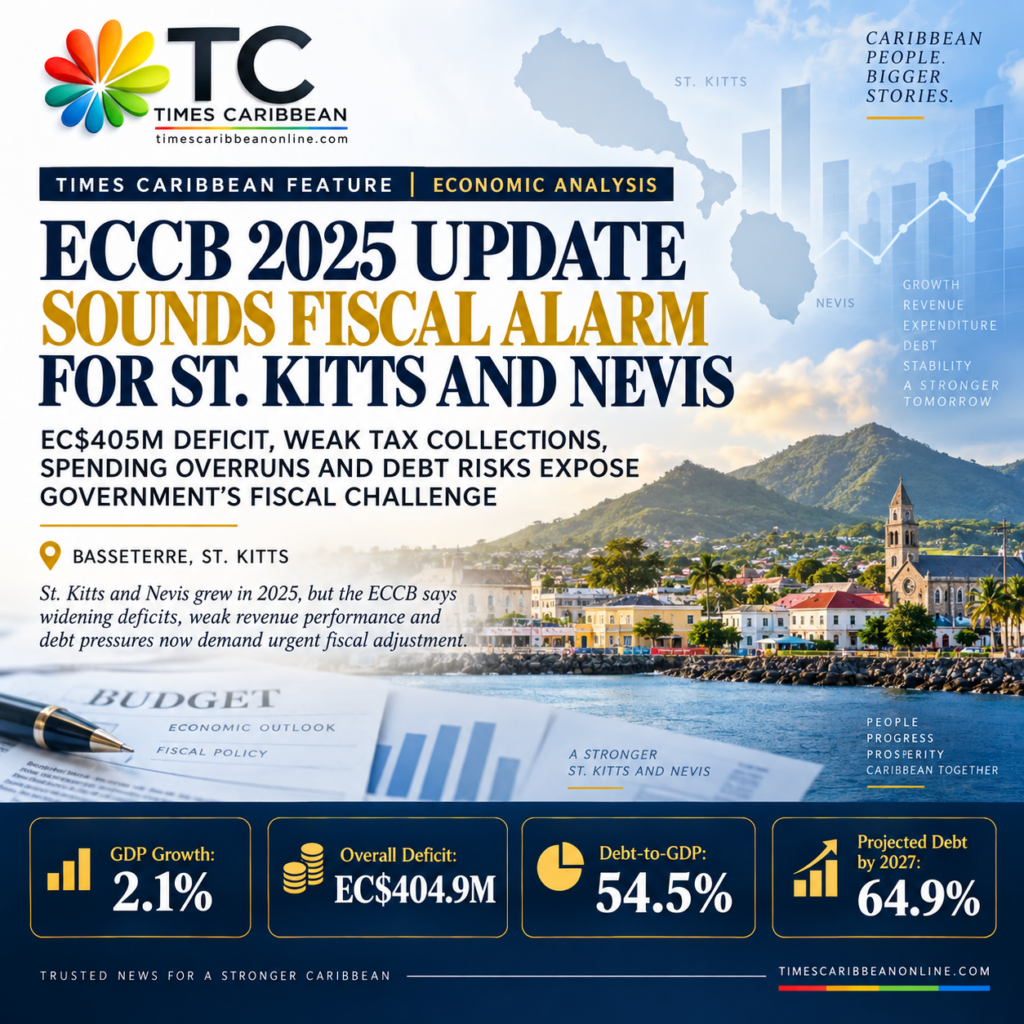
Real GDP expanded by 2.1 per cent in 2025, considerably better than the weak 0.3 per cent performance recorded in 2024.
That is good news.
But it was also below the 2.7 per cent growth initially estimated, and marginally below the country’s long-run average growth rate of approximately 2.3 per cent.
Tourism and public investment were important drivers. Construction accounted for 15.3 per cent of GDP, while total visitor arrivals exceeded one million. Agriculture also recorded strong percentage growth, although it remains a very small component of the overall economy.
So this was not an economy in recession.
The problem is that moderate growth was accompanied by a severe deterioration in the Government’s finances.
That combination matters.
A government normally wants stronger economic activity to improve revenues and narrow deficits. In St. Kitts and Nevis during 2025, however, tax revenue weakened even while the economy expanded. The ECCB’s economic snapshot specifically notes that tax revenue underperformed despite overall economic growth.
THE BIG NUMBER: A 12.8% OF GDP FISCAL DEFICIT
This is arguably the most consequential figure in the entire report.
The Federal Government recorded an overall deficit equivalent to 12.8 per cent of GDP — approximately EC$404.9 million.
That was substantially worse than the earlier estimate of an 8.8 per cent deficit, approximately EC$271.7 million.
In other words, the final fiscal gap was roughly EC$133 million larger than initially estimated.
And compared with 2024, when the deficit was already a sizeable 9.7 per cent of GDP, the position deteriorated further.
The primary deficit — which excludes interest costs and therefore provides a clearer picture of the Government’s underlying fiscal operations — reached 11.5 per cent of GDP, compared with the previously projected 7.4 per cent.
Those are not minor forecasting misses.
They suggest that the fiscal adjustment required after the decline in CBI revenue did not occur fast enough or deeply enough during 2025.
CBI REVENUE FELL — BUT GOVERNMENT SPENDING DID NOT ADJUST ENOUGH
For years, St. Kitts and Nevis has benefited from extraordinary revenues generated by the Citizenship by Investment programme.
That era of easy fiscal comfort appears increasingly uncertain.
CBI receipts fell by EC$126.4 million, declining to just 3.7 per cent of GDP in 2025, compared with 8.1 per cent in 2024.
The ECCB attributes the decline to several factors, including international regulatory scrutiny, domestic programme reforms, reputational considerations and increased competition among investment migration programmes.
Not every one of those factors is within the Government’s control.
But the fiscal response is.
And that is where the report becomes particularly significant.
A government dependent on volatile CBI inflows has essentially two choices when those inflows fall sharply: generate sustainable replacement revenue or reduce expenditure to a level that can be financed from more dependable income.
The 2025 numbers suggest neither adjustment happened sufficiently.
TAX COLLECTIONS ALSO WEAKENED
CBI was not the only revenue problem.
Tax revenue fell from 18.6 per cent of GDP in 2024 to 17.1 per cent in 2025.
The ECCB says collections were weaker than anticipated across taxes on income, profits and capital gains; goods and services; and international trade and transactions.
Most significantly, the Bank identifies what it describes as continuing problems associated with a “narrow tax base and broad fiscal incentives by the Federal Government.”
That is important.
It means the revenue weakness cannot simply be explained away as a CBI problem.
The ECCB is effectively warning that the country’s regular revenue machinery also needs attention — including the structure of concessions, exemptions and incentives.
The Bank’s table goes even further. Tax buoyancy was negative 0.9 in 2025. That means tax revenue moved in the opposite direction from the expanding economy.
For a government facing diminishing extraordinary revenues, that is precisely the wrong direction.
SPENDING OVERSHOT — BY ABOUT EC$100 MILLION
Revenue weakness might have been manageable had spending remained tightly controlled.
It did not.
Total expenditure reached approximately EC$1.3 billion, or 41.4 per cent of GDP, compared with an earlier estimate of 38.7 per cent.
The difference was approximately EC$100 million.
The principal factor was capital expenditure.
Government had initially been expected to spend approximately EC$167.7 million on capital projects.
The approved budget allocation was approximately EC$209.6 million.
Actual capital expenditure?
EC$239.1 million.
So capital spending exceeded not only the earlier economic projection but also the budget allocation itself.
And recurrent expenditure pressures remained.
Goods and services spending exceeded previous estimates by EC$23.8 million, while compensation of employees was approximately EC$7.5 million higher than expected. Transfers and subsidies still amounted to approximately EC$368.6 million, or 11.6 per cent of GDP.
The ECCB’s assessment is telling: “expenditure rigidities remain elevated.”
Translated into everyday fiscal language, Government simply does not appear to have had enough flexibility — or exercised enough restraint — to reduce expenditure as revenues deteriorated.
THE MOST WORRYING NUMBER MAY BE THE DEFICIT WITHOUT CBI
There is an even more revealing indicator buried inside the fiscal table.
The Government’s primary balance excluding CBI revenue was negative 15.2 per cent of GDP in 2025.
Its overall fiscal balance excluding CBI was negative 16.5 per cent of GDP.
That exposes the deeper structural problem.
St. Kitts and Nevis is not merely experiencing a temporary CBI revenue downturn.
The figures suggest that the underlying government expenditure structure remains substantially larger than the revenue generated from conventional sources.
For years, exceptional CBI income helped conceal that structural imbalance.
As those revenues decline, the underlying gap becomes much harder to ignore.
That is why the ECCB specifically recommends that Government avoid programming expenditures based on expected CBI receipts.
That recommendation is more than technical advice.
It amounts to a warning that volatile CBI money should not be treated like guaranteed tax revenue when constructing recurrent government commitments.
GOVERNMENT IS DRAWING DOWN DOMESTIC FINANCIAL BUFFERS
How was the deficit financed?
Primarily at home.
Domestic financing amounted to 12.3 per cent of GDP, compared with external financing of only 0.5 per cent.
The ECCB reports that fiscal financing pressures caused Government to draw more heavily on domestic liquidity.
Government deposits in commercial banks were reduced substantially, with commercial bank liabilities to central government falling by EC$143 million.
Government also accessed approximately EC$85.4 million in short-term ECCB credit.
The Bank says this shifted the monetary balance sheet away from external asset accumulation and toward domestic fiscal financing.
This does not mean the Government has suddenly run out of money.
It does mean fiscal deficits are increasingly consuming financial buffers that could otherwise strengthen resilience against future shocks.
And for a small island economy vulnerable to hurricanes, global recessions, energy shocks and tourism downturns, buffers matter.
A lot.
DEBT LOOKS COMFORTABLE TODAY. THE TRAJECTORY DOES NOT.
Government may reasonably point out that St. Kitts and Nevis ended 2025 with a public debt-to-GDP ratio of 54.5 per cent, still below the Eastern Caribbean Currency Union’s 60 per cent debt benchmark.
That number, viewed alone, appears reassuring.
But debt sustainability is about direction, not simply today’s figure.
Public sector debt rose from approximately EC$1.648 billion in 2024 to EC$1.728 billion in 2025.
And the ECCB projects debt at:
60.6 per cent of GDP in 2026, then
64.9 per cent in 2027.
Worse still, the Bank’s baseline analysis indicates that without fiscal adjustment, debt could reach approximately 86.9 per cent of GDP by 2035, far above the regional 60 per cent target.
The ECCB says plainly that debt sustainability is a key medium-term concern and that decisive policy action will be required.
That is perhaps the clearest rebuttal to any argument that the current 54.5 per cent debt ratio means there is little reason for concern.
The problem is not where debt stood on December 31, 2025.
The problem is where existing fiscal policy could take it.
CURRENT SPENDING IS ALSO EXCEEDING CURRENT REVENUE
Another warning deserves considerably more public attention.
Current revenue was 24.6 per cent of GDP.
Current expenditure was 33.8 per cent.
That left a current-account fiscal deficit equivalent to 6.6 per cent of GDP, worsening from a 3 per cent deficit in 2024.
This distinction matters because borrowing for a productive hospital, water system, road network or energy project can potentially create an asset that benefits future generations.
Running persistent deficits to finance recurrent operations is much harder to justify.
It suggests the Government’s everyday cost structure has become too large for its dependable revenue base.
That is fundamentally a fiscal management problem.
THE ECCB’S RECOMMENDATIONS READ LIKE A FISCAL REFORM CHECKLIST
The recommendations on pages 21 and 22 of the ECCB report are strikingly specific.
The Central Bank wants Government to:
- reform and strengthen the CBI programme while improving access to targeted markets;
- review and justify discretionary social transfers, tax holidays and subsidies;
- strengthen its medium-term fiscal framework;
- establish a primary balance path consistent with reaching the regional debt target;
- develop and legislate fiscal rules governing the prudent treatment of CBI receipts;
- stop programming expenditure on the expectation that CBI money will arrive;
- strengthen tax administration;
- consider making the Housing and Development Levy more progressive; and
- reduce tax leakages, including overly easy access to duty-free concessions on certain goods.
Those recommendations reveal the areas in which the ECCB believes the fiscal architecture needs strengthening.
This is not simply about collecting more taxes.
It is about changing the way Government budgets, forecasts revenue, controls concessions, evaluates subsidies and decides how much of temporary windfall income can safely support permanent expenditure.
THERE ARE IMPORTANT ECONOMIC BRIGHT SPOTS
A fair reading of the ECCB report cannot ignore the positives.
Tourism strengthened significantly.
Total arrivals increased by 18.5 per cent, cruise arrivals rose by 21.3 per cent, and regional stayover arrivals performed better than earlier estimates.
Inflation was only 0.9 per cent overall, although food inflation — a much more immediate issue for ordinary households — reached 4.6 per cent.
Construction remained the economy’s largest sector.
Agriculture recorded impressive 10.3 per cent growth, although from a relatively small economic base.
And major public projects have the potential to improve long-term productive capacity.
These are genuine strengths.
But they also underscore the fiscal contradiction.
St. Kitts and Nevis recorded stronger tourism, ongoing construction activity and positive economic growth — yet Government finances deteriorated sharply.
That makes the 2025 fiscal outcome harder, not easier, to dismiss.
THE EXTERNAL ECONOMY IS ANOTHER WARNING
The trade deficit widened to 34.2 per cent of GDP, approximately EC$1.084 billion.
Imports amounted to 38.2 per cent of GDP while exports represented only 4 per cent.
The current account deficit widened to 14.2 per cent of GDP.
Tourism receipts improved by EC$44 million, but the ECCB says they were still insufficient to compensate for the merchandise trade imbalance.
This is not solely a Government fiscal-management issue.
But it points to the same vulnerability: St. Kitts and Nevis continues to consume and import substantially more than it produces and exports.
That dependence becomes particularly dangerous when Government itself is also running large fiscal deficits.
TIMES CARIBBEAN ANALYSIS: THE CENTRAL ISSUE IS NOT WHETHER GOVERNMENT SPENT — BUT WHETHER IT ADJUSTED
Governments must spend.
Schools require investment. Water infrastructure costs money. Roads must be repaired. Hospitals must be built. Public servants must be paid. Vulnerable citizens sometimes need assistance.
The question raised by this ECCB report is therefore not whether Government should have spent anything.
The question is whether expenditure and revenue policy were adequately adjusted when the Government’s principal extraordinary revenue source deteriorated.
The evidence presented by the ECCB suggests there was a significant disconnect.
CBI receipts fell sharply.
Tax revenue weakened.
Capital spending exceeded budget.
Recurrent expenditure remained rigid.
The current balance worsened.
The overall deficit reached EC$404.9 million.
Government financing increasingly relied on domestic resources.
And debt is projected to climb.
That combination represents a fiscal policy warning that should transcend partisan politics.
THE BOTTOM LINE
St. Kitts and Nevis is not facing an immediate economic collapse.
That is not what the ECCB report says.
The economy grew. Tourism performed reasonably well. The banking sector remains liquid, and public debt at the end of 2025 was still below the regional benchmark.
But the report clearly shows something else:
The country’s fiscal cushion is being consumed.
The Government has moved from an era when exceptionally high CBI income could comfortably support ambitious expenditure to one in which the underlying tax base must increasingly carry the burden.
The adjustment to that new reality appears incomplete.
And unless Government tackles spending rigidities, strengthens tax collection, reforms concessions, reduces dependence on unpredictable CBI revenue and establishes credible fiscal rules, the ECCB’s projections suggest today’s manageable 54.5 per cent debt ratio could become tomorrow’s far more difficult problem.
The warning has now been put on paper by the region’s Central Bank.
Growth alone will not fix this.
Fiscal management will.
















Leave a comment
You must be logged in to post a comment.