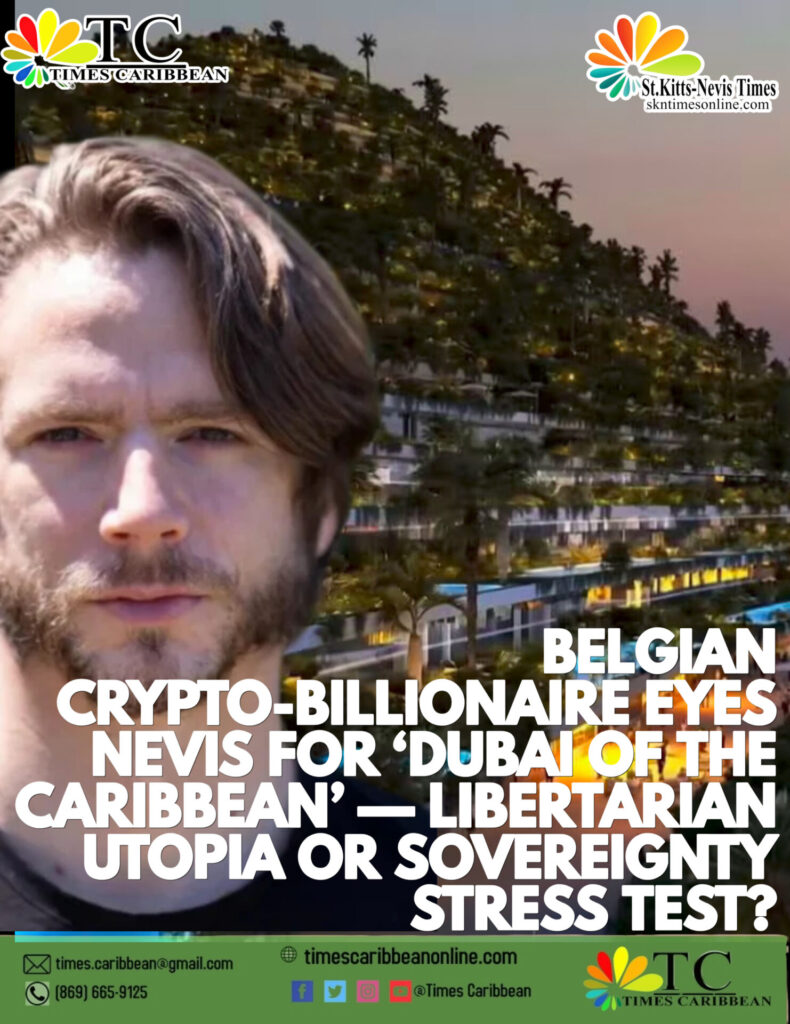
BELGIAN CRYPTO-BILLIONAIRE EYES NEVIS FOR ‘DUBAI OF THE CARIBBEAN’ — LIBERTARIAN UTOPIA OR SOVEREIGNTY STRESS TEST?
By Times Caribbean News Desk
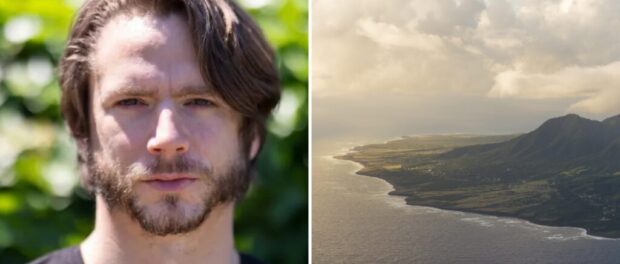
A bold, controversial and deeply polarising vision is taking shape on the shores of Nevis, as Belgian-born crypto billionaire Olivier Janssens advances plans to build what he describes as the “Dubai of the Caribbean” — a libertarian enclave with its own legal framework, governance mechanisms and dispute-resolution system.
According to reports by the Financial Times and Belga, Janssens — a dual Belgian-Nevisian citizen by way of Saint Kitts and Nevis’ Citizenship by Investment (CBI) programme — is acquiring vast tracts of land on Nevis’ southern coast through his company South Nevis for a mega-development dubbed “Destiny.”
The proposed project, reportedly valued in the multi-billion-dollar range, is the first major test case of a controversial law passed last summer that allows large-scale developments to operate under special governance arrangements. Destiny is envisioned to include luxury villas, hospitals, green spaces and resort-style amenities, designed by world-renowned U.S. firm Skidmore, Owings & Merrill — architects behind Dubai’s iconic Burj Khalifa.
But while glossy renderings promise prosperity, the political and social implications have ignited unease.
A STATE WITHIN A STATE?
Janssens has been unusually candid about his ideological ambitions. In interviews and social media posts, he has framed Destiny as a “libertarian community” modelled after Dubai or Monaco, built on “maximum freedom” and “self-determination.” Central to the controversy is his stated desire to introduce a separate legal system, made possible under provisions that allow developers to establish their own “dispute resolution services and mechanisms.”
To supporters, it represents innovation and foreign investment. To critics, it raises an existential question: how much sovereignty can a small island state afford to outsource?
Janssens has openly criticised the Nevis court system as inefficient, arguing that replicating it would deter investors. He has also referred to Nevis as a “host nation” — language that has unsettled many residents who see the island not as a platform for experiments, but as a homeland shaped by colonial trauma, sugar plantations and enslavement.
One viral online comment captured that sentiment sharply:
“When Olivier Janssens sings the National Anthem and writes about the impact of sugar and slavery on St. Kitts and Nevis, then I might consider him Nevisian.”
INFRASTRUCTURE PROMISES — AND POLITICAL PROXIMITY
Janssens has pledged US$50 million in infrastructure investment should negotiations with the government conclude successfully. Yet scrutiny has intensified following revelations that the real estate agent facilitating his land purchases is Sharon Brantley, wife of Nevis Premier Mark Brantley — a fact that has fuelled allegations of conflict of interest and insider access.
The Nevis government maintains that the project is still under negotiation, and that safeguards will be enforced. Still, Destiny has become a lightning rod in wider debates over CBI-fuelled development, foreign capital influence, and democratic accountability in small island states.
UTOPIA OR WARNING SIGN?
As Saint Kitts and Nevis positions itself as a hub for high-net-worth investment, Destiny forces a reckoning: Is this visionary transformation — or the commodification of sovereignty?
For now, the promise of a Caribbean Dubai glitters on the horizon. Whether it becomes an engine of inclusive development — or a precedent that reshapes governance itself — may define Nevis’ future for generations to come.
Belgian crypto-billionaire wants to build the ‘Dubai of the Caribbean’ https://www.brusselstimes.com/1885370/belgian-crypto-billionaire-wants-to-start-community-on-caribbean-island
















Leave a comment
You must be logged in to post a comment.