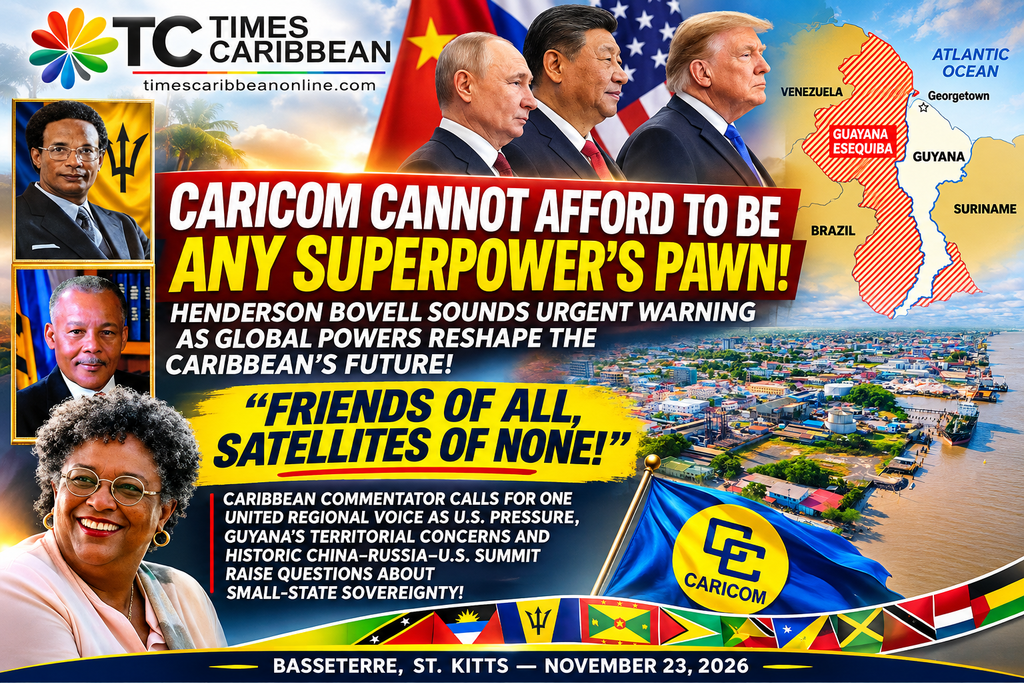
CARICOM CANNOT AFFORD TO BE ANY SUPERPOWER’S PAWN! HENDERSON BOVELL SOUNDS URGENT WARNING AS GLOBAL POWERS RESHAPE THE CARIBBEAN’S FUTURE!
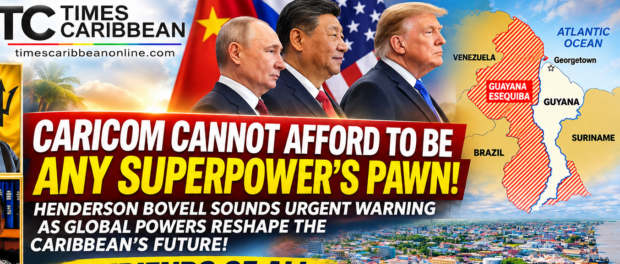
“FRIENDS OF ALL, SATELLITES OF NONE!” — CARIBBEAN COMMENTATOR CALLS FOR ONE UNITED REGIONAL VOICE AS U.S. PRESSURE, GUYANA’S TERRITORIAL CONCERNS AND HISTORIC CHINA–RUSSIA–U.S. SUMMIT RAISE QUESTIONS ABOUT SMALL-STATE SOVEREIGNTY!
BASSETERRE, ST. KITTS — November 23, 2026
A powerful intervention in the Caribbean’s growing geopolitical debate has placed the future of regional unity under renewed scrutiny, with political commentator Henderson Bovell warning that the Caribbean Community (CARICOM) risks becoming a bargaining instrument of global powers unless its 15 member states develop a stronger, more coordinated international voice.
His central argument is direct. The Caribbean cannot afford to divide itself into competing geopolitical camps, particularly when the world’s largest powers are increasingly prepared to negotiate directly with one another over international security, energy supplies and global governance.
And the consequences of regional fragmentation, he argues, could be enormous.
In a wide-ranging commentary examining American diplomatic influence, financial dependence, Guyana’s security challenges and the future of CARICOM integration, Bovell challenges Caribbean governments to reconsider whether bilateral relationships with powerful countries can ever provide the same long-term protection as genuine regional solidarity.
THE UNCOMFORTABLE QUESTION: CAN THE CARIBBEAN AFFORD TO DISAGREE WITH WASHINGTON?
Bovell begins by confronting a question raised by reader Keith Douglas: What happens when a small Caribbean country refuses to follow the policy preferences of the United States?
His answer is unequivocal.
Yes, there can be consequences.
Bovell argues that American influence extends well beyond traditional diplomacy and security cooperation. Washington possesses substantial financial, commercial and immigration-policy instruments capable of affecting small economies.
One example is the controversy surrounding Cuban medical missions.
In February 2025, the U.S. State Department expanded visa-restriction policies affecting individuals it considered involved in Cuba’s overseas labour-export programmes, including certain foreign government officials and their immediate families.
The measures demonstrated how disagreements over international policy can produce personal consequences for officials, although individual restrictions depend on the applicable policy and circumstances. United States Department of State+1
For Caribbean governments that rely on international partnerships in healthcare, education, trade and security, such measures create difficult diplomatic choices.
But Bovell believes that fear of consequences must not automatically become a justification for abandoning independent regional positions.
THE FINANCIAL PRESSURE POINT: CARIBBEAN ECONOMIES REMAIN EXPOSED
Perhaps the most serious concern raised in his commentary involves correspondent banking.
Caribbean financial institutions depend heavily on international banking relationships to process foreign-currency transactions, facilitate trade and support cross-border payments.
The consequences of losing those relationships are well documented.
In a submission to the United States Congress, CARICOM reported that the region had lost more than 40% of its active U.S.-dollar correspondent banks between 2011 and 2020.
The International Monetary Fund has also warned that correspondent-bank withdrawals threaten Caribbean financial stability and economic development.
Bovell identifies tariffs, reductions in assistance and restrictions affecting remittances as additional areas of vulnerability.
Importantly, correspondent banking losses are not necessarily political sanctions. They can also arise from compliance costs, commercial decisions and financial-risk assessments.
Nevertheless, their economic consequences demonstrate how exposed smaller countries can become when essential financial services depend on decisions made outside their borders.
THE SHENZHEN SUMMIT: WHEN THE GIANTS SIT AT THE SAME TABLE
6
Bovell points to the November 19, 2026, trilateral summit in Shenzhen, China, as a reminder that global powers can pursue direct agreements even while maintaining substantial disagreements.
The meeting brought together U.S. President Donald Trump, Chinese President Xi Jinping and Russian President Vladimir Putin.
According to the declaration published by the White House, the leaders discussed international security, United Nations reform, stable energy supplies and nuclear-risk reduction.
They also expressed support for increasing the production and supply of refined petroleum products. The White House+1
For Bovell, the significance goes beyond the agreement itself.
If competing powers can negotiate strategic arrangements directly, he argues, small states should question the wisdom of defining their own foreign policies through unconditional allegiance to one major power.
His concern is that countries which sacrifice diplomatic flexibility for presumed protection may ultimately discover that their interests are secondary to larger strategic negotiations.
The Shenzhen declaration does not establish that Caribbean territory was negotiated at the summit. Rather, Bovell uses the meeting to illustrate how rapidly major-power relationships can evolve.
GUYANA AND THE ESSEQUIBO QUESTION: A WARNING ABOUT DEPENDENCE?
Aerial of downtown Georgetown with Demerara river Guyana
The Forgotten Dispute that Could Ignite a War in South America
Guyana occupies a particularly sensitive position in Bovell’s analysis.
With significant offshore petroleum resources and expanding international partnerships, Guyana has become an increasingly important country in the Americas.
Yet its longstanding territorial controversy with Venezuela remains a major national security concern.
On November 19, Reuters reported that a Trump administration official had previously suggested Guyana consider ceding some territory to Venezuela, citing three people familiar with the matter.
The reported suggestion concerned the disputed Essequibo region.
However, the United States subsequently reaffirmed that its policy supporting Guyana’s territorial integrity had not changed. Reuters+1
For Bovell, the reported episode raises a broader question about security guarantees and diplomatic dependence.
Could a country with substantial natural resources and powerful international partners still find itself vulnerable to decisions made in foreign capitals?
He believes the answer should concern every Caribbean government.
At the same time, Guyana’s desire for strong international security partnerships must be understood in the context of its territorial concerns. Regional unity and bilateral security relationships are not necessarily mutually exclusive.
The challenge is ensuring that one does not undermine the other.
MIA MOTTLEY’S CALL: CARICOM NEEDS A POLITICAL HEAD
Barbados Prime Minister Mia Amor Mottley has recently called for stronger and more consistent CARICOM leadership.
Bovell’s argument gains particular significance following a major intervention by Barbados Prime Minister Mia Mottley in Jamaica.
Speaking at the University of the West Indies in November, Mottley argued that CARICOM’s rotating six-month chairmanship does not provide sufficient continuity for the region’s international representation.
“Without a political head CARICOM will not go any further,” she declared. Jamaica Gleaner+1
Her proposal goes beyond symbolism.
Mottley has advocated a dedicated political leadership mechanism and more reliable regional financing arrangements, suggesting that CARICOM needs both the authority and resources to advance collective interests.
Bovell identifies her intervention as an opportunity to revive a longstanding conversation about meaningful Caribbean integration.
He invokes former regional leaders, including Errol Barrow, Tom Adams and Owen Arthur, whose political legacies reflected differing but important contributions to the debate over sovereignty, cooperation and collective regional strength.
The principle Bovell embraces is familiar:
Friends of all. Satellites of none.
In his assessment, this philosophy does not require hostility toward Washington, Beijing, Moscow or any other international partner.
Instead, it means preserving the freedom to cooperate with multiple countries without allowing external rivalries to determine the Caribbean’s collective identity.
AMERICA’S MIDTERM ELECTIONS ADD ANOTHER DIMENSION
The changing American political environment also features in Bovell’s assessment.
The November 3, 2026, U.S. midterm elections delivered major Democratic gains, with the party securing control of both chambers of Congress.
Economic concerns, particularly the cost of living, played a major role in voter dissatisfaction, according to election reporting and polling.
Bovell interprets this domestic political pressure as a possible opening for more structured negotiations between the United States and Caribbean governments.
That possibility remains an interpretation rather than an established policy shift.
A divided American government could create opportunities for dialogue, but it could also complicate foreign-policy negotiations.
For CARICOM, the broader question is whether it can coordinate its positions well enough to take advantage of emerging opportunities.
FIFTEEN COUNTRIES, ONE VOICE — OR FIFTEEN DIFFERENT NEGOTIATIONS?
CARICOM comprises 15 full member states, alongside associate members, representing countries with different economies, political systems, security priorities and external partnerships.
Bovell argues that this diversity should become a source of collective strength rather than permanent fragmentation.
A more coordinated regional approach could provide greater negotiating weight on banking access, trade, climate financing, migration and international security.
But unity is not automatic.
Member states have distinct national interests, and an empowered regional political authority would require clear rules concerning its mandate, accountability and decision-making powers.
Nor would a united CARICOM be immune to external economic measures.
Its advantage would be a stronger platform for negotiation, greater policy coordination and potentially reduced exposure to attempts to negotiate separately with each government.
That is the strategic choice now facing Caribbean leaders.
A DEFINING MOMENT FOR CARIBBEAN LEADERSHIP
Bovell’s commentary ultimately presents a choice between two competing approaches to Caribbean diplomacy.
One places greater emphasis on individual bilateral arrangements with powerful international partners.
The other seeks stronger regional institutions capable of coordinating national interests without eliminating the sovereignty of individual states.
Both approaches offer potential benefits, and neither is free of risk.
But Bovell believes that continued fragmentation represents the greater long-term danger.
His warning arrives as the Caribbean confronts uncertainty surrounding international finance, trade preferences, citizenship-by-investment programmes, geopolitical competition and regional energy security.
For St. Kitts and Nevis and other small Caribbean nations, these debates are not distant foreign-policy abstractions.
They affect investment, tourism, banking, employment, government revenue and the affordability of everyday life.
And that is why the future of CARICOM leadership matters.
Bovell closes his argument by urging the region to replace competing national messages with a more effective collective diplomatic voice.
His central warning is that even countries enjoying rapid economic growth cannot assume that powerful international relationships eliminate their vulnerabilities.
The Caribbean must maintain productive relationships with major powers. But it must also retain the capacity to speak independently, defend shared interests and pursue cooperation on its own terms.
The question confronting CARICOM is no longer simply whether its members can afford the political and economic consequences of standing together. It is whether they can afford the long-term consequences of continuing to stand apart.
TIMES CARIBBEAN | SPECIAL REGIONAL NEWS ANALYSIS
This article examines and contextualizes commentary by Caribbean political writer Henderson Bovell. His geopolitical assessments and policy recommendations are attributed to him; independently reported developments are distinguished from interpretation.
















Leave a comment
You must be logged in to post a comment.