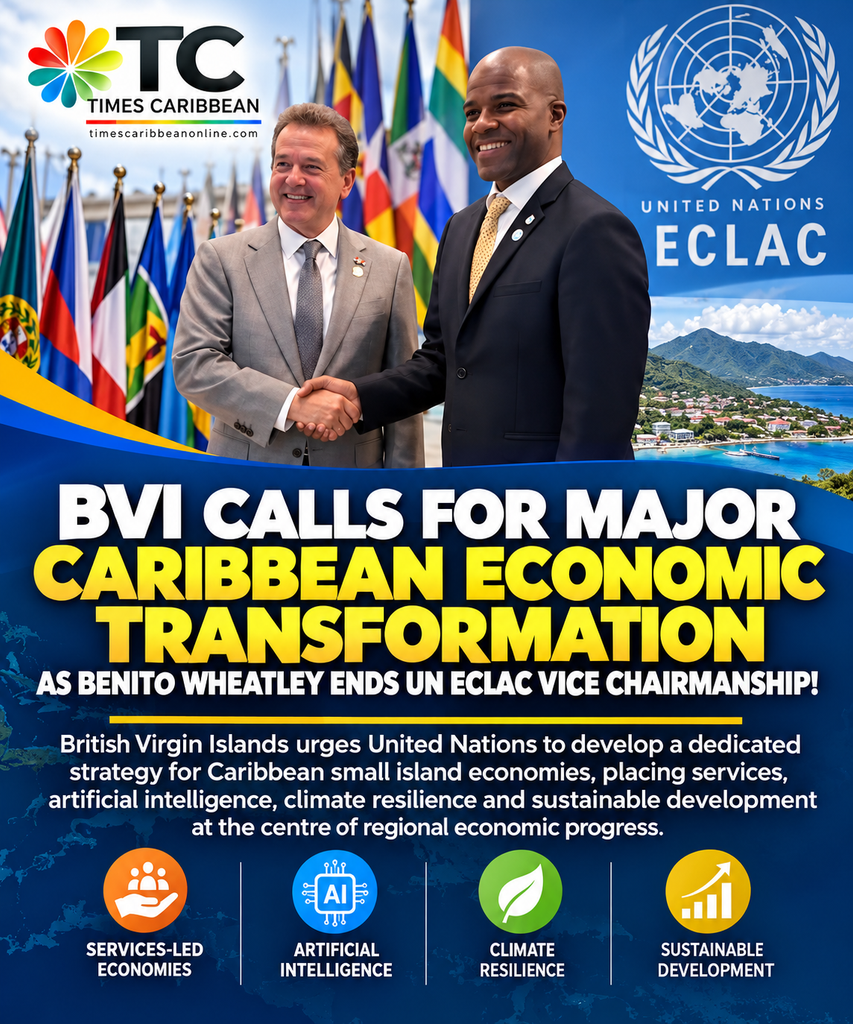
BVI CALLS FOR MAJOR CARIBBEAN ECONOMIC TRANSFORMATION AS BENITO WHEATLEY ENDS UN ECLAC VICE CHAIRMANSHIP!

TIMES CARIBBEAN | REGIONAL NEWS | OCTOBER 20, 2026
British Virgin Islands urges United Nations to develop a dedicated strategy for Caribbean small island economies, placing services, artificial intelligence, climate resilience and sustainable development at the centre of regional economic progress.
SANTO DOMINGO, DOMINICAN REPUBLIC — October 20, 2026 (Times Caribbean) — The British Virgin Islands has issued a significant call for a new Caribbean-focused economic development strategy, urging the United Nations Economic Commission for Latin America and the Caribbean (ECLAC) to recognise the unique challenges facing Small Island Developing States (SIDS) whose economies depend heavily on services rather than large-scale manufacturing or agriculture.
The appeal came from BVI Special Envoy Benito Wheatley during the 41st Session of ECLAC in the Dominican Republic, marking the conclusion of the territory’s term as Vice Chair of the Commission’s highest intergovernmental body.
Wheatley argued that the Caribbean needs an economic transformation framework designed around its own circumstances, resources and development potential.
CARIBBEAN ECONOMIES REQUIRE A DIFFERENT APPROACH
Addressing the regional gathering, Wheatley acknowledged the importance of ECLAC’s strategic document, Managing Transformations in an Era of Ruptures, but raised concerns about its applicability to smaller Caribbean economies.
The document was developed through a special ECLAC commission established by Executive Secretary José Manuel Salazar-Xirinachs and co-chaired by former Chilean President Michelle Bachelet and former Colombian President Iván Duque.
According to Wheatley, while the strategy contains important proposals for productive transformation, its emphasis does not sufficiently address the economic realities of Caribbean microstates such as the British Virgin Islands.
Unlike larger countries with significant manufacturing and agricultural export capacity, many Caribbean territories operate economies built primarily around tourism, financial services and other service-based industries.
For these islands, Wheatley argued, meaningful economic transformation must begin with the sectors that already sustain their economies.
ARTIFICIAL INTELLIGENCE IDENTIFIED AS POTENTIAL ECONOMIC DRIVER
A central feature of the BVI’s proposal is the opportunity to use artificial intelligence and emerging technologies to strengthen productivity, expand economic opportunities and support innovation.
Wheatley identified AI as a potential driver of productive development, particularly for smaller economies seeking to improve competitiveness without depending on traditional industrial expansion.
He also stressed that economic transformation cannot be separated from climate resilience.
For Caribbean SIDS, where extreme weather events and climate-related vulnerabilities can disrupt businesses, infrastructure and livelihoods, building resilience must form part of any serious long-term development strategy.
The BVI’s position calls for a coordinated approach that connects technological innovation, service-sector productivity, sustainable economic development and climate adaptation.
WHEATLEY: THE GOAL IS BETTER LIVING STANDARDS FOR CARIBBEAN PEOPLE
In his official remarks, Wheatley emphasised the importance of continued cooperation between ECLAC and Caribbean small island states.
“UN ECLAC is an important partner for Caribbean SIDS and it is critical that we deepen our engagement on productive transformation and productive development.”
He explained that the ultimate objective should be structural economic change that delivers tangible improvements in living standards and quality of life throughout the subregion.
Wheatley also reaffirmed the BVI’s commitment to advocating for Caribbean SIDS, despite the conclusion of its term on the ECLAC Leadership Bureau.
Reflecting on his tenure, he described representing the British Virgin Islands as Vice Chair of ECLAC’s 40th Session as a personal honour.
BVI REAFFIRMS REGIONAL LEADERSHIP AND COOPERATION
The Special Envoy congratulated Dominican Republic Foreign Affairs Minister Víctor Orlando Bisonó on the country’s assumption of the Chairmanship of ECLAC’s 41st Session and pledged the British Virgin Islands’ continued support.
Although its ECLAC vice chairmanship has ended, the BVI retains other regional leadership responsibilities.
The territory continues to serve as Vice Chair of the 30th Session of the Caribbean Development and Cooperation Committee (CDCC) and Vice Chair of the 2nd Regional Conference on South-South Cooperation in Latin America and the Caribbean, with Wheatley representing the territory in both capacities.
These positions provide opportunities for continued engagement on Caribbean economic development, regional cooperation and international policy discussions.
A SIGNIFICANT DEVELOPMENT DEBATE FOR THE CARIBBEAN
The BVI’s intervention highlights a longstanding challenge for Caribbean policymakers: how to create stronger, more diversified and productive economies when geographic size, limited domestic markets and structural vulnerabilities constrain traditional development options.
For service-dependent territories, the question is increasingly about how to generate greater economic value from existing industries while embracing emerging opportunities in technology, digital services and innovation.
The proposals advanced by Wheatley place those issues before ECLAC at a time when Caribbean governments are seeking more tailored international development support.
Whether the Commission will develop a dedicated productive transformation strategy for service-based Caribbean SIDS remains to be seen.
For the British Virgin Islands, however, the message is clear: the Caribbean’s economic transformation must reflect the realities of Caribbean economies, with the ultimate measure of success being improved opportunities and quality of life for its people.
SOURCE: Government of the British Virgin Islands | Official Statement, October 20, 2026. This article is based on the government-provided release.
TIMES CARIBBEAN — Your Caribbean. Your News. Your Voice.
















Leave a comment
You must be logged in to post a comment.